Arizona Braces for Another Political Firestorm as Primary Season Sets the Stage for High-Stakes Fall Showdowns
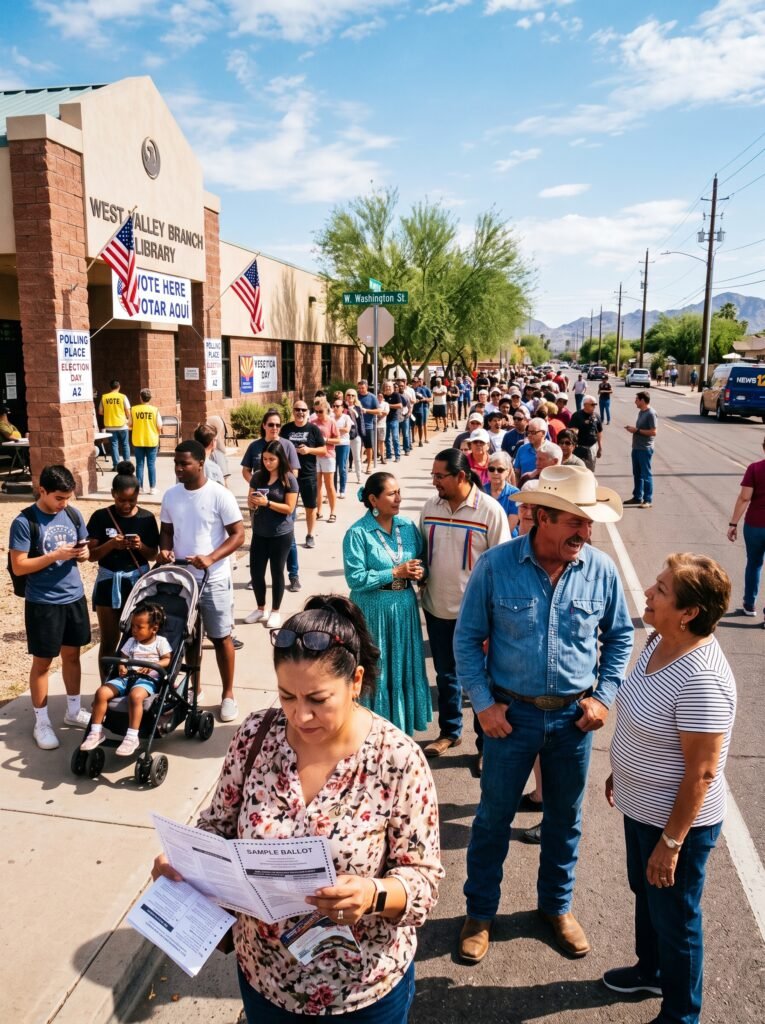
PHOENIX — The Grand Canyon State is no stranger to political drama. From the bitter recriminations of the 2020 election to the razor-thin margins that have defined every major contest since, Arizona has cemented its reputation as the ultimate battleground — a place where national destinies are forged and political careers are made or broken.
Tuesday’s primary elections will finalize the matchups in several races that could determine the balance of power not just in Arizona, but in Washington itself. At the top of the ticket, Democratic Gov. Katie Hobbs is fighting for a second term against a Republican challenger who has yet to be determined. Two closely divided House districts are also on the ballot, along with the critically important secretary of state race — a position that has become ground zero for election integrity battles since the 2020 presidential contest.
And as the 2026 election looms large, the ghost of 2020 continues to haunt campaigns across the state.
The Governor’s Race: Hobbs Faces an Uphill Battle
Katie Hobbs entered office in 2023 after defeating election denier Kari Lake in one of the most contentious gubernatorial races in modern American history. The margin was narrow — just over 17,000 votes out of more than 2.5 million cast — and Lake never conceded, spending months challenging the results in court and on social media.
Now, Hobbs is seeking a second term in a state that remains deeply divided. Her approval ratings have hovered around 50 percent throughout her first term, according to recent polling, with Republicans uniformly disapproving and Democrats largely supportive. Independents, the critical swing voting bloc in Arizona, are split nearly evenly.
The Republican primary field is crowded, with several candidates vying for the chance to take on Hobbs in November. The frontrunners include a former state legislator, a business owner with deep pockets, and a Trump-endorsed candidate who has made election integrity the centerpiece of his campaign. All have pledged to aggressively challenge Hobbs on issues ranging from border security to the economy.
The Battle for Congress: Two Seats That Could Tip the House
Arizona’s two most competitive House districts — the 1st and the 6th — are once again in play. Both were decided by margins of less than 3 percent in the 2024 cycle, and both are expected to be among the most expensive and closely watched races in the country this fall.
In the 1st District, which encompasses much of the northeastern Phoenix suburbs and extends into rural areas to the east, incumbent Republican Rep. David Schweikert is facing a primary challenge from a more conservative opponent who has attacked him for not being sufficiently loyal to former President Trump. The winner will face a well-funded Democrat who has made reproductive rights and healthcare access the centerpiece of her campaign.
The 6th District, which covers parts of Tucson and surrounding Pima County, is an open seat following the retirement of longtime Republican Rep. Juan Ciscomani. The primary field is crowded on both sides, with Republicans favoring a Trump-backed candidate and Democrats rallying behind a former state senator who narrowly lost the seat in 2024. National party committees have already begun pouring money into the district, signaling its importance in the battle for control of the House.
The Secretary of State Race: Democracy Itself on the Ballot
Perhaps no race in Arizona carries more symbolic weight than the contest for secretary of state. The position, which oversees elections in the state, has become a lightning rod for controversy since 2020, when Trump and his allies falsely claimed that widespread voter fraud cost him the state.
The current secretary of state, Democrat Adrian Fontes, is running for re-election after a tumultuous first term marked by relentless attacks from election deniers and death threats against election workers. Fontes has defended Arizona’s election system against claims of fraud, but he has also acknowledged that the state needs to do more to restore public confidence in the integrity of its elections.
His Republican challenger, who is expected to emerge from a competitive primary, has made election reform the central theme of his campaign. He has called for stricter voter ID laws, more aggressive purging of voter rolls, and a ban on drop boxes — measures that Democrats say would suppress turnout among minority and young voters.
The Ghost of 2020
Every candidate in every race is grappling with the enduring legacy of the 2020 election. For Republicans, the issue is about election integrity — a rallying cry that energizes the base and drives turnout. For Democrats, it’s about protecting democracy — a message that resonates with suburban voters who were turned off by Trump’s refusal to accept defeat.
The tension is palpable in every campaign ad, every debate, and every town hall. Voters are being asked not just to choose between candidates, but to choose between two fundamentally different visions of what American democracy should look like.
A Swing State Under Siege
Arizona’s status as a battleground state has made it a target for national political spending. Already, more than $50 million has been spent or reserved for advertising in the state’s competitive races, and that number is expected to climb into the hundreds of millions by November.
The issues driving voters are familiar: the economy, immigration, healthcare, and abortion. But beneath the surface, there is a deeper anxiety about the future of the state and the country. Arizonans are proud of their independent streak, but they are also acutely aware that their choices will reverberate far beyond their borders.
What’s at Stake
For Democrats, holding onto the governorship and the secretary of state’s office is essential to maintaining a firewall against Republican attempts to reshape the state’s election laws. Losing either seat would give Republicans control over the redistricting process after the 2030 census, potentially locking in a decade of Republican dominance.
For Republicans, winning back the governorship and the secretary of state’s office would be a major step toward reclaiming the state’s political direction. It would also provide a powerful boost to the party’s presidential nominee in 2028, as Arizona’s 11 electoral votes are widely seen as must-win for any Republican candidate.
The Bottom Line
Arizona is once again at the center of the political universe. Tuesday’s primaries will set the stage for a fall campaign that promises to be as bitter and closely fought as any in the state’s history. The outcomes will shape not just the future of Arizona, but the future of the country.
As one veteran Arizona political consultant put it: “Every election here feels like the most important one we’ve ever had. And somehow, they keep getting more important.”