Spain Stuns Argentina in World Cup Final as U.K. Gets New Prime Minister and FDA Clears Lettuce in Parasite Scare
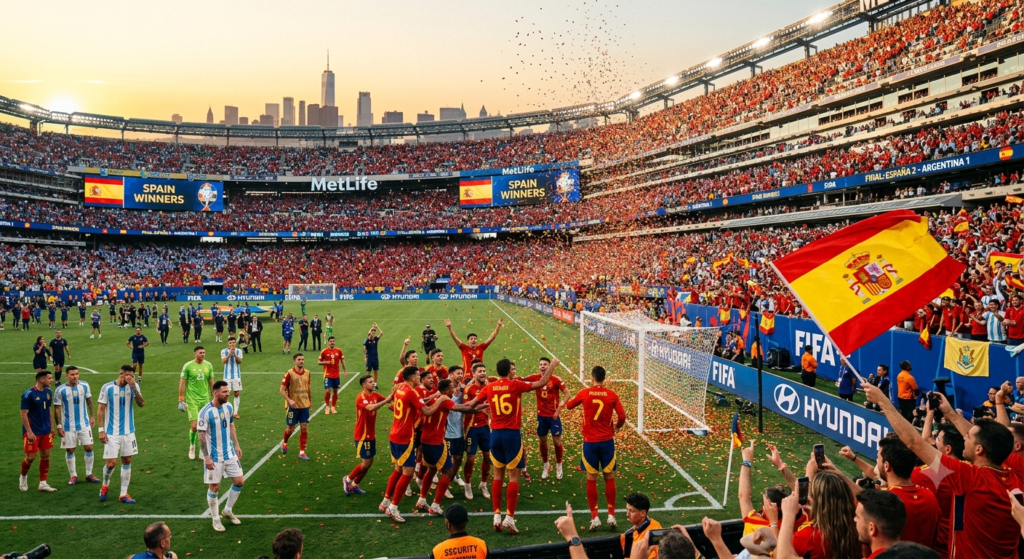
A one-sided final in New Jersey delivered Spain its second World Cup title, while across the Atlantic, Britain’s revolving-door politics installed yet another leader—and U.S. health officials walked back a key finding in a nationwide food safety scare.
EAST RUTHERFORD, N.J. — The 2026 World Cup final was supposed to be a clash of titans. Instead, it was a masterclass in Spanish dominance.
Spain defeated Argentina 1-0 in extra time at MetLife Stadium on Sunday, securing its second World Cup title in a match that was far less competitive than the scoreline suggested. The European champions controlled possession with more than 65% of the ball and never allowed Argentina to register a single shot on target—a staggering defensive performance against the reigning world and South American champions.
The decisive moment came from an unlikely hero. Substitute Ferran Torres, who had spent most of the tournament watching from the bench, scored the only goal of the match in extra time. “I just saw the ball coming to me and I shot with the power of all the Spanish people,” Torres said afterward.
The match wasn’t without controversy. Argentine midfielder Enzo Fernández was sent off with a red card in the 93rd minute, capping a tournament filled with heated officiating calls that left fans and players alike debating the quality of refereeing.
For Argentina, the loss raises an unavoidable question: Was this Lionel Messi’s final appearance in a World Cup jersey? The 39-year-old legend, who had carried his nation to glory in 2022, walked off the field with his head bowed—perhaps for the last time on soccer’s biggest stage.
France’s Kylian Mbappé, meanwhile, provided a subplot of his own, breaking Messi’s World Cup goal record and securing his second consecutive Golden Boot.
Britain’s Leadership Carousel Keeps Spinning
While the world watched soccer, British politics delivered its own brand of drama.
Andy Burnham, the 56-year-old Labour Party politician known as the “King of the North,” became the United Kingdom’s seventh prime minister in a decade on Sunday. Burnham was appointed unchallenged after incumbent Keir Starmer agreed to step down last month following a series of election defeats, policy U-turns, and scandals that eroded public confidence.
In a quirk of the British parliamentary system, ruling parties can change leaders—and therefore the prime minister—in the middle of an election cycle without the public ever casting a vote. That revolving door has become a defining feature of modern British politics, raising questions about democratic accountability and the stability of governance in one of America’s closest allies.
Burnham, who built a reputation as the mayor of Greater Manchester, now faces the daunting task of halting a decade of political turbulence and economic stagnation. Whether he can succeed where five predecessors failed remains an open question.
FDA Walks Back Lettuce Warning in Parasite Outbreak
In a development that will come as a relief to salad lovers across the country, the Food and Drug Administration announced that a Taylor Farms lettuce sample previously flagged for the cyclospora parasite produced a false positive result.
The false positive was discovered when the FDA re-reviewed the results of the sample. “As of July 19, 2026, there are no confirmed positive sample results for product testing for Cyclospora,” the FDA said in a statement.
The news does not change Taylor Farms’ earlier voluntary recall of its iceberg lettuce sourced from central Mexico. But it does raise questions about the reliability of testing for the parasite, which has sickened thousands of Americans across multiple states in recent weeks.
Donald W. Schaffner, chair of the Department of Food Science at Rutgers University, defended Taylor Farms’ decision to recall its products. “Unfortunately testing for this organism is difficult,” he said, urging consumers not to ignore the false positive “but realize that the science is complicated”.
American Service Members Killed in Middle East
The U.S. military continued to suffer losses in the Middle East over the weekend, with one service member killed in Iraq during the controlled detonation of a downed Iranian drone. Separately, the military recovered unidentified human remains while searching for an American service member reported missing after an Iranian missile and drone attack in Jordan, where two other service members were killed.
The U.S. and Iran continued trading strikes over the weekend, but Secretary of State Marco Rubio said Washington remains open to diplomacy, adding that “there’s a growing split” in Tehran.
The Bigger Picture
Spain’s World Cup victory cements its place as the dominant force in international soccer. Argentina’s defeat leaves a generation of fans wondering whether their golden era has come to an end. Britain’s new prime minister faces the unenviable task of stabilizing a nation that has gone through more leaders in a decade than it did in the previous half-century. And the FDA’s false positive highlights the challenges of protecting the food supply in an era of complex supply chains and imperfect testing.
For American readers, the common thread is uncertainty—on the pitch, in the halls of power, and on our dinner tables. In a world that feels increasingly unpredictable, one thing is clear: the stories that shape our world rarely follow the script we expect.