Pope Leo XIV Issues Historic Vatican Apology for Church’s Role in Legitimizing Slavery
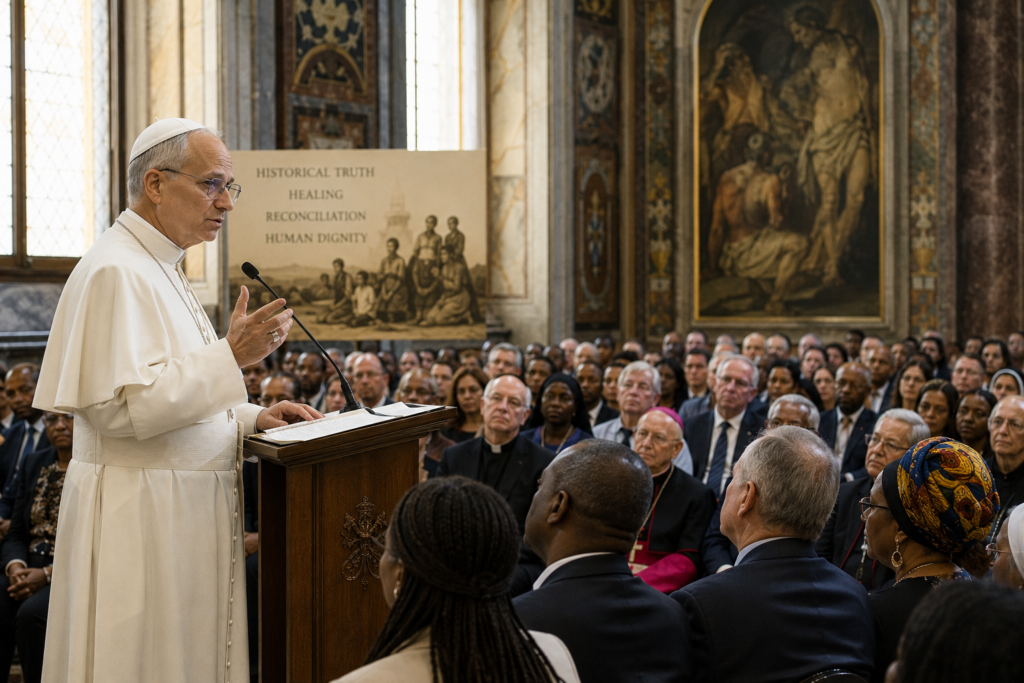
In a landmark moment for the Catholic Church and global religious history, Pope Leo XIV has issued an unprecedented apology acknowledging the Vatican’s historical role in legitimizing slavery, marking one of the most significant acts of institutional reflection ever undertaken by a modern pope.
The apology came as part of the pope’s first major papal document, a sweeping statement focused on human dignity, ethics, and the challenges facing society in the age of artificial intelligence. While much of the document addresses the future of technology, one section has generated worldwide attention for confronting a painful chapter of Church history.
For the first time, a pope formally recognized that past Vatican actions helped provide religious justification for systems of human enslavement during the colonial era. The statement has been described by historians, religious scholars, and civil rights advocates as a groundbreaking acknowledgment of responsibility.
The announcement immediately sparked global discussion surrounding Pope Leo slavery apology historic moment, with religious leaders and historians calling it one of the most consequential Vatican statements of the modern era.
For centuries, historians have debated the role played by religious institutions during the expansion of European colonial powers. During the fifteenth century, several papal decrees granted European monarchs authority to conquer territories inhabited by non-Christians, creating legal and religious frameworks that were later used to justify conquest, exploitation, and slavery.
While previous popes had expressed regret for the suffering caused by the transatlantic slave trade and acknowledged the involvement of Christians in slavery, no pope had directly addressed the Holy See’s own institutional role in authorizing systems that contributed to human bondage.
That changed this week.
In language that was both reflective and deeply personal, Pope Leo described the Church’s historical failure to fully condemn slavery as a moral wound that continues to affect Christian memory and global society today. He expressed sorrow for the suffering endured by millions of enslaved people and asked forgiveness on behalf of the Church.
The statement has intensified conversations around Catholic Church role in slavery history, a topic that has increasingly gained attention among scholars and faith communities around the world.
The significance of the apology extends beyond historical symbolism.
Many advocates have spent decades urging Church leaders to directly confront documents issued by previous popes that authorized European rulers to conquer and enslave non-Christian populations. Historians argue that these decrees helped shape colonial policies across parts of Africa and the Americas.
Although the Vatican previously rejected the controversial Doctrine of Discovery—a legal and theological concept associated with colonial expansion—the original historical documents themselves have remained subjects of debate.
By publicly addressing the issue, Pope Leo has moved the Church into a new phase of historical accountability.
Interest in Vatican acknowledges colonial era injustices has surged following the announcement as Catholics and non-Catholics alike examine the broader implications of the pope’s remarks.
The apology is particularly notable because of Pope Leo’s own family background.
Genealogical research has shown that the first American-born pope has ancestors who were both enslaved individuals and slaveholders. That personal connection has added another dimension to the statement, making it not only an institutional acknowledgment but also a deeply human reflection on historical injustice.
Observers say the pope’s willingness to discuss both personal and institutional history has strengthened the emotional impact of the message.
Religious leaders from multiple faith traditions welcomed the apology, describing it as an important step toward reconciliation and historical truth.
The broader conversation has also fueled growing interest in religious institutions confronting historical injustices, as organizations worldwide continue reevaluating their roles in past systems of discrimination and exploitation.
Beyond addressing slavery, Pope Leo connected historical exploitation to modern ethical challenges.
The document warns that technological advances, particularly in artificial intelligence, could create new forms of inequality and exploitation if left unchecked. The pope argued that societies must learn from history rather than repeat it in new forms.
He cautioned that economic systems built around emerging technologies should never sacrifice human dignity for profit, efficiency, or political power.
This connection between historical slavery and modern labor concerns has sparked discussion around human dignity in artificial intelligence era, a theme that runs throughout the pope’s broader vision for the future.
The statement arrives at a time when institutions around the world are facing increasing pressure to acknowledge historical wrongdoing.
Universities, corporations, governments, and religious organizations have all undertaken efforts in recent years to investigate historical ties to slavery and colonialism. Some have issued apologies, while others have launched educational initiatives, memorial projects, and reconciliation programs.
Supporters argue that acknowledging history is essential for building trust and promoting healing.
Critics, however, continue debating whether symbolic statements should be accompanied by additional actions, including educational reforms, community investments, or other measures designed to address lasting consequences of historical injustice.
Those debates have contributed to rising searches for historical accountability and institutional reconciliation, reflecting broader public interest in how organizations respond to difficult chapters of their past.
For many Black Catholics and descendants of enslaved communities, the apology represents a moment they have sought for decades.
Advocates say the statement validates generations of concerns about how religious authority was sometimes used to support systems of oppression rather than challenge them.
While reactions vary, many view the acknowledgment as an important milestone in a longer process of understanding, reconciliation, and healing.
The pope’s words are unlikely to end debates about history, responsibility, or institutional accountability.
Yet they have undeniably opened a new chapter in the Church’s relationship with its past.
Search interest in global reaction to Vatican slavery apology continues to rise as religious communities, historians, and political leaders assess the significance of the announcement.
For Pope Leo XIV, the message was ultimately about more than history.
It was about ensuring that future generations learn from past failures.
By confronting one of the most controversial aspects of the Church’s historical record, the pope has challenged institutions everywhere to examine their own histories honestly and to place human dignity at the center of future decisions.
Whether discussing slavery centuries ago or emerging technologies today, his central message remains clear: societies cannot build a just future without acknowledging the truths of their past.