Deadly Violence at San Diego Mosque Sparks Grief and Calls for Unity
For years, members of San Diego’s Muslim community quietly carried a concern that many hoped would never become reality.
Religious leaders, worshippers, parents, and longtime community members often discussed the possibility that rising anti-Muslim hostility across the country could one day lead to violence at a local place of worship. That fear became tragically real when a deadly attack struck one of Southern California’s most prominent Islamic institutions, leaving a grieving community searching for answers and healing.
The attack on the Islamic Center of San Diego shocked residents across the region and reignited a national conversation about religious safety, hate-driven violence, and the security of houses of worship in America. Authorities are investigating the shooting as a possible hate crime after evidence suggested the attackers were motivated by extremist beliefs and broad expressions of hatred.
Search interest surrounding San Diego mosque attack community response has surged nationwide as Americans seek to understand how local residents are coping with one of the region’s most devastating acts of violence in recent memory.
The Islamic Center of San Diego has long been more than a mosque.
For thousands of families, it serves as a community hub, educational center, cultural gathering place, and spiritual home. Children attend classes there, families gather for celebrations, and residents rely on the center for support during difficult moments in their lives. Community members often describe the institution as a second home rather than simply a place of worship.
That deep connection has made the tragedy particularly painful.
Three people lost their lives during the attack, including security guard Amin Abdullah, whose actions are widely credited with preventing an even greater catastrophe. Authorities and community leaders say Abdullah helped initiate emergency lockdown procedures that protected approximately 140 children inside the center’s school.
His courage has become a symbol of resilience throughout the community.
The growing discussion around hero security guard saves children mosque shooting reflects widespread recognition of those actions and the lives that may have been spared because of them.
Investigators believe the two teenage attackers shared extremist views and had become increasingly radicalized through online networks. Authorities recovered writings expressing hatred toward multiple groups and are continuing to examine the circumstances leading up to the attack.
The revelation has intensified concerns about online radicalization and the ability of extremist content to influence vulnerable individuals.
For many local Muslims, however, the tragedy did not come entirely without warning.
Community leaders say the Islamic Center had experienced threats and hateful messages in previous years. Following international attacks targeting Muslim worshippers, security measures were strengthened and additional precautions were introduced. Yet despite those efforts, many residents now feel that their long-standing concerns about religiously motivated violence have been validated.
Interest in rising anti Muslim incidents in America has increased significantly following the attack as Americans examine broader trends involving religious discrimination and hate crimes.
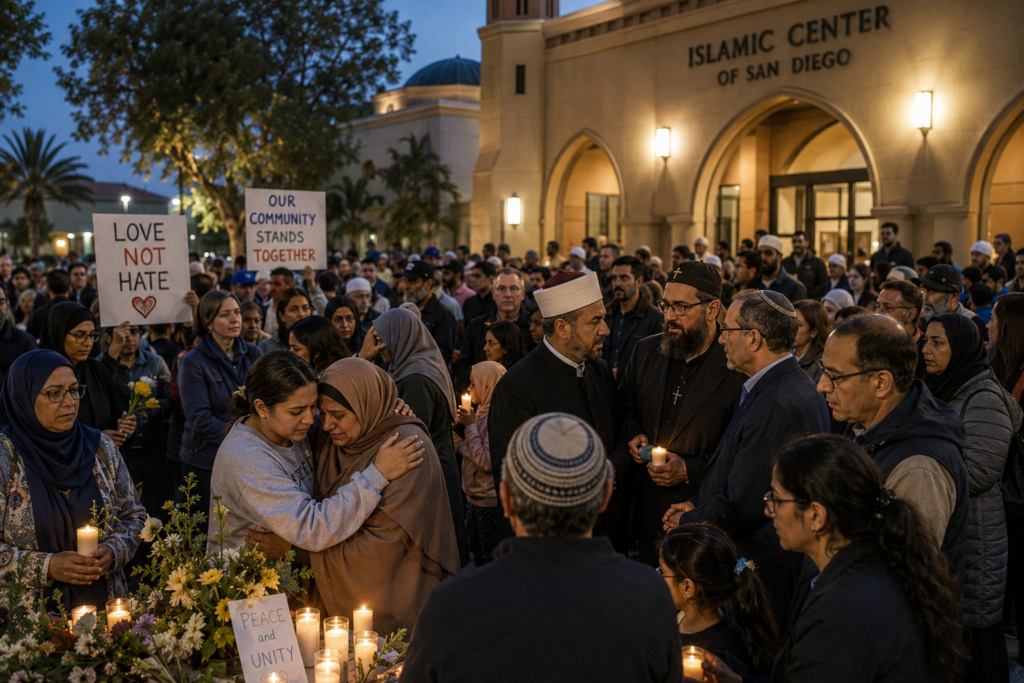
In the days after the shooting, hundreds of people gathered across San Diego for vigils, prayer services, and community events honoring the victims.
What emerged was a powerful display of solidarity.
Religious leaders representing Christian, Jewish, Muslim, and other faith communities stood together, offering support and emphasizing the importance of unity in the face of hatred. Community members described scenes of neighbors comforting one another, strangers embracing, and families finding strength through collective mourning.
Those gatherings sent a message that violence would not define the future of the community.
The growing attention surrounding interfaith support after religious violence highlights how communities across the country often respond to tragedy by strengthening relationships rather than retreating into division.
For many parents, one of the most emotional aspects of the incident involved the children who were inside the Islamic school during the attack.
Educators and staff quickly implemented emergency procedures, helping students remain safe throughout the crisis. Mental health professionals and counselors have since been working closely with families to address trauma and anxiety resulting from the event.
Parents say conversations with their children have been particularly difficult.
Many are now grappling with questions about safety, faith, and how to explain acts of hatred to young people who viewed the mosque as one of the safest places in their lives.
National interest in protecting houses of worship from violence has grown as faith communities evaluate their own security measures and emergency preparedness plans.
The attack has also renewed attention on hate crime prevention efforts.
Civil rights organizations note that reports involving religious discrimination and anti-Muslim incidents have increased in recent years. Advocacy groups argue that stronger community education, improved monitoring of extremist threats, and expanded support for vulnerable communities are necessary to prevent future violence.
Many religious leaders stress that addressing hate requires more than law enforcement alone.
They believe long-term solutions must involve education, dialogue, and sustained efforts to combat prejudice before it escalates into violence.
Interest surrounding community healing after hate crime tragedy continues rising as people search for examples of resilience and recovery following traumatic events.
Despite overwhelming grief, members of the Islamic Center are determined not to allow the attack to define their identity.
Daily prayers have resumed, community programs are gradually returning, and volunteers continue supporting affected families. Donations and messages of support have arrived from across the country, reflecting the broad national response to the tragedy.
Many worshippers say the mosque will continue serving as a place of peace, faith, and community.
The road to healing will undoubtedly be long.
Yet amid sorrow, fear, and unanswered questions, many residents believe the response from neighbors, faith leaders, and supporters across the country has demonstrated something equally powerful: that communities can unite against hatred and stand together in defense of religious freedom.
As investigations continue and families mourn their losses, San Diego’s Muslim community remains focused on honoring the victims, supporting one another, and ensuring that the values of compassion, faith, and unity endure far beyond this tragic moment.