Tennessee Execution Sparks National Debate as Questions Persist Over Evidence, Mental Competency, and Death Penalty Process
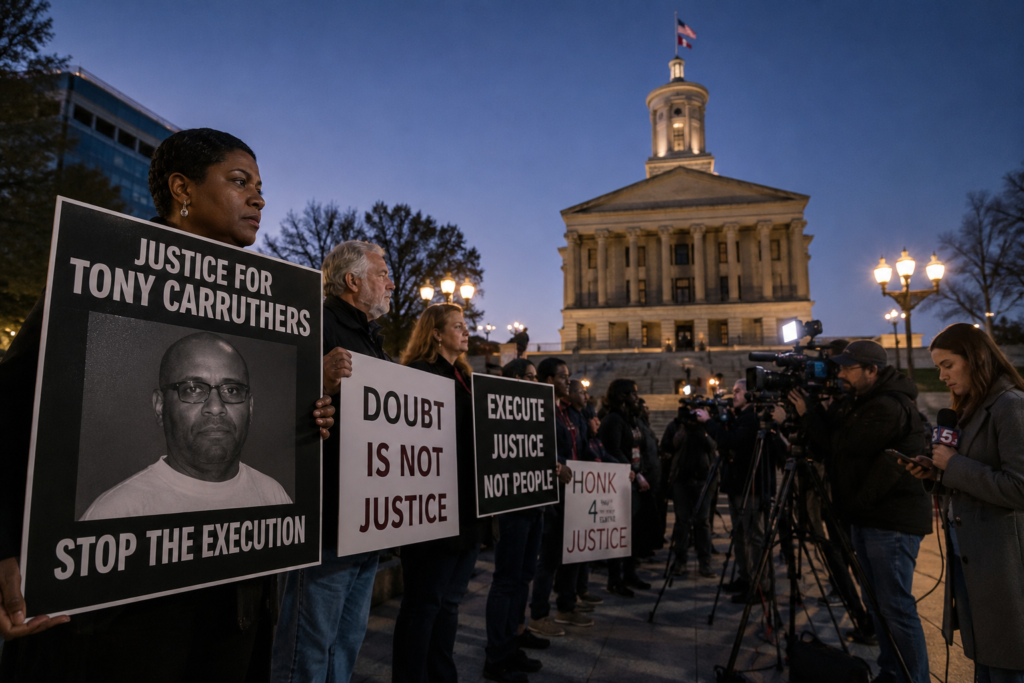
Tennessee is moving forward with the scheduled execution of death row inmate Tony Carruthers, a case that has reignited nationwide debate over capital punishment, mental competency, forensic testing, and the standards required before carrying out the ultimate criminal penalty.
As the execution date approaches, legal advocates, civil rights organizations, faith leaders, and criminal justice reform groups continue urging state officials to pause the process, arguing that unresolved questions remain regarding evidence, trial fairness, and Carruthers’ mental condition. Meanwhile, prosecutors and courts have maintained that the conviction has survived decades of legal review and appeals.
The case traces back to a 1994 triple homicide in Memphis involving Marcellos Anderson, Delois Anderson, and Frederick Tucker. Carruthers was convicted and sentenced to death after prosecutors argued he played a central role in the kidnappings and murders. For more than three decades, however, the case has remained the subject of legal challenges and controversy.
Search interest surrounding Tennessee death row execution controversy 2026 has surged across the United States as Americans follow the increasingly emotional legal battle.
One of the most significant concerns raised by Carruthers’ supporters involves the absence of physical evidence directly linking him to the murders. Defense advocates argue that the conviction relied heavily on witness testimony, including statements from individuals whose credibility has been challenged over the years. Critics of the conviction point specifically to testimony from a confidential informant who was later revealed to have received compensation from law enforcement.
Supporters of Carruthers have also focused on forensic evidence that has never undergone additional testing. Legal filings sought DNA and fingerprint analysis that attorneys argued could potentially provide new information regarding the crimes. Tennessee courts ultimately rejected those requests, ruling that the legal requirements for additional testing had not been met.
The issue has fueled widespread discussion involving untested DNA evidence in capital cases, a topic that continues generating strong reactions among both death penalty supporters and opponents.
Another major point of controversy involves Carruthers’ mental health.
According to court records and defense filings, attorneys have argued that longstanding mental illness, paranoia, and delusional beliefs impaired his ability to cooperate with legal counsel and understand aspects of the proceedings. Defense teams have repeatedly sought rulings declaring him incompetent for execution, but courts ultimately rejected those arguments.
Mental health experts and criminal justice advocates say the case highlights broader national questions about how the legal system evaluates competency in death penalty cases.
At the same time, prosecutors have maintained that Carruthers received extensive judicial review and that courts consistently found sufficient grounds to uphold the conviction and sentence. Tennessee’s highest courts have repeatedly reviewed various claims connected to the case over many years.
Interest surrounding mental competency challenges in death penalty cases continues growing as Americans examine how mental illness intersects with criminal responsibility and capital punishment.
The execution has also attracted significant public activism.
Civil rights organizations, innocence advocacy groups, religious leaders, and former death row inmates have joined calls for clemency. Large petitions have circulated nationally, attracting tens of thousands of signatures from individuals urging Tennessee officials to halt the execution until additional evidence can be reviewed.
The growing public attention reflects increasing scrutiny of capital punishment nationwide.
Over recent years, debates surrounding wrongful convictions, forensic reliability, prosecutorial conduct, and execution procedures have intensified across multiple states. Cases involving disputed evidence often generate particularly strong public reactions because of the irreversible nature of executions.
Discussions tied to wrongful conviction concerns before execution have expanded rapidly across social media, legal forums, and national political conversations.
Adding another layer to the controversy are concerns involving Tennessee’s execution protocols.
Defense attorneys have questioned whether the lethal injection drugs intended for use meet all required standards and have raised concerns regarding expiration dates and testing procedures. These concerns come after previous reviews found problems within Tennessee’s administration of lethal injection protocols, prompting years of scrutiny and reform efforts.
The state previously paused executions after discovering deficiencies involving drug testing procedures. Although officials have since resumed executions, critics continue questioning whether sufficient transparency exists regarding execution methods.
Searches related to Tennessee lethal injection protocol legal challenges have increased significantly as Americans seek information about how executions are conducted and regulated.
Perhaps one of the most unusual aspects of the case involves Carruthers’ representation during trial.
Court records show that he repeatedly clashed with appointed attorneys, leading to circumstances in which he represented himself. Defense advocates argue that his mental condition contributed to those conflicts and ultimately undermined his ability to receive a fair trial. Prosecutors and judges, however, have characterized many of his actions as deliberate and voluntary.
Legal experts note that cases involving self-representation in capital trials are extraordinarily rare, adding another layer of public interest to the proceedings.
The case has become larger than one individual conviction.
For supporters of the death penalty, it represents the conclusion of a lengthy legal process involving horrific crimes and decades of appeals.
For opponents, it symbolizes ongoing concerns about whether the justice system can ever guarantee absolute certainty when a human life is at stake.
Interest surrounding national debate over capital punishment fairness continues rising as Americans grapple with difficult questions about justice, accountability, and due process.
As Tennessee moves closer to carrying out the execution, the case remains a powerful reminder of the enduring divisions surrounding the death penalty in America.
Whether viewed through the lens of criminal justice, civil rights, mental health, or legal procedure, the controversy surrounding Tony Carruthers has become one of the most closely watched capital punishment cases in the country.
And regardless of the final outcome, the debate it has sparked is likely to continue long after the courtroom proceedings have ended.