America’s New Space Race Is No Longer Just About Flags—It’s About Private Power, Global Competition, and the Future Beyond Earth
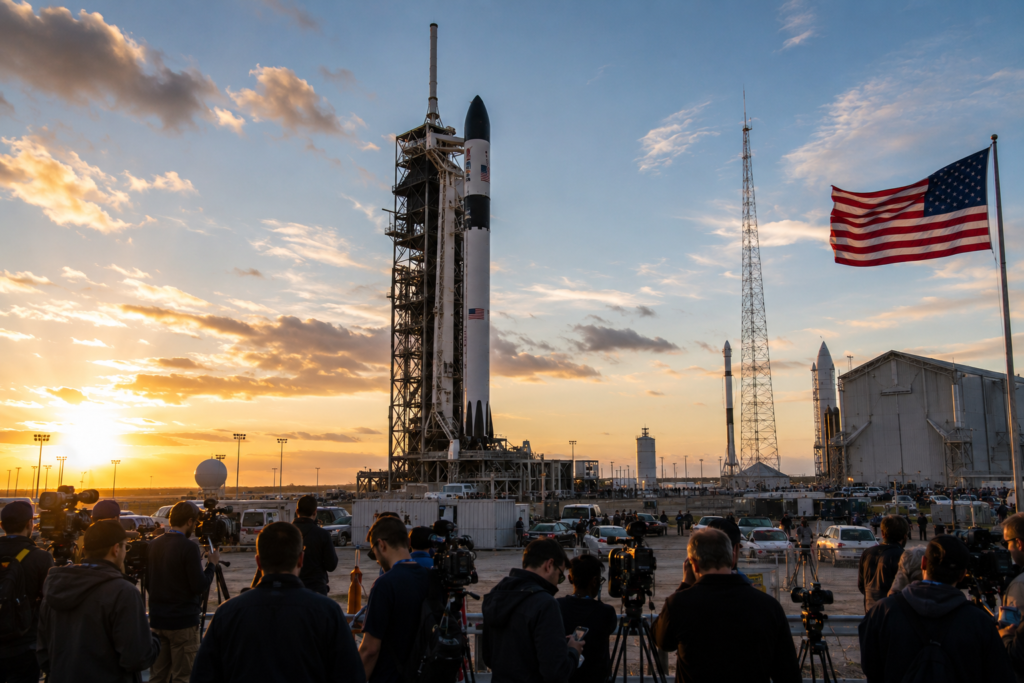
For decades, the space race was defined by national pride. Governments competed to plant flags on the Moon, launch astronauts into orbit, and demonstrate technological superiority. Today, however, the competition has entered a dramatically different era—one increasingly driven by private investment, commercial innovation, and a rapidly intensifying rivalry with China.
The transformation is reshaping not only how space missions are funded but also how nations view economic power, national security, and technological leadership beyond Earth’s atmosphere.
What was once a government-led contest between the United States and the former Soviet Union has evolved into a complex global race involving billion-dollar private companies, venture capital firms, and international partnerships. Industry experts say the center of gravity has shifted from public institutions toward commercial enterprises capable of developing rockets, satellites, lunar landers, and future space infrastructure at unprecedented speed.
This evolution has sparked renewed discussion about private companies leading modern space race, a trend redefining America’s position in the global space economy.
Unlike previous generations of exploration, today’s missions often rely on partnerships between government agencies and private aerospace companies. NASA increasingly contracts commercial firms to transport astronauts, deliver cargo, develop lunar technology, and expand access to low-Earth orbit. These collaborations have significantly reduced launch costs while accelerating innovation.
Industry analysts believe this model has fundamentally changed the economics of space exploration.
Reusable rocket technology, privately financed launch systems, satellite internet networks, and commercial research platforms have transformed what was once considered prohibitively expensive into an expanding marketplace attracting investors worldwide.
The commercial sector has become one of the fastest-growing areas of advanced technology, drawing billions of dollars in investment despite broader economic uncertainty. Investors increasingly view space technology as a long-term growth industry supporting communications, defense, navigation, Earth observation, manufacturing, and future lunar exploration.
This momentum has increased interest in commercial space industry investment growth, one of the fastest-rising topics among technology investors.
Yet America no longer operates without serious competition.
China has rapidly expanded its space capabilities through sustained government investment, advanced launch systems, lunar missions, and an expanding commercial ecosystem supported by state policy. Analysts say Beijing’s progress has intensified strategic competition and reinforced Washington’s determination to maintain technological leadership in space.
Many policymakers now view space as an essential component of national security.
Modern military operations, communications networks, financial systems, weather forecasting, GPS navigation, and disaster response all depend heavily on satellite infrastructure. Protecting these assets has become a major priority for governments around the world.
The growing competition has fueled conversations surrounding United States and China space competition, as both nations continue investing heavily in next-generation technologies.
Private companies are also changing public expectations.
Instead of waiting decades between historic missions, today’s industry is producing frequent rocket launches, reusable spacecraft, commercial space stations, lunar cargo systems, and ambitious plans for human exploration beyond the Moon.
Some companies envision mining resources from asteroids, manufacturing products in orbit, and eventually supporting permanent human settlements on the Moon or Mars.
While those goals remain years away, experts argue that many technologies once considered science fiction are steadily becoming commercially viable.
This changing landscape reflects future of private space exploration, where entrepreneurs and investors increasingly influence decisions once made exclusively by governments.
However, the commercial revolution also presents new challenges.
Some experts caution that dependence on a relatively small number of powerful aerospace companies could create strategic vulnerabilities. Governments must balance innovation with oversight while ensuring critical infrastructure remains reliable and secure.
Questions surrounding regulation, international cooperation, orbital congestion, and space sustainability are becoming increasingly important as more satellites and spacecraft enter orbit each year.
Industry leaders emphasize that successful growth will require clear international rules governing commercial activity beyond Earth.
Another significant factor is affordability.
Reduced launch costs have opened opportunities for universities, startups, scientific organizations, and smaller nations to participate in space missions previously reserved for global superpowers. This broader participation is expanding scientific research while encouraging new commercial applications.
Analysts believe this democratization of access could produce innovations comparable to the early internet revolution.
The expanding market has also strengthened interest in global commercial space economy expansion, particularly among investors seeking long-term opportunities in advanced technology sectors.
Economic forecasts suggest the worldwide space economy could continue growing substantially over the coming decades as satellite services, telecommunications, artificial intelligence, Earth observation, and lunar development create entirely new industries.
Meanwhile, American policymakers remain focused on preserving the country’s leadership position.
Federal agencies continue investing in deep-space exploration, advanced propulsion systems, next-generation communications, and human spaceflight while expanding partnerships with commercial providers.
Supporters argue this approach allows government resources to concentrate on pioneering research while private companies deliver operational efficiency and rapid technological development.
For consumers, many benefits are already visible.
Satellite internet, GPS navigation, weather forecasting, environmental monitoring, emergency communications, precision agriculture, and global logistics all depend on technologies developed through space programs.
As commercial investment continues accelerating, those services are expected to become even more sophisticated.
The modern space race is therefore no longer measured simply by who reaches the Moon first.
It is increasingly defined by innovation, economic opportunity, technological leadership, and commercial partnerships capable of shaping the global economy for generations to come.
The growing focus on space technology driving economic innovation reflects a broader understanding that success beyond Earth may ultimately influence prosperity here at home.
America remains one of the world’s leading space powers, but today’s competition looks very different from the Cold War era.
Governments still play a central role, yet private enterprise has become an equally powerful force.
Together, they are building the next chapter of human exploration—one where rockets carry not only national ambitions, but also commercial opportunity, scientific discovery, and the promise of an entirely new space economy.