Beirut Braces for New Airstrikes as Israel Expands Offensive and Regional Tensions Deepen
The fragile calm that briefly settled over parts of Lebanon is rapidly fading as Israel intensifies military operations and orders new strikes targeting Beirut’s southern suburbs, raising fears that the conflict is entering a far more dangerous phase.
Israeli Prime Minister Benjamin Netanyahu authorized fresh attacks against Hezbollah-linked targets in the Dahiyeh district of southern Beirut, one of the group’s most influential strongholds. The decision follows days of escalating military activity along the Israel-Lebanon border and comes as diplomatic efforts aimed at reducing violence continue to struggle.
The latest escalation has placed Lebanon’s capital back at the center of a growing regional crisis that now stretches beyond local border tensions and increasingly intersects with wider geopolitical disputes involving Iran, regional alliances, and international mediation efforts.
Search interest has surged around Israel Beirut airstrike latest updates, Netanyahu orders attacks on Beirut, and Middle East conflict escalation 2026 as global audiences closely monitor developments.
Israeli officials say the military operation was ordered in response to what they describe as repeated violations of ceasefire understandings by Hezbollah. According to Israeli authorities, Hezbollah has continued launching rockets, drones, and other attacks targeting northern Israeli communities despite previous diplomatic attempts to reduce hostilities.
In a joint statement, Israeli leadership argued that military action remains necessary to protect Israeli civilians and weaken Hezbollah’s operational capabilities.
The targeted area, known as Dahiyeh, carries major strategic importance.
Located in Beirut’s southern suburbs, the district has long served as one of Hezbollah’s primary political and organizational centers. Previous conflicts between Israel and Hezbollah have repeatedly focused on the area because of its military significance and symbolic role within the broader regional power struggle.
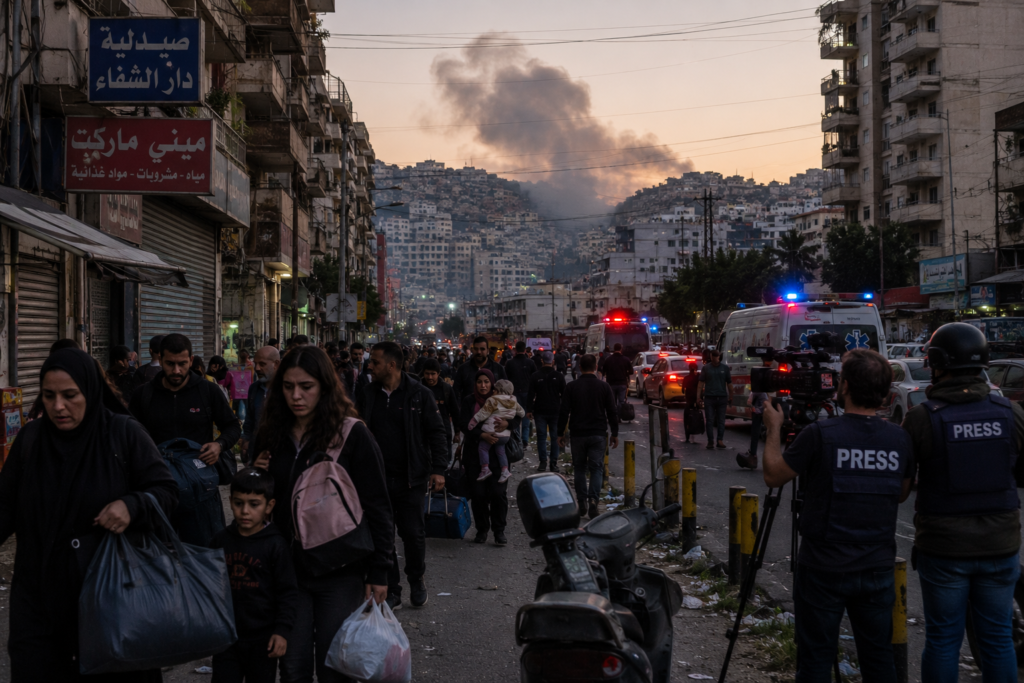
Residents reported growing anxiety after evacuation warnings circulated ahead of potential strikes. Families rushed to gather belongings while traffic congestion increased across several neighborhoods as people attempted to move away from locations considered vulnerable.
For many Lebanese civilians, the scenes revived memories of earlier wars that caused widespread destruction across the capital.
The renewed military pressure comes only days after Israeli forces expanded ground operations deeper into southern Lebanon. Israeli troops recently captured the historic Beaufort Castle area and strengthened positions near the Litani River, marking one of the most significant territorial advances inside Lebanon in decades.
Military analysts believe these developments signal a broader strategic effort rather than a limited operation.
Online discussions surrounding Israeli military operations southern Lebanon, Beirut southern suburbs security crisis, and Hezbollah Israel conflict latest developments have increased sharply as concern grows over the possibility of a prolonged confrontation.
Hezbollah has strongly condemned the attacks.
The organization accuses Israel of deliberately escalating the conflict while undermining diplomatic initiatives designed to prevent further violence. Hezbollah officials maintain that military pressure will not force the group to abandon its position and have continued signaling resistance through public statements and military activity.
Rocket launches and drone attacks directed toward northern Israel have continued despite previous ceasefire announcements.
Israeli defense officials argue that these attacks justify stronger military responses and insist that Hezbollah remains responsible for prolonging instability along the border.
The conflict’s impact on civilians continues to expand.
Lebanese authorities estimate that more than one million people have been displaced since fighting intensified earlier this year. Entire communities across southern Lebanon have faced evacuation orders, while many residents of Beirut now fear that the capital could once again experience sustained military strikes.
Businesses, schools, and public services across multiple regions are operating under increasing uncertainty.
Humanitarian organizations warn that prolonged instability could place additional pressure on already struggling communities. Lebanon continues facing severe economic challenges, making displacement and infrastructure damage even more difficult for families trying to rebuild their lives.
Meanwhile, international diplomatic efforts remain complicated.
The United States, France, and several regional governments have spent months attempting to broker arrangements capable of reducing hostilities. However, recent developments have exposed how fragile those efforts remain.
Diplomatic discussions have reportedly focused on creating phased de-escalation agreements involving military restraint from both Israel and Hezbollah. Yet disagreements over enforcement, security guarantees, and regional political conditions continue slowing progress.
Search traffic linked to Lebanon ceasefire negotiations facing challenges, international response to Beirut strikes, and regional diplomacy amid Middle East conflict reflects growing concern about whether diplomacy can still prevent a wider crisis.
Iran has also emerged as a central factor in ongoing discussions.
Iranian officials have repeatedly argued that military actions inside Lebanon are directly affecting broader negotiations taking place across the region. Several analysts believe developments in Lebanon cannot be separated from wider strategic calculations involving Iran, Israel, and Western governments.
This interconnected reality has made the conflict increasingly complex.
What initially appeared to be a localized confrontation has evolved into a broader geopolitical challenge involving multiple governments, military alliances, and competing regional interests.
Security experts warn that continued escalation around Beirut could increase the risk of wider instability across the Middle East.
The symbolism of renewed strikes targeting Beirut’s southern suburbs is particularly significant because the area has often represented both Hezbollah’s influence and Lebanon’s vulnerability during periods of regional conflict.
For ordinary residents, however, the immediate concern remains survival and stability.
Many families are once again preparing emergency plans, monitoring security updates, and deciding whether to remain in their homes or seek temporary shelter elsewhere.
Local businesses report growing uncertainty, while schools and community institutions face disruption as military tensions continue rising.
The coming days may prove decisive.
Whether diplomatic channels can regain momentum or military operations continue expanding could shape the next chapter of one of the region’s most dangerous conflicts.
For now, Beirut finds itself once again standing at the center of a crisis that extends far beyond Lebanon’s borders.
As warplanes, political negotiations, military calculations, and regional rivalries converge, millions of people across the Middle East are watching closely to see whether the situation moves toward de-escalation—or a deeper and more unpredictable confrontation.