Israel Pushes Beyond Litani River as Strategic Lebanon Offensive Sparks Regional Alarm
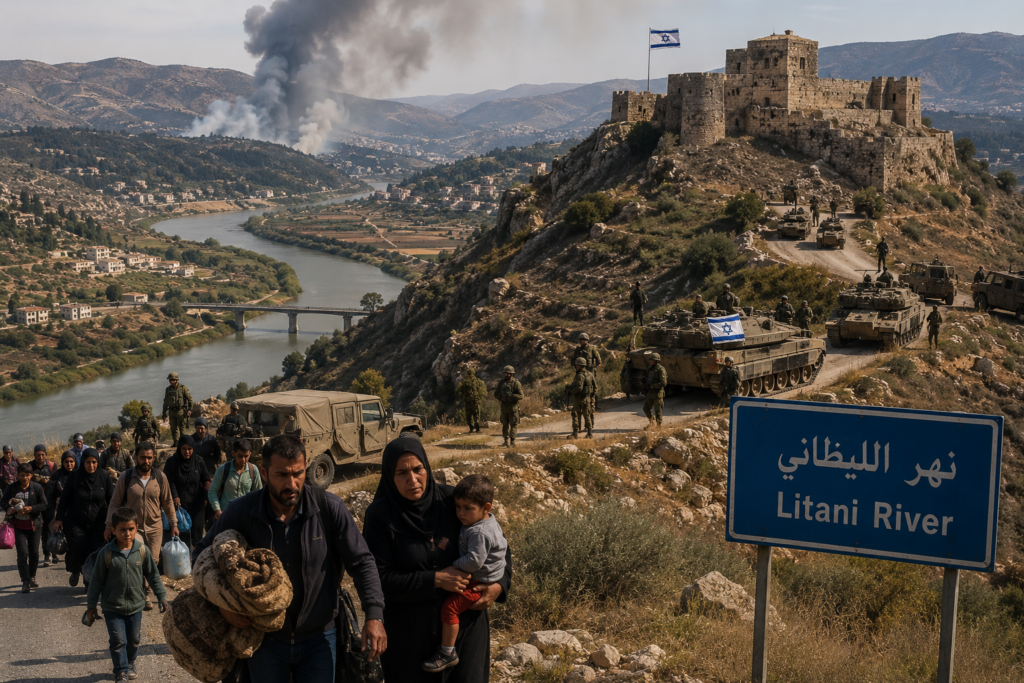
In a major escalation that is reshaping the security landscape of the Middle East, Israeli forces have advanced deeper into southern Lebanon and seized one of the region’s most strategically significant military positions, marking the furthest Israeli ground push into Lebanese territory in more than two decades.
The operation has intensified concerns about a wider regional conflict, displaced thousands of civilians, and raised fresh questions about the future of already fragile diplomatic efforts aimed at reducing violence between Israel and Hezbollah.
Israeli military officials confirmed that troops captured the historic Beaufort Castle ridge, a commanding hilltop position overlooking large sections of southern Lebanon near the Litani River. The fortress, originally built centuries ago, has long held strategic military value because of its elevated location and visibility across surrounding valleys and transportation routes.
Military analysts say the capture gives Israel a significant tactical advantage in monitoring movement throughout key parts of southern Lebanon.
The development comes amid a broader campaign targeting Hezbollah infrastructure and positions that Israeli officials claim have been used to coordinate attacks against northern Israel.
The latest advance has become one of the most discussed international security developments online, with search interest rapidly growing around Israel Lebanon military escalation 2026, Israeli forces cross Litani River, and Middle East border conflict latest updates.
For Lebanon, the military push represents a dramatic shift in the conflict.
The Litani River has long been viewed as one of southern Lebanon’s most important geographic and strategic boundaries. Crossing beyond it carries major symbolic and military significance because previous international agreements and security frameworks often centered around controlling activity south of the river.
Israeli officials argue that expanding military operations is necessary to eliminate threats posed by Hezbollah fighters operating near the border.
According to military statements, troops are focusing on securing elevated terrain, transportation corridors, and areas believed to contain weapons storage facilities and underground military infrastructure.
Meanwhile, Lebanese leaders have strongly condemned the operation.
Government officials accused Israel of pursuing a destructive military strategy that is causing widespread damage across southern communities. Lebanese authorities warned that continued advances could further destabilize the country and complicate already difficult diplomatic negotiations taking place behind the scenes.
The capture of Beaufort Castle has become particularly significant because of its historical role in previous conflicts.
Israeli forces controlled the site during earlier military operations in Lebanon before eventually withdrawing decades ago. Its recapture signals a major shift in battlefield dynamics and reflects the broader expansion of current operations.
Search traffic related to Beaufort Castle strategic military significance, Israel Hezbollah conflict southern Lebanon, and Lebanon security crisis international concerns has increased sharply as people seek to understand the wider implications of the military move.
Residents across southern Lebanon continue facing growing uncertainty.
Evacuation warnings have expanded across several regions, with military authorities urging civilians to move away from active combat zones. Thousands of families have reportedly left homes in vulnerable areas as airstrikes and ground operations continue.
Many communities that were already struggling with economic hardship now face additional challenges linked to displacement, infrastructure damage, and limited access to services.
Humanitarian organizations have expressed concern over the worsening conditions.
Aid workers say large numbers of civilians remain caught between military operations and rapidly changing security conditions. Schools, local businesses, and transportation routes have been disrupted in multiple areas, further affecting daily life.
At the same time, Hezbollah has continued signaling resistance to Israeli advances.
The group views Israeli operations beyond the Litani River as a direct challenge to its influence in southern Lebanon. Analysts warn that intensified fighting around strategic locations could increase the risk of broader confrontations in the coming weeks.
International observers are closely monitoring developments.
Several governments have called for restraint while encouraging renewed diplomatic engagement to prevent the conflict from expanding further. Behind closed doors, regional and Western officials continue discussing possible pathways toward reducing tensions, though progress remains uncertain.
The situation has become even more sensitive because of its connection to wider geopolitical tensions involving Iran, regional security alliances, and ongoing negotiations affecting multiple Middle Eastern conflicts.
Many analysts believe current military actions are not occurring in isolation.
Instead, they view the offensive as part of a larger strategic environment where military pressure, diplomatic negotiations, and regional power dynamics are all influencing decision-making.
Growing online attention around Middle East military tensions growing rapidly, Lebanon civilian displacement crisis worsening, and Israel Hezbollah battlefield developments today reflects increasing public concern about where the conflict could lead next.
Military experts note that controlling elevated positions such as Beaufort Castle provides both operational and intelligence advantages.
From such locations, forces can monitor surrounding territory, coordinate movements, and establish defensive positions that are difficult for opponents to challenge.
This is one reason why the fortress has remained militarily important for decades despite changes in warfare technology.
The broader offensive has also triggered debate inside Israel.
Supporters argue that stronger military action is necessary to prevent future attacks and create greater security along the northern border.
Critics, however, warn that deeper military involvement inside Lebanon could increase long-term risks while drawing Israel into a more prolonged conflict.
For civilians living on both sides of the border, the immediate concern remains safety.
Families continue monitoring developments while preparing for the possibility of further escalation. Businesses, schools, and local institutions are adjusting to an increasingly uncertain environment shaped by military operations and security warnings.
The coming days may prove critical.
Whether diplomatic efforts gain momentum or military activity expands further could determine the direction of one of the Middle East’s most closely watched conflicts.
For now, the capture of Beaufort Castle and Israel’s deeper movement beyond the Litani River stand as powerful indicators that the situation has entered a new and potentially more dangerous phase.