Louisiana Redistricting Battle Ignites National Debate Over Voting Power Ahead of 2026 Elections
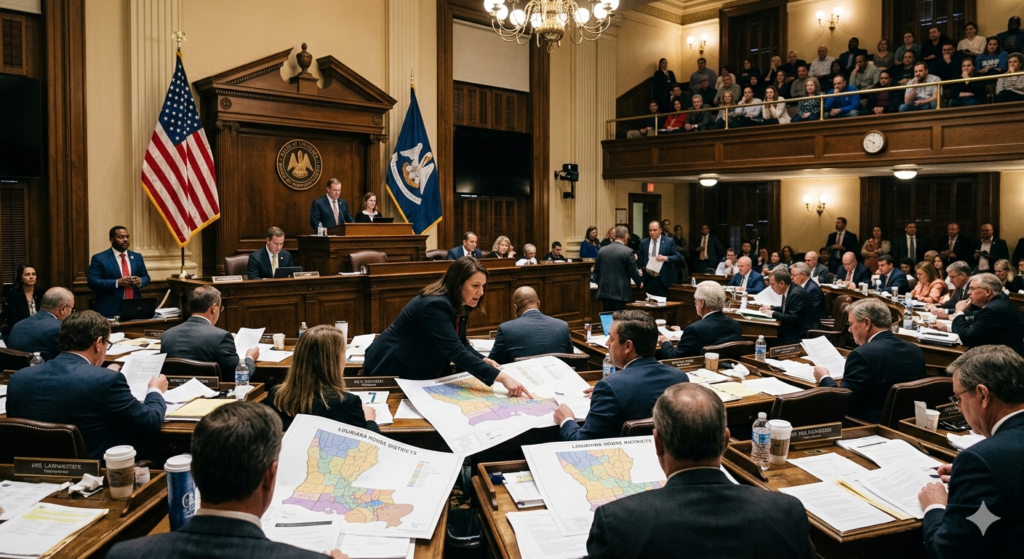
A heated political fight is unfolding in Louisiana after Republican lawmakers advanced a new congressional district proposal that could dramatically reshape the state’s political landscape and potentially weaken Democratic representation in Washington ahead of the 2026 midterm elections.
The proposal, which moved forward through the state legislature amid intense partisan disagreement, would redraw Louisiana’s congressional boundaries in a way that eliminates one district currently favorable to Democratic voters. The move has already sparked accusations of political manipulation, racial representation concerns, and broader fears about the future of voting power in the United States.
Political analysts say the battle unfolding in Louisiana may become one of the most closely watched redistricting fights in the country as both major parties prepare for an increasingly competitive election cycle.
The issue centers on how Louisiana’s congressional maps should be configured following ongoing legal and political disputes over representation and voting rights.
Republican lawmakers backing the proposal argue the updated map reflects political realities and legal considerations while helping create what they describe as a more balanced congressional structure for the state.
Democrats and civil rights advocates strongly disagree.
Critics argue the plan could dilute the voting influence of Black communities and reduce Democratic electoral opportunities in a state already dominated politically by Republicans. Several advocacy groups have warned that the proposal may face legal challenges tied to racial representation and voting rights protections.
The controversy has quickly fueled nationwide interest surrounding Louisiana congressional redistricting political controversy as voting rights organizations and election analysts closely monitor the developing battle.
At the heart of the dispute is a larger national conversation about how district boundaries shape political power in America.
Redistricting has become one of the most contentious issues in modern U.S. politics because small changes to district lines can significantly influence which party controls seats in Congress.
Both Republicans and Democrats across multiple states have faced accusations of gerrymandering — the practice of drawing district boundaries in ways designed to favor one political party over another.
In Louisiana, the stakes are especially high because the state’s political makeup and racial demographics make congressional boundaries highly sensitive.
Civil rights groups argue that reducing districts where Black voters have strong influence could weaken minority representation at the federal level. Supporters of the Republican-backed proposal, however, insist the plan remains legally defensible and politically reasonable.
The growing national debate surrounding voting rights and district map changes reflects broader concerns about electoral fairness and political representation heading into the 2026 election season.
The timing of the proposal has intensified attention even further.
With control of the U.S. House of Representatives expected to remain highly competitive, even a single congressional seat could carry major significance nationally. Political strategists from both parties are already treating redistricting battles as critical components of broader election strategy.
Election experts note that district maps do far more than determine local races — they can shape national policy direction, congressional leadership, and legislative priorities for years.
That reality has transformed state-level redistricting disputes into national political flashpoints.
The Louisiana proposal also arrives during a period of growing public distrust surrounding election systems and political institutions more broadly.
Many voters across the country already feel frustrated by partisan gridlock, legal battles, and increasing polarization inside American politics. Redistricting controversies often deepen those frustrations because they raise questions about whether politicians are choosing voters rather than voters choosing politicians.
Searches tied to 2026 election redistricting impact on Congress have surged online as Americans seek to understand how local district decisions could influence the national balance of power.
Legal experts believe the Louisiana plan could eventually face courtroom scrutiny if approved fully.
Previous district maps in the state have already been challenged through lawsuits involving racial representation and federal voting protections. Analysts expect similar arguments could emerge again depending on how the final boundaries are structured.
The legal dimension adds another layer of uncertainty to an already volatile political situation.
Some constitutional scholars argue redistricting disputes increasingly expose deeper structural tensions inside American democracy itself — particularly surrounding representation, race, and partisan power.
Meanwhile, lawmakers supporting the proposal say criticism from Democrats is politically motivated and ignores broader demographic and geographic realities across Louisiana.
Republican officials have defended the effort as part of a legitimate legislative process, arguing states have authority to redraw districts within constitutional guidelines.
Opponents counter that the issue goes beyond party politics and directly affects minority communities whose representation could be reduced under the new map.
Online discussions involving Black voter representation in Louisiana districts have expanded rapidly as civil rights organizations, political commentators, and voters debate the long-term consequences of the proposal.
The controversy is also drawing national attention because Louisiana has historically played a significant role in legal battles involving voting rights and race-based representation.
Advocacy groups are already mobilizing public campaigns warning that the proposed changes could set broader precedents for future redistricting efforts in other states.
At the same time, conservative organizations argue courts should allow elected legislatures greater flexibility in determining district boundaries without excessive judicial intervention.
The clash reflects the increasingly nationalized nature of state politics in modern America.
Issues once considered local legislative matters now regularly become nationwide ideological battles amplified by social media, cable news coverage, and national party involvement.
Interest surrounding Republican map proposal facing legal challenges continues climbing as political observers analyze how the Louisiana dispute could influence redistricting fights elsewhere in the country.
For voters in Louisiana, however, the debate is deeply personal.
Communities across the state are now confronting questions about political influence, representation, and whether their voices will carry equal weight in future elections.
Many residents worry that ongoing partisan battles over district boundaries are making ordinary voters feel increasingly disconnected from the political system itself.
As lawmakers continue debating the proposal and legal challenges loom in the background, one thing has become increasingly clear: the fight over Louisiana’s congressional map is no longer just a state issue.
It is rapidly becoming a national test of how political power, voting rights, and representation will be shaped in America ahead of the pivotal 2026 elections.