Trump Delays Final Call on Iran Deal as High-Stakes Nuclear Talks Enter Critical Phase
A tense diplomatic standoff between Washington and Tehran entered a decisive new chapter Friday after President Donald Trump stopped short of approving a proposed agreement that could reshape relations between the United States and Iran while easing months of geopolitical uncertainty across the Middle East.
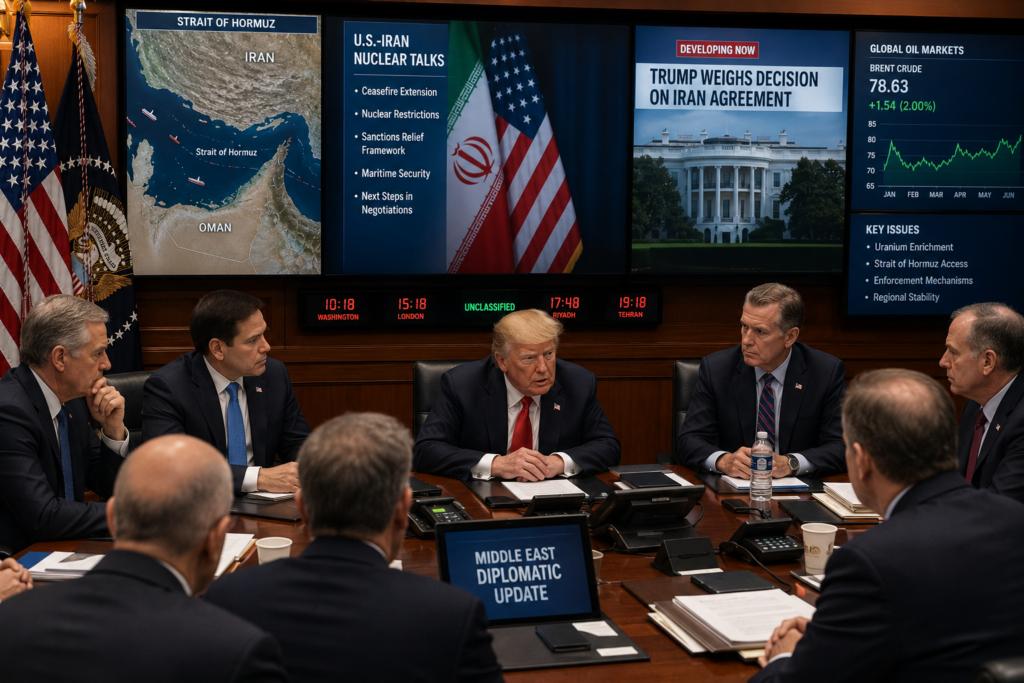
The White House confirmed that Trump met with senior national security advisers in the Situation Room to evaluate a developing framework aimed at extending the fragile ceasefire between the two countries and creating a pathway toward broader negotiations over Iran’s nuclear activities.
Despite expectations that a major announcement could emerge from the meeting, administration officials left without revealing a final decision, signaling that significant disagreements remain unresolved.
The delay underscores how complicated the negotiations have become as both governments attempt to balance security concerns, economic pressures, and regional stability.
At the center of the discussions is a proposed arrangement that would temporarily reduce tensions while allowing both sides to continue negotiations over Iran’s nuclear program. The framework reportedly includes provisions connected to maritime security, sanctions relief, nuclear restrictions, and the future status of shipping routes through the Strait of Hormuz.
For global markets and world leaders, the outcome carries enormous importance.
The strategic waterway remains one of the most critical energy corridors on the planet, handling a significant portion of international oil transportation. Any disruption in the region has the potential to impact fuel prices, global trade flows, and economic confidence worldwide.
Recent online interest surrounding US Iran nuclear deal negotiations, Trump final decision on Iran, and Middle East ceasefire agreement talks has surged as investors, policymakers, and ordinary citizens closely monitor developments.
Trump publicly outlined several conditions he believes must be addressed before any agreement can move forward.
Among the administration’s key demands are long-term guarantees preventing Iran from developing nuclear weapons, unrestricted commercial navigation through the Strait of Hormuz, and measures involving highly enriched nuclear material currently at the center of international concerns.
While U.S. officials describe the negotiations as productive, Iranian leaders have signaled a more cautious position.
Officials in Tehran insist that discussions remain ongoing and argue that no final understanding has been reached. Iranian representatives have repeatedly emphasized that any agreement must include tangible actions from Washington rather than verbal commitments alone.
That difference in messaging has become one of the biggest obstacles facing negotiators.
On one side, American officials have highlighted progress and suggested that meaningful breakthroughs may be within reach. On the other, Iranian leaders continue stressing that critical issues remain unresolved.
The gap between public statements from both governments has fueled uncertainty about whether a final agreement is truly close.
Search activity involving Iran ceasefire extension diplomatic negotiations, Strait of Hormuz shipping security, and global oil market Iran tensions has climbed rapidly as international observers attempt to interpret conflicting signals.
The negotiations are taking place against the backdrop of months of military confrontation, economic sanctions, and escalating regional instability.
Although large-scale combat operations have slowed significantly since the ceasefire took effect, tensions have not disappeared entirely.
Reports of maritime incidents, military positioning, and ongoing security concerns continue reminding diplomats how fragile the current situation remains.
For the Trump administration, the decision involves far more than a single agreement.
The president faces competing pressures from political allies, national security officials, foreign partners, and financial markets.
Supporters of a deal argue that a negotiated outcome could help stabilize energy markets, reduce military risks, and open opportunities for broader diplomatic engagement.
Critics, however, warn that any agreement perceived as too lenient could strengthen Iran’s regional influence or weaken American leverage in future negotiations.
Inside Washington, officials are carefully evaluating whether the proposed framework sufficiently protects U.S. interests while reducing the possibility of renewed conflict.
Analysts say the administration is also weighing how any decision could affect domestic politics heading into future election cycles.
The uncertainty has already influenced financial markets.
Oil traders, shipping companies, and global investors are watching developments closely because the future of the Strait of Hormuz remains one of the most significant economic variables connected to the negotiations.
A successful agreement could ease concerns about energy supply disruptions, while failure could trigger renewed volatility across global markets.
Meanwhile, diplomats from multiple countries continue monitoring the talks behind the scenes.
Several regional governments have reportedly encouraged both sides to continue negotiations, fearing that a collapse in diplomacy could create broader instability across the Middle East.
International observers note that even a temporary framework would represent a meaningful step forward after months of confrontation and uncertainty.
However, experts caution that extending a ceasefire is only one piece of a much larger challenge.
Long-term disagreements surrounding nuclear enrichment, sanctions relief, regional security arrangements, and international oversight mechanisms remain deeply complex.
Those issues will likely require months of additional negotiations even if a temporary understanding is eventually approved.
For now, Trump’s decision to postpone a final announcement highlights the difficult balancing act facing both governments.
Neither side appears eager to abandon diplomacy completely, yet neither appears willing to make major concessions without stronger guarantees.
As a result, the negotiations remain suspended in a delicate political space between breakthrough and breakdown.
Across Washington, Tehran, and major global capitals, officials are now waiting to see whether continued discussions can transform cautious optimism into a formal agreement.
Until then, the future of the proposed deal—and the broader direction of U.S.-Iran relations—remains uncertain.
What happens next could shape not only regional security but also global energy markets, international diplomacy, and the broader balance of power throughout the Middle East for years to come, making Trump Iran foreign policy decision one of the most closely watched geopolitical developments of the year.