Starbucks Faces Growing Backlash in South Korea After Controversial ‘Tank Day’ Campaign Sparks National Debate
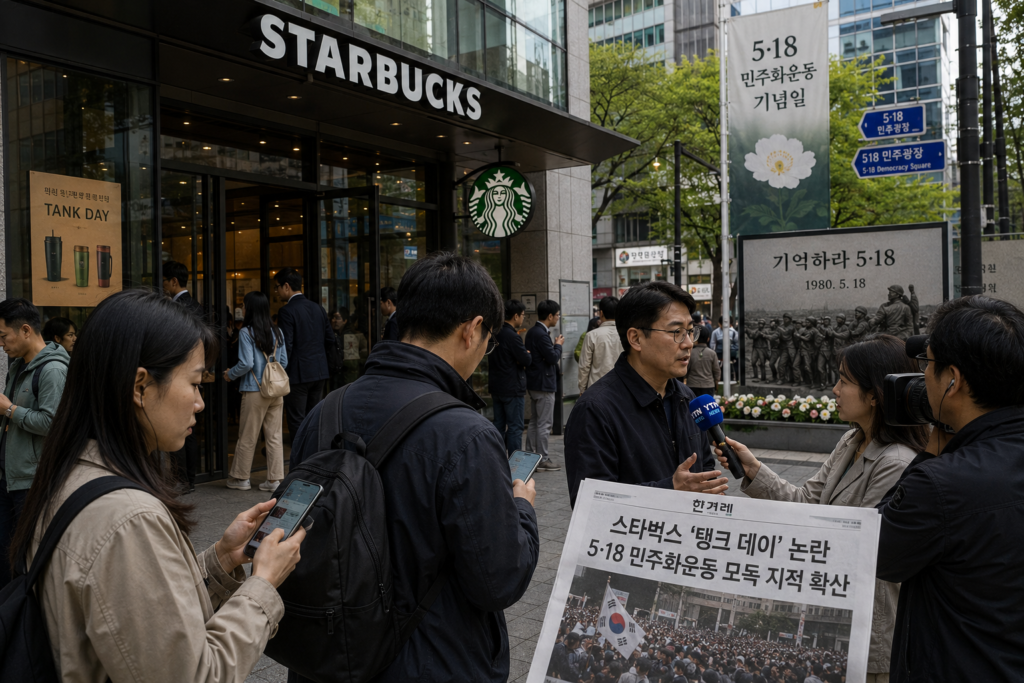
A marketing campaign intended to promote drinkware has turned into one of the most significant corporate controversies in South Korea this year, triggering public outrage, executive dismissals, political criticism, and a sharp decline in sales for Starbucks’ local operation.
The controversy erupted after Starbucks Korea launched a promotion called “Tank Day” to advertise a line of tumblers. What may have appeared to be a routine marketing campaign quickly became a national issue because the promotion coincided with May 18, one of the most emotionally significant dates in modern South Korean history.
For many South Koreans, May 18 marks the anniversary of the 1980 Gwangju Uprising, a pro-democracy movement that was violently suppressed by military forces. Hundreds of people were killed, injured, or disappeared during the crackdown, making the date a symbol of democratic struggle and national remembrance. As a result, critics argued that the campaign demonstrated a profound lack of historical awareness and sensitivity.
The incident rapidly fueled discussions around Starbucks South Korea marketing controversy, with social media users, activists, politicians, and ordinary consumers questioning how such a campaign could have received approval.
Public criticism intensified because of additional language used in the promotion. Some observers believed certain slogans and phrases echoed painful memories associated with South Korea’s authoritarian era and well-known human rights abuses from the 1980s. Although Starbucks Korea denied any intention to reference historical tragedies, many consumers felt the similarities were too significant to ignore.
The backlash spread quickly across online platforms.
Consumers called for boycotts, civic organizations demanded accountability, and public officials criticized the campaign. Demonstrations emerged in some areas, while discussions about historical memory and corporate responsibility dominated national headlines. The controversy became larger than a single advertising mistake and evolved into a broader conversation about how major brands should approach culturally sensitive issues.
Interest in corporate responsibility and historical sensitivity surged as many South Koreans questioned whether large companies are doing enough to understand the social and historical context of the communities they serve.
Facing mounting criticism, Starbucks Korea quickly withdrew the campaign and issued an apology.
However, the public response did not immediately subside.
The parent company responsible for operating Starbucks in South Korea launched an internal review to determine how the campaign was developed and approved. Company leadership acknowledged serious shortcomings in oversight procedures and admitted that existing review systems failed to identify potential concerns before the promotion was released.
The consequences soon reached the executive level.
The head of Starbucks Korea was removed from the position, and senior management faced increasing scrutiny regarding decision-making processes inside the organization. The dismissal was viewed by many observers as an effort to demonstrate accountability and rebuild public trust.
The controversy also generated attention beyond the business community.
Government officials publicly condemned the campaign, arguing that companies operating in South Korea have a responsibility to respect the nation’s democratic history and the sacrifices made by previous generations. Some public agencies announced they would reconsider using Starbucks products for official events, further highlighting the political sensitivity surrounding the issue.
The growing debate has fueled searches for Gwangju uprising anniversary public reaction, as international audiences seek to understand why the campaign generated such an intense response.
Financially, the fallout has been significant.
Company officials acknowledged that Starbucks Korea experienced a notable decline in sales following the controversy. While Starbucks remains one of the most recognizable consumer brands in South Korea, the incident illustrates how quickly public trust can be affected when marketing campaigns collide with deeply rooted historical memories.
Industry analysts note that South Korea presents unique challenges for global brands because historical events often remain highly relevant to contemporary political and social discussions.
Consumers increasingly expect companies to demonstrate awareness of local culture, history, and public sentiment. Marketing strategies that might appear harmless elsewhere can generate powerful reactions if they intersect with nationally significant events.
This has led to growing interest in brand reputation crisis management strategies, particularly among multinational corporations operating in diverse international markets.
Adding another layer to the controversy, internal findings suggested that flaws in the campaign review process may have contributed to the mistake. Reports indicated that multiple levels of oversight failed to identify potential risks before the campaign launched. Questions have also been raised about the role of automated systems and internal communication failures during the planning process.
For many South Koreans, however, the issue extends beyond corporate procedures.
Families connected to the Gwangju movement continue to view the anniversary as a solemn occasion of remembrance. Survivors and relatives of victims have spent decades preserving the historical significance of the event, making any perceived trivialization particularly painful.
As a result, discussions surrounding South Korea democracy movement remembrance have become central to understanding the public reaction.
Despite repeated apologies from company leadership, rebuilding trust may take time.
The chairman of the company overseeing Starbucks Korea publicly accepted responsibility, apologized directly to affected communities, and pledged to implement stronger safeguards to prevent similar incidents in the future. The apology was notable for its public and emotional tone, reflecting the seriousness with which the controversy has been treated within South Korea.
Meanwhile, experts say the incident offers an important lesson for corporations around the world.
In an era when information spreads instantly and consumers closely monitor corporate behavior, understanding historical context has become as important as understanding market trends.
The story has also increased searches for global brands navigating cultural controversies, highlighting growing awareness that successful marketing requires more than creativity—it requires cultural intelligence and social awareness.
For Starbucks Korea, the road ahead will likely involve more than operational changes.
It will require rebuilding relationships with consumers who expect businesses to recognize and respect the historical experiences that continue to shape national identity.
What began as a product promotion has ultimately become a powerful reminder that history remains deeply present in modern society—and that businesses ignore it at their own risk.