White House Correspondents’ Dinner Overshadowed by Shooting Scare and Political Tensions Across Washington
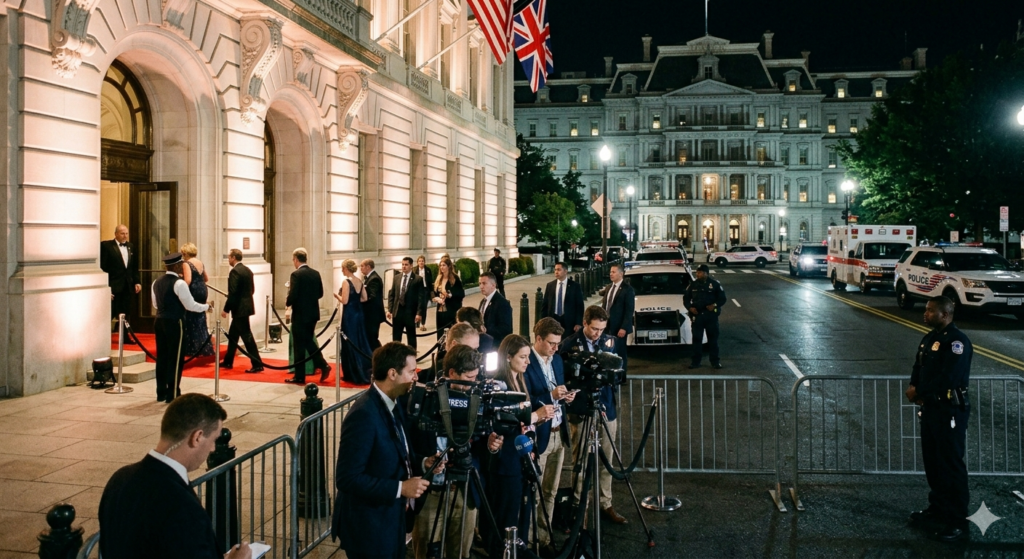
The annual White House Correspondents’ Dinner—typically a night of humor, media reflection, and political satire—took on a far more serious tone this year as a security scare and a separate shooting incident rattled Washington, D.C., casting a shadow over one of the capital’s most high-profile gatherings.
What is normally considered a celebration of journalism and free speech quickly turned into a moment of heightened concern, as authorities responded to a developing security incident near Washington political events that prompted increased vigilance among law enforcement and event organizers alike. While the dinner itself proceeded under tight security, the broader atmosphere in the city was marked by unease.
Officials confirmed that a shooting incident occurred elsewhere in the city around the same time, sparking fears and raising urgent questions about safety during large-scale public events. Although there was no direct connection established between the shooting and the dinner, the proximity in timing intensified the sense of uncertainty among attendees and residents.
The situation underscores growing concerns over public safety concerns during high-profile Washington events, particularly as political gatherings continue to draw large crowds and significant attention. Security agencies were already on high alert due to the presence of influential figures from media, government, and entertainment, but the unexpected developments further heightened precautions.
Inside the venue, the tone was noticeably more subdued than in previous years. Comedians and speakers, including late-night host Jimmy Kimmel, adjusted their remarks to acknowledge the tense environment. While humor remained a central element of the evening, there was a clear shift toward more reflective and measured commentary.
Kimmel, known for his sharp political satire, delivered a performance that balanced wit with sensitivity, avoiding overly provocative jokes in light of the day’s events. His approach reflected a broader understanding that the evening’s audience—and the nation watching—were grappling with a complex mix of emotions.
The White House Correspondents’ Dinner has long served as a platform where journalists and politicians momentarily set aside differences to engage in lighthearted exchange. However, this year’s event highlighted how external realities can intrude on even the most carefully planned traditions.
Beyond the immediate concerns, the incident has reignited debate over Washington DC shooting incident latest updates, with lawmakers and public officials calling for renewed focus on urban safety measures. The timing of the shooting, coinciding with a major national event, has amplified calls for stronger coordination between local law enforcement and federal agencies.
Authorities have not released detailed information about the suspect or motive, but investigations are ongoing. Officials emphasized that there is no ongoing threat related to the dinner itself, though they continue to monitor the situation closely.
Meanwhile, the broader political landscape added another layer of complexity to the evening. Discussions around media accountability, political polarization, and public trust were already expected to dominate conversations. The unexpected events only deepened those themes, turning what might have been a night of laughter into a moment of reflection.
The dinner also served as a reminder of the critical role journalism plays in documenting and contextualizing such events. Reporters present at the gathering found themselves covering not only the event itself but also the unfolding developments across the city, illustrating the unpredictable nature of news.
In recent years, the intersection of politics, media, and public safety has become increasingly pronounced. Events like this highlight the challenges of maintaining normalcy in an environment where unexpected incidents can quickly shift the national mood.
For many attendees, the evening became less about celebration and more about solidarity. Conversations often turned toward the importance of resilience and the need for continued vigilance in the face of uncertainty.
The incident also brought attention to impact of political events on public safety, a topic that has gained prominence amid rising concerns about security at large gatherings. Experts note that while such events are typically well-protected, they remain vulnerable to external disruptions that can have wide-ranging effects.
As the night concluded, there was a shared sense that this year’s Correspondents’ Dinner would be remembered not for its humor or headline-making jokes, but for the context in which it took place.
In the days ahead, authorities are expected to provide more clarity on the shooting and any potential connections or broader implications. For now, the focus remains on ensuring safety and understanding how such incidents can be prevented in the future.
Ultimately, the evening served as a powerful reminder that even in moments meant for celebration, the realities of the world can quickly reshape the narrative. The White House Correspondents’ Dinner, a symbol of democratic discourse and press freedom, became a reflection of a nation navigating both its traditions and its challenges.