Pennsylvania’s Shapiro Navigates Divided Government Ahead of 2028 Political Landscape
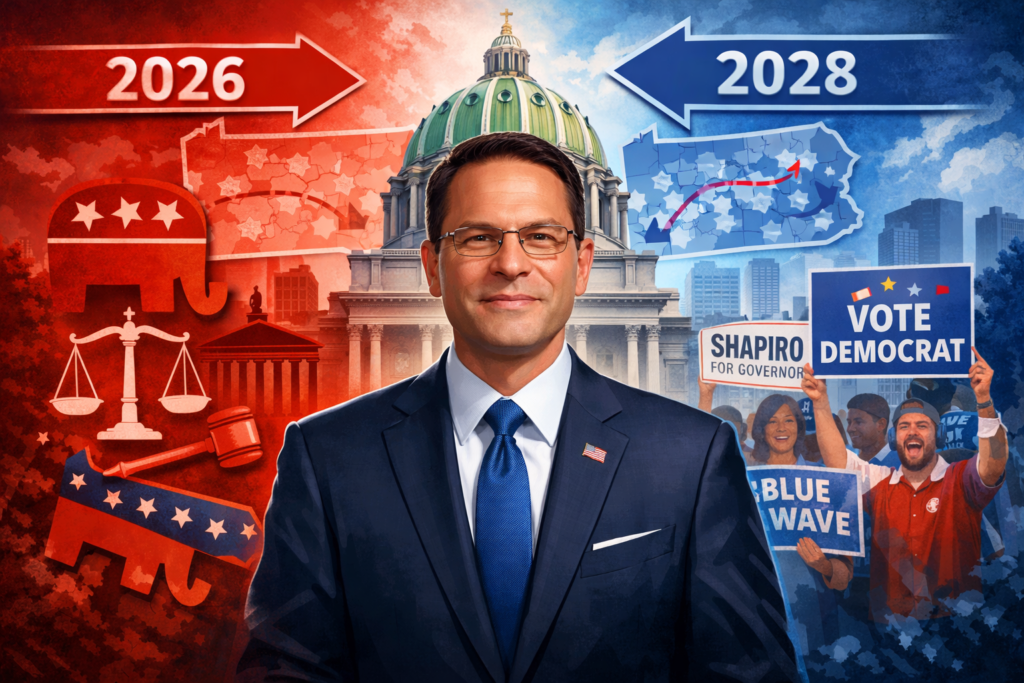
HARRISBURG, Pa. — Pennsylvania Governor Josh Shapiro is managing a politically divided state government as his administration prepares for major elections in 2026 and 2028, even as his own rising national profile draws attention from Democratic strategists and voters alike.
Shapiro, a Democrat elected governor in 2022, leads a commonwealth where power is split between parties, with Republicans controlling the governorship’s “row offices” and Shapiro working with a legislature that has often been evenly divided or narrowly split along partisan lines. In January 2025, all three statewide row officers — treasurer, auditor general and attorney general — were sworn in as Republicans, underscoring the tight political balance in Pennsylvania’s government.
That divided government has made Shapiro’s agenda a study in compromise and careful negotiation. Facing a Republican-controlled Senate and a razor-thin Democratic edge in the state House, Shapiro has had to craft bipartisan deals on key policy areas — from education investment and budget negotiations to public safety and infrastructure priorities — while avoiding prolonged stalemates.
This political landscape sets the stage for the 2026 Pennsylvania gubernatorial election, where Shapiro is eligible for reelection and expected to campaign to maintain Democratic leadership in the state — a crucial battleground that President Donald Trump won in 2024.
Meanwhile, Pennsylvania plays a central role in the broader 2028 national electoral map, with Democratic strategists arguing that winning the Keystone State will be essential for any presidential candidate aiming to unseat a sitting Republican president. Bloomberg Government analysts suggest that a future Democratic nominee will likely need strong support in Pennsylvania to carry the Electoral College.
Shapiro’s political profile has continued to rise, and some observers place him among a group of Democratic leaders with potential presidential ambitions for 2028. Yet his future ambitions remain closely tied to how well he manages state governance in a divided system where effective leadership requires both partisan vision and pragmatic compromise.
As Pennsylvania approaches pivotal election cycles in 2026 and 2028, its internal political dynamics — marked by split power, contested policy priorities and fierce voter engagement — will likely reverberate far beyond the commonwealth’s borders.