“God Wants You to Buy Bitcoin?” Inside the Rise of Crypto-Fueled Churches Blending Faith and Finance
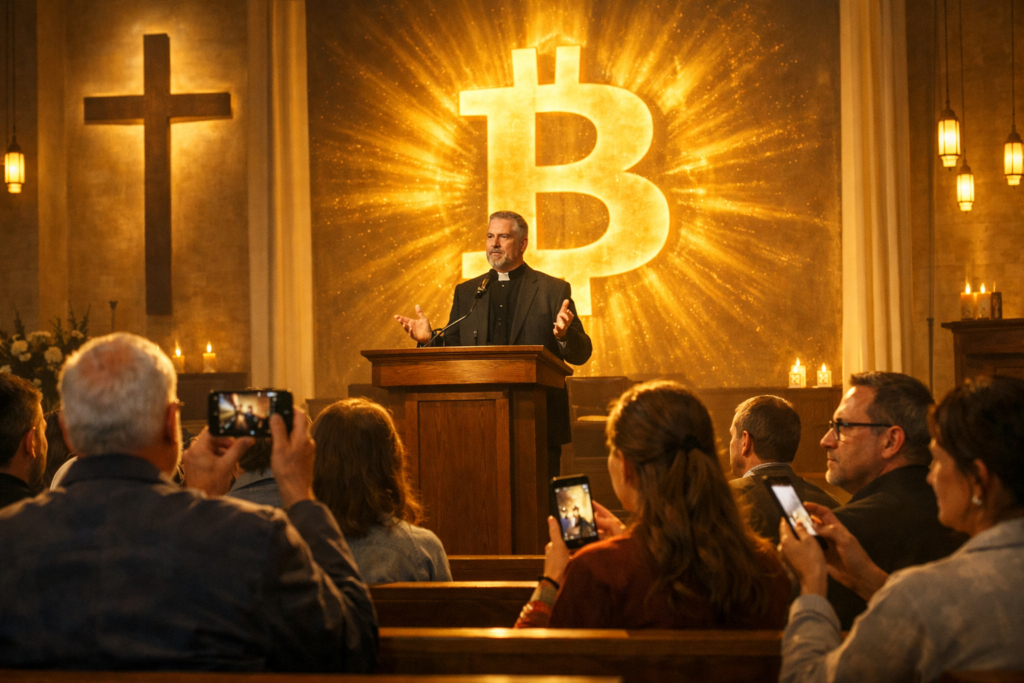
A new and controversial movement is emerging at the intersection of faith and finance, as a growing number of Christian groups across the United States begin promoting cryptocurrency—particularly Bitcoin—as part of their religious message.
What was once considered an unlikely pairing is now gaining traction, with some pastors and faith leaders encouraging congregants to view digital currency not just as an investment, but as a divinely inspired opportunity. The message, often delivered from pulpits or online sermons, frames cryptocurrency as a tool for financial empowerment and even spiritual stewardship.
At the heart of this trend is the idea that modern technology, including decentralized finance, can align with biblical principles of independence, prosperity, and preparation. In some churches, Bitcoin is being described as a safeguard against inflation and government control—an argument that resonates with believers concerned about economic uncertainty.
This movement reflects a broader shift captured by religious groups promoting cryptocurrency investment trends, where faith-based communities are increasingly engaging with emerging financial technologies. Supporters argue that embracing innovation is consistent with adapting religious teachings to contemporary realities.
However, critics warn that mixing financial speculation with spiritual guidance carries significant risks. Cryptocurrency markets are notoriously volatile, and presenting them within a religious framework may create a false sense of security among followers. Experts caution that faith should not be used to validate high-risk financial decisions.
Some congregations have gone beyond mere endorsement, integrating cryptocurrency into their operations. Donations in Bitcoin are becoming more common, and in certain cases, churches are organizing educational sessions to teach members how to buy, store, and trade digital assets.
The trend is also being fueled by charismatic leaders who see an opportunity to expand their influence. By positioning themselves at the forefront of both spiritual and financial conversations, these figures are attracting attention—and in some cases, controversy.
Observers say this development highlights Bitcoin adoption in American churches increasing rapidly, particularly among younger congregants who are already familiar with digital platforms. For many, cryptocurrency represents not just a financial tool but a symbol of independence and innovation.
Yet the blending of faith and finance is raising ethical questions. Should religious leaders be offering investment advice? And if so, what responsibility do they bear if those investments result in losses?
Financial advisors stress the importance of separating spiritual guidance from financial decision-making. They emphasize that while individuals are free to make their own choices, those choices should be based on sound research rather than religious persuasion.
The issue has also drawn attention from regulators and watchdog groups. As cryptocurrency continues to gain popularity, concerns about fraud, misinformation, and lack of oversight are becoming more pronounced. The involvement of religious institutions adds another layer of complexity.
This has led to growing discussions around crypto financial risks within religious communities, particularly in cases where followers may feel pressured to participate. Transparency and accountability are key concerns, as is the need for clear boundaries between faith and financial advice.
Despite the criticism, proponents remain optimistic. They argue that cryptocurrency aligns with values such as self-reliance and empowerment, which are central to many religious teachings. For them, embracing Bitcoin is not about abandoning tradition but about evolving with the times.
The movement is also benefiting from the broader cultural shift toward digital finance. As more Americans explore alternatives to traditional banking and investment systems, the appeal of cryptocurrency continues to grow. Within this context, the integration of faith-based messaging can amplify interest and adoption.
At the same time, skeptics warn of potential exploitation. They point to instances where charismatic leaders have used their influence to promote questionable financial schemes, raising concerns about the potential for abuse. This underscores the importance of critical thinking and informed decision-making.
The phenomenon is part of a larger trend captured by faith leaders endorsing cryptocurrency investment platforms, where technology and spirituality intersect in new and unexpected ways. Whether this represents a lasting shift or a passing phase remains to be seen.
For many congregants, the appeal lies in the promise of financial freedom and security. In an era marked by economic uncertainty, the idea of a decentralized system that operates outside traditional structures can be particularly attractive.
However, experts urge caution. They emphasize that while innovation can be beneficial, it must be approached with care and responsibility. Blind faith—whether in religion or finance—can lead to unintended consequences.
As this movement continues to grow, it is likely to spark further debate about the role of religion in modern society. It also raises important questions about how emerging technologies are reshaping not just economies, but belief systems as well.
For now, the fusion of faith and cryptocurrency remains a fascinating—and controversial—development, one that reflects the complexities of a rapidly changing world.