Court Delivers Verdict in Moscow Concert Hall Terror Case as ISIS-K Attackers Convicted Over Deadly Crocus City Massacre
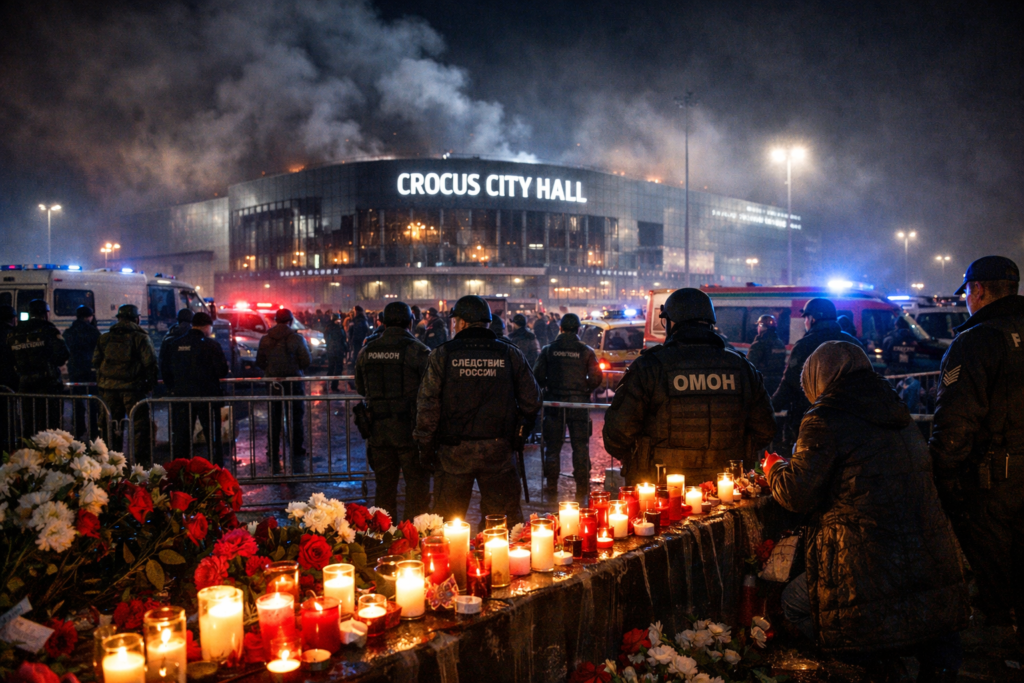
MOSCOW — A Russian court has delivered a major ruling in one of the most shocking terrorist attacks in recent Russian history, convicting several men accused of carrying out the brutal assault at a packed concert venue outside Moscow earlier this year.
The deadly attack at Crocus City Hall left more than a hundred people dead and many others injured, sending shockwaves across Russia and drawing international condemnation. Authorities say the massacre was carried out by militants linked to Islamic State – Khorasan Province, commonly known as ISIS-K.
The court ruling marks a critical moment in the ongoing investigation into the “ISIS-K Moscow concert hall attack investigation”, a case that has drawn global attention due to the scale of violence and the international security concerns surrounding the extremist group.
A Night of Horror at a Popular Concert Venue
The attack unfolded when gunmen stormed the large concert complex on the outskirts of Moscow, opening fire on crowds attending a performance. Witnesses described scenes of chaos and panic as concertgoers scrambled for exits while attackers fired indiscriminately and set parts of the building ablaze.
Within minutes, the venue was engulfed in smoke and flames as terrified spectators tried to escape the sprawling complex. Emergency responders rushed to the scene while Russian security forces launched an immediate manhunt for the perpetrators.
The violence quickly became known as the “Russia Moscow Crocus City Hall massacre”, one of the deadliest attacks in Russia in decades.
Authorities later confirmed that more than 140 people were killed and hundreds were injured. Many victims died from gunshot wounds, while others were trapped in the burning structure as the fire spread through the concert hall.
Arrests and the Expanding Terror Investigation
In the days following the attack, Russian law enforcement agencies conducted a sweeping crackdown across multiple regions. Several suspects were arrested after authorities said they attempted to flee the country.
Officials said the individuals arrested were believed to be directly involved in planning and carrying out the assault.
During the investigation, prosecutors argued that the attackers had coordinated their actions in advance, carefully targeting a crowded entertainment venue where large numbers of civilians would be gathered.
Security experts say the case highlights the ongoing threat posed by extremist groups operating beyond the Middle East.
ISIS-K, a regional affiliate of the broader Islamic State network, has been linked to multiple attacks across Central Asia and Afghanistan in recent years. Intelligence agencies around the world have warned that the group continues to seek high-profile targets outside its primary areas of operation.
The Crocus City attack has now become a key example frequently referenced in discussions about the “global security concerns over ISIS-K terrorism”.
Court Proceedings and Convictions
The trial proceedings revealed disturbing details about the planning and execution of the attack.
Prosecutors presented evidence including surveillance footage, witness testimony, and digital communications allegedly connecting the suspects to extremist networks.
During court hearings, officials described how the attackers allegedly received instructions and ideological guidance from individuals associated with ISIS-K.
The defendants faced multiple charges related to terrorism, murder, and participation in an organized extremist network.
After reviewing the evidence, the court ultimately convicted the men accused of carrying out the assault.
The verdict is being seen by Russian authorities as a step toward justice for the victims and their families.
However, investigators say the broader probe is far from over.
Officials continue to examine whether additional individuals helped plan, finance, or facilitate the attack. Authorities have suggested that international networks may have played a role in enabling the perpetrators.
Global Reaction and Security Concerns
The massacre triggered strong reactions from governments around the world.
Leaders from numerous countries condemned the violence and expressed solidarity with the victims. Counterterrorism officials also emphasized the need for increased vigilance against extremist threats.
Analysts say the tragedy underscores the persistent danger posed by ISIS-K, which has attempted to expand its influence beyond its traditional base in Afghanistan.
The Crocus City Hall attack also renewed discussions about the “international counterterrorism response to ISIS-K”, particularly as intelligence agencies track the group’s evolving tactics.
Impact on Russia and Public Safety Measures
Inside Russia, the attack has prompted heightened security measures at public venues.
Authorities have increased police presence at concerts, sporting events, and major transportation hubs. Event organizers across the country have also implemented stricter entry procedures and enhanced surveillance systems.
Security officials say these measures are intended to prevent future attacks and reassure the public following the devastating incident.
For families of the victims, however, the trauma remains deeply personal.
Many lost loved ones in what should have been an evening of music and celebration. Memorials and tributes continue to appear outside the concert complex, where mourners gather to remember those who died.
A Case That Continues to Shape Global Security Debate
The Crocus City Hall massacre has become a defining moment in the ongoing fight against international terrorism.
Experts say extremist groups increasingly aim to stage attacks that generate global headlines and widespread fear. By targeting civilian gatherings, attackers attempt to maximize both casualties and psychological impact.
This strategy has made high-profile venues particularly vulnerable.
As investigators continue their work and security agencies analyze the attack’s broader implications, the case remains a stark reminder of the persistent threat posed by extremist networks.
For now, the court’s verdict represents a significant milestone in the pursuit of accountability.
But for many observers, the larger question remains how governments around the world will respond to the evolving threat of global terrorism in the years ahead.