Federal Judge in Oregon Restricts Tear Gas Use Against ICE Protesters, Citing Free Speech Concerns
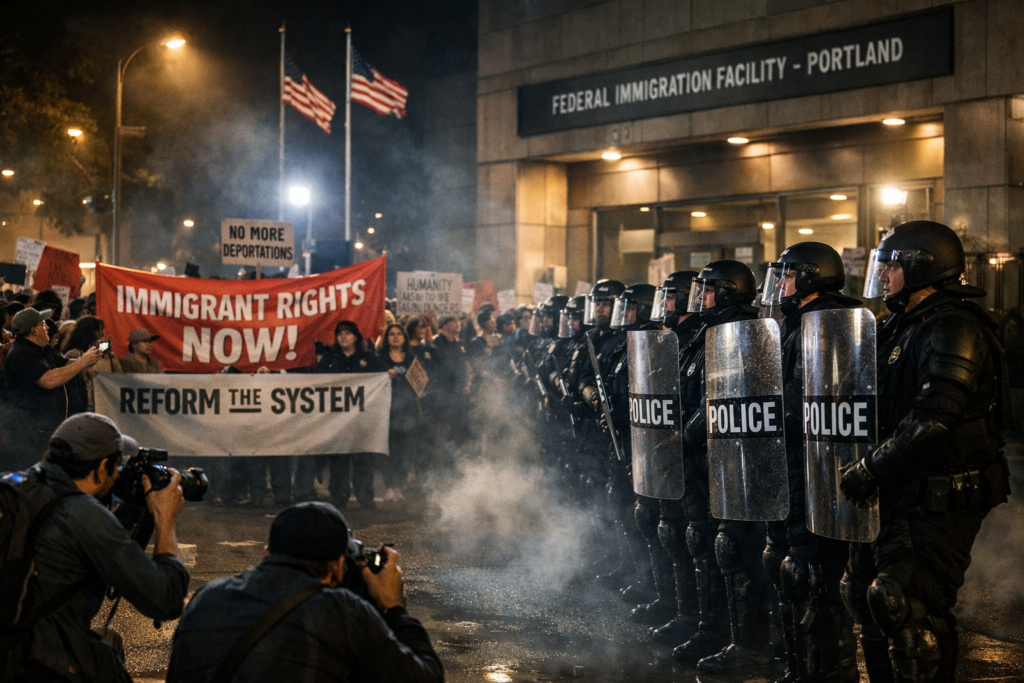
A federal judge in Portland has imposed new restrictions on how federal law enforcement officers can respond to protesters outside a major immigration enforcement facility, marking a significant moment in the ongoing national debate over protest rights and government authority.
The ruling, issued by Michael H. Simon, places clear limits on the use of tear gas and other crowd-control weapons by federal agents stationed outside a building operated by U.S. Immigration and Customs Enforcement. The decision comes after months of tense demonstrations surrounding immigration policies and enforcement actions across the United States.
The order follows a lawsuit brought by protesters and journalists who argued that federal officers used excessive force while they were exercising their constitutional right to peacefully assemble.
A Court Ruling Centered on Constitutional Rights
In his decision, Judge Simon emphasized that the protections guaranteed by the First Amendment—including freedom of speech and peaceful protest—must remain protected even during moments of political tension.
The court determined that chemical agents such as tear gas and pepper spray cannot be used against demonstrators unless individuals present an imminent threat of physical harm to law enforcement officers or others nearby.
The ruling also restricts the use of projectile munitions, including pepper balls and similar crowd-control tools. Officers are specifically prohibited from aiming such weapons at sensitive areas of a person’s body, such as the head, neck, or torso, unless circumstances legally justify deadly force.
These restrictions will remain in place while the legal case moves forward through the federal court system.
Allegations of Excessive Force
The lawsuit was filed by civil rights advocates including American Civil Liberties Union, representing protesters and journalists who claim they were exposed to chemical irritants and other crowd-control weapons despite not posing a threat.
According to testimony presented in court, demonstrators described incidents in which tear gas and pepper spray were deployed into crowds that included elderly individuals, journalists, and people simply standing near the protest site.
Some participants reported injuries from projectile munitions fired during the demonstrations.
The plaintiffs argued that these tactics discouraged people from exercising their constitutional right to protest and created a climate of fear around political expression.
The court reviewed videos, witness testimony, and evidence showing how federal officers responded during several protest events.
Judge Simon ultimately concluded that there was a significant risk that similar incidents could continue without judicial intervention.
What the New Restrictions Mean
Under the court’s order, federal officers can still act to protect themselves and the public if a real threat emerges. However, they must meet strict legal standards before deploying chemical agents or projectile weapons.
The ruling states that crowd-control weapons cannot be used simply because protesters refuse to disperse or step off federal property.
Instead, officers must demonstrate that someone poses a clear and immediate threat of violence before using such measures.
The decision also prohibits indiscriminate deployment of pepper spray or chemical irritants that could affect bystanders who are not involved in violent activity.
Legal experts say the ruling reflects growing scrutiny over how federal law enforcement handles protest situations.
Across the United States, courts have increasingly been asked to weigh the balance between maintaining public safety and protecting constitutional rights.
Tensions Surrounding Immigration Protests
The demonstrations outside the Portland immigration facility have been part of a broader wave of protests linked to immigration enforcement policies and federal actions.
Activists have gathered outside the building repeatedly, demanding changes to detention policies and calling for greater transparency around immigration enforcement.
Supporters of the protests argue that peaceful demonstrations are essential for democratic accountability.
Meanwhile, federal officials have defended the actions of officers at the facility, saying that agents must maintain security and protect government property from potential threats.
In court filings, government attorneys argued that officers need flexibility to respond quickly when protests escalate or when individuals attempt to breach restricted areas.
National Debate Over Law Enforcement Tactics
The legal battle unfolding in Oregon reflects a broader national conversation about law enforcement tactics used during protests.
In recent years, incidents involving tear gas, rubber bullets, and other so-called “less-lethal” weapons have sparked controversy in multiple American cities.
Civil liberties groups argue that such tactics can easily be misused against peaceful protesters.
Law enforcement agencies, however, maintain that these tools are necessary for maintaining order and preventing violence during large demonstrations.
Judge Simon’s ruling attempts to strike a balance between those competing concerns.
By allowing force only when there is an imminent threat of harm, the court aims to ensure that peaceful protest activity is not suppressed while still allowing officers to act when necessary.
Impact on Future Demonstrations
Legal analysts say the decision could influence how similar cases are handled in other parts of the country.
Because the ruling specifically addresses the use of chemical agents and projectile munitions against demonstrators, it could serve as a framework for future court challenges involving protest policing.
For activists in Portland, the order is being viewed as an important step toward protecting protest rights.
Civil liberties advocates say the decision sends a message that the Constitution still provides strong protections for peaceful political expression.
For now, the restrictions will remain in effect as the lawsuit continues to move through the courts.
And as debates about immigration policy and protest rights continue across the United States, the ruling highlights the ongoing tension between security enforcement and the fundamental freedoms that define American democracy.