New Poll Shows Americans Split on Trump’s Agenda as Immigration Gains Support but Tariffs and Economy Face Growing Skepticism
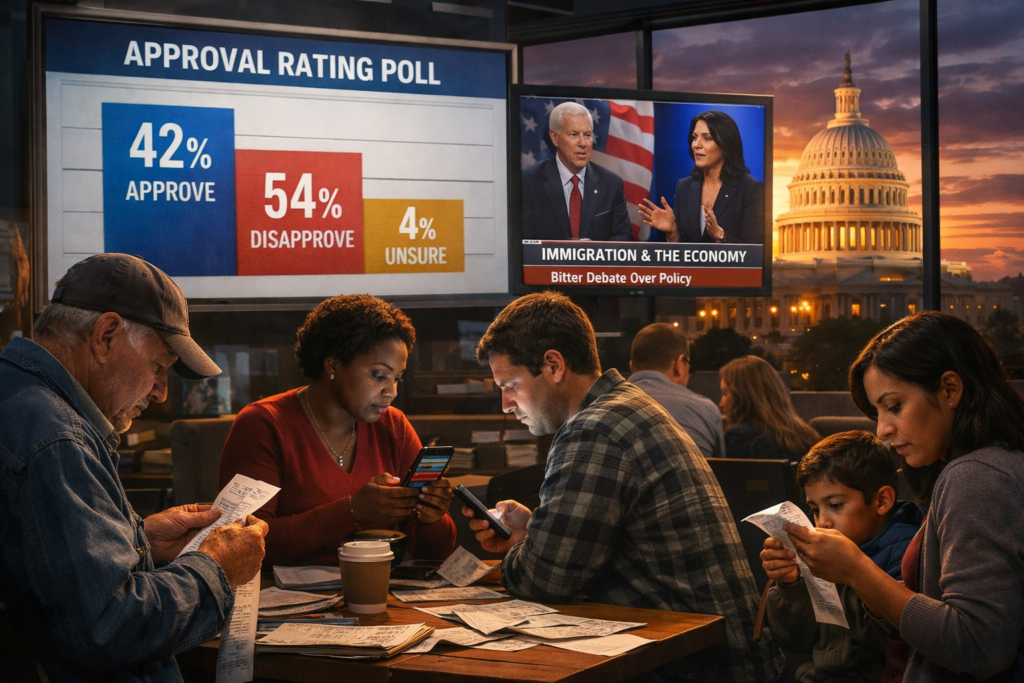
A fresh national snapshot of American public opinion reveals a complicated political reality: voters remain deeply divided over President Donald Trump’s policies as the country moves closer to the next election cycle.
While immigration enforcement continues to earn relatively strong support among many voters, Americans are increasingly skeptical about the president’s handling of the economy, tariffs, and the rising cost of living. The findings highlight a political landscape shaped by competing priorities—security at the border on one side and economic pressure at home on the other.
For the Trump administration, the message from voters is clear: immigration policies still resonate with many Americans, but economic concerns are beginning to overshadow other issues.
Immigration Remains Trump’s Strongest Political Advantage
Among the major policy areas examined in recent public opinion surveys, immigration continues to be one of Trump’s most favorable topics among voters.
Many Americans say they support stronger border security measures and tougher immigration enforcement. That support appears particularly strong among Republican voters and some independents who believe stricter policies are necessary to address illegal crossings and security concerns.
Border security, in particular, consistently ranks as the issue where Trump receives his highest approval ratings. For supporters, the administration’s aggressive stance signals a commitment to restoring control at the U.S.–Mexico border and enforcing existing immigration laws.
Political analysts say this reflects a continuation of the messaging that helped fuel Trump’s political rise in the first place.
Immigration was one of the defining themes of his campaigns, and for many voters who prioritize border security, the president’s policies still align with their expectations.
However, even on immigration, opinions are far from unanimous.
Critics argue that the administration’s enforcement tactics can sometimes be too aggressive and raise humanitarian concerns. The issue remains emotionally charged, with both sides framing the debate as a question of national priorities and moral responsibility.
Economic Anxiety Dominates Voters’ Concerns
Despite Trump’s relative strength on immigration, the economy is increasingly becoming a source of frustration for many Americans.
Across multiple surveys, voters consistently rank inflation, household expenses, and the overall cost of living as their top concerns.
For families across the country, the rising price of groceries, housing, and everyday necessities has become a defining economic challenge. Many households say their income is struggling to keep pace with inflation.
A large share of voters report that their earnings are falling behind the cost of living, creating financial stress even among middle-income families.
For some Americans, the economic strain has become personal.
Workers say they are cutting back on spending, delaying large purchases, or dipping into savings simply to keep up with everyday costs. These pressures are shaping political opinions and influencing how voters evaluate the administration’s performance.
Polls show that approval ratings for Trump’s handling of the economy are significantly lower than for immigration policy.
Economic confidence has also been affected by uncertainty surrounding trade policies and tariffs.
Tariffs and Trade Policies Spark Debate
Another area drawing criticism from voters is the administration’s use of tariffs as a key economic strategy.
Trump has long argued that tariffs on foreign goods are necessary to protect American industries and correct unfair trade practices. Supporters of the policy say it helps strengthen domestic manufacturing and reduce dependence on foreign supply chains.
But critics warn that tariffs can also increase prices for American consumers.
Many economists say tariffs often lead to higher costs on imported goods, which businesses may pass along to shoppers. That means everyday items—from electronics to clothing to household goods—can become more expensive.
Public opinion appears to reflect those concerns.
A majority of Americans believe tariffs are hurting the economy or contributing to higher prices. These concerns are particularly strong among independent voters and Democrats, though even some Republicans express reservations about the long-term economic impact.
Trade tensions with major global partners have also fueled uncertainty in financial markets, adding another layer of complexity to the debate.
For the White House, defending the strategy has become a balancing act between appealing to economic nationalism and addressing voters’ immediate financial concerns.
Overall Approval Reflects a Divided Nation
Taken together, the polling data paints a picture of a country still sharply divided over Trump’s leadership.
Overall job approval ratings remain mixed, with roughly four in ten Americans expressing support for the president’s performance. While this level of support remains strong among Republicans, opposition among Democrats is overwhelming, and independents tend to lean negative.
That partisan divide underscores the broader political environment heading into future elections.
Republicans often argue that the administration’s immigration policies and border security efforts demonstrate strong leadership.
Democrats, meanwhile, continue to criticize the president’s economic strategy and trade policies, arguing they have contributed to higher prices and economic instability.
For independent voters, the calculus is often more complicated.
Many say they agree with certain policies—particularly border enforcement—while remaining critical of others, especially economic decisions that affect daily life.
What It Means for the Political Road Ahead
As the political calendar moves forward, these voter attitudes could play a significant role in shaping upcoming elections.
Economic performance has historically been one of the most powerful factors influencing voter behavior. If inflation and cost-of-living concerns remain high, they could dominate the national political conversation.
At the same time, immigration and border security are unlikely to fade as major issues.
Political strategists from both parties are closely watching how these topics resonate with voters across key battleground states.
Ultimately, the polling data suggests that Americans are evaluating their leaders through two competing lenses: security and economic stability.
For the Trump administration, maintaining support on immigration while improving confidence in the economy may prove to be one of the biggest political challenges in the months ahead.
As voters weigh these issues, the direction of the country’s political future may hinge on a single question many Americans are already asking themselves: which policies truly make their lives better.