World’s Oldest Cave Art Found in Indonesia: 67,800-Year-Old Hand Stencil Discovery
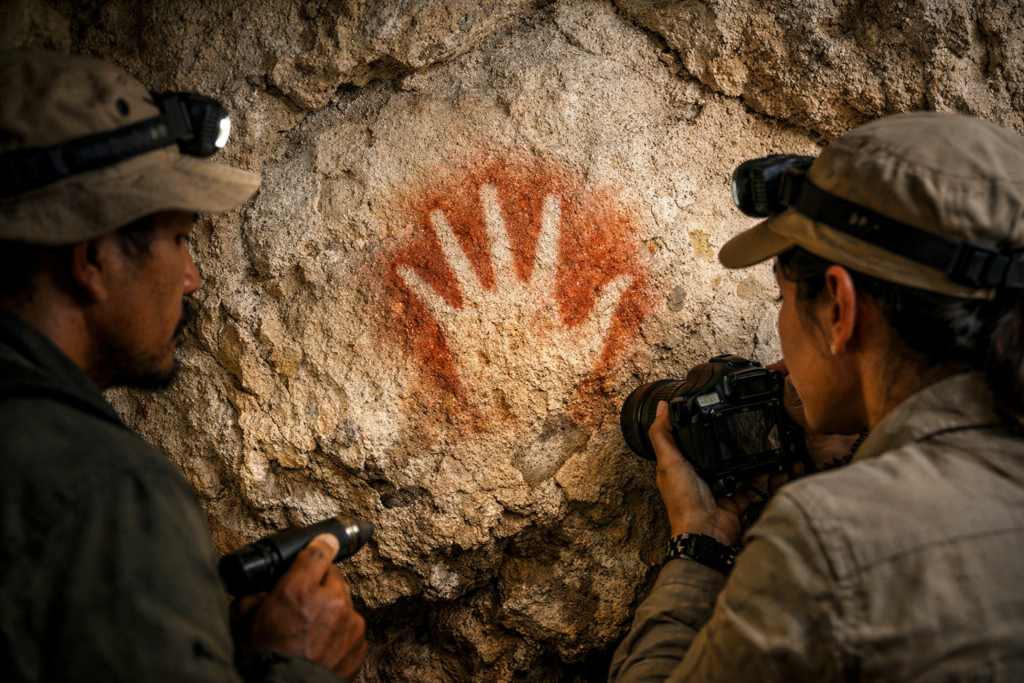
In a discovery that is reshaping our understanding of early human creativity and migration, archaeologists have identified what may be the world’s oldest known rock art — a stenciled handprint found deep inside a cave on the Indonesian island of Muna that dates back at least 67,800 years. These faint outlines, created by blowing pigment over human hands pressed against limestone walls, predate all previously confirmed cave art and challenge long-held theories about early symbolic behavior and artistic expression among ancient human populations.
The stunning find is published in the journal Nature by a team of Indonesian and Australian researchers who say the art was made long before similar cave paintings in Europe and may shine new light on how early humans moved through Southeast Asia on their way toward Australia and beyond.
A Handprint That Defies Time
The faded reddish hand stencil was discovered on the limestone walls of Liang Metanduno Cave, located on Muna Island, off the southeastern tip of the Indonesian island of Sulawesi. The art was not easy to spot at first — it lies beneath layers of newer paintings — but careful tracing revealed several outlines of hands, one notably featuring elongated, slender fingers that may have been intentionally shaped to resemble animal claws or symbolic forms.
Using a high-precision scientific method called U-series dating, researchers analyzed tiny amounts of the element uranium in mineral deposits that formed on top of the pigment. Because these calcite layers accumulated only after the art was created, analyzing their uranium decay provided a clear minimum age for the painting — at least 67,800 years old.
This puts the Indonesian stencil significantly older than the famous Spanish hand stencils, previously attributed to Neanderthals and dated to around 64,000 years ago, and even older than other ancient Sulawesi cave paintings that have been dated to roughly 51,200 years old.
Early Artistic Intelligence
While a simple handprint might seem symbolic only in a rudimentary way, the sophistication lies in how it was made. Early humans or related hominin species placed their hands on the cave wall and then applied pigment — likely by blowing a mixture of ground red ochre and water or another medium — around their fingers, leaving behind a negative imprint. In the Muna stencil, the elongated fingertips reflect artistic choices that go beyond mere representation.
“It shows not only craftsmanship but also abstract thinking,” said one of the co-authors of the study. While the precise cultural meaning of the elongated or claw-like finger shapes remains uncertain, it hints at symbolic or ritual significance that ancient artists imbued into their work.
Such evidence pushes back the timeline for symbolic expression among early humans — possibly including early Homo sapiens groups migrating through Southeast Asia — and presents a compelling case that artistic behavior was well developed in northern and island Asia long before previously thought.
Implications for Early Human Migration
The location and age of the Indonesian rock art offer tantalizing clues about how early human populations may have travelled and interacted more than 65,000 years ago. As sea levels were lower during the last Ice Age, islands in Southeast Asia, including Muna and Sulawesi, were connected through land bridges that formed parts of the ancient super-landmass called Sundaland.
This geographical context supports the so-called “long chronology” model of human migration — in which modern humans or their close relatives moved through Southeast Asia much earlier than previously documented, and possibly continued on to become some of the first inhabitants of Australia and New Guinea roughly 60,000–65,000 years ago.
Anthropologists have long debated exactly when and how early humans reached Sahul — the prehistoric combined landmass of Australia, New Guinea, and Tasmania — and the Indonesian hand stencil adds important archaeological weight to the idea that these migrations began earlier than many scientists once believed.
A Region Rich in Ancient Art
Sulawesi and its surrounding islands have produced multiple examples of prehistoric art over the past decades. In 2024, researchers announced cave paintings in the same region depicting human-like figures and animals that were dated to at least 51,200 years ago — already among the oldest figurative art known anywhere.
The new Muna discovery extends this record by more than 15,000 years and suggests a much older and broader artistic tradition in Indonesia and Southeast Asia than previously documented. More recent hand stencils dated to between roughly 44,500 and 20,400 years ago were also found nearby, indicating continued cultural continuity in artistic expression over tens of thousands of years.
Who Made This Art?
One of the lingering questions is who exactly created these early hand stencils. While many archaeologists consider Homo sapiens — our own species — to be the most likely candidate, the possibility of other ancient hominins’ involvement, such as Denisovans, cannot be fully ruled out due to the fragmentary nature of physical fossils from this period in the region.
The presence of art itself is a strong indication of cognitive complexity, regardless of species, and suggests that whoever made the art possessed symbolic thinking and cultural behavior far earlier than previously documented in this part of the world.
A Record That Shapes Our Story
The Indonesian hand stencil discovery is not just a remarkable archaeological find — it is a historical milestone. At a minimum of 67,800 years old, it is the oldest rock art yet discovered anywhere on Earth, eclipsing prior records by thousands of years and inviting us to rethink how our ancestors lived, expressed themselves, and spread across the globe.
As scientists continue excavating and dating other early sites in Indonesia and beyond, this ancient handprint may serve as a key piece in the puzzle of human prehistory — and a powerful reminder that art, creativity, and symbolic thought have deep roots in the human story.