WHO Says Low Risk of Nipah Virus Spreading Beyond India — What Americans Should Know
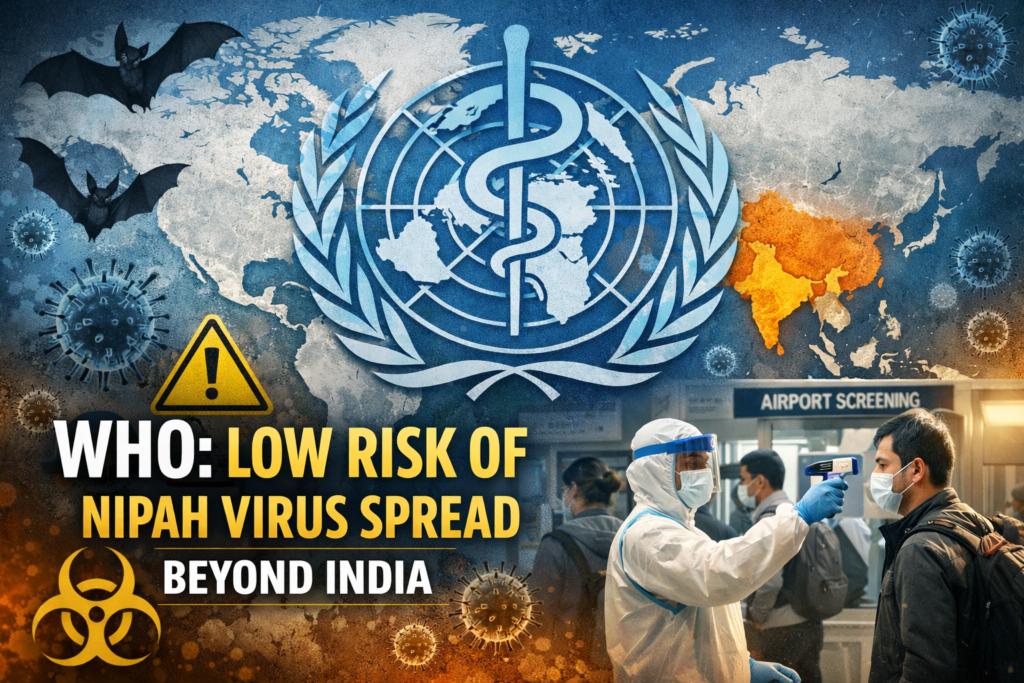
The World Health Organization (WHO) has issued a measured but reassuring update on the Nipah virus outbreak reported in India, stating that the risk of the virus spreading outside the country remains low — a critical assessment with implications for public health officials, travelers, and global disease monitoring systems.
This development comes as health authorities in West Bengal, India, confirm a small cluster of cases and intensify containment efforts, while nearby countries like Thailand, Singapore, Malaysia, Vietnam, and Hong Kong increase screening at airports as a precautionary measure.
While the Nipah virus is known for causing severe illness and has a high fatality rate in some outbreaks, international health experts say there is no evidence of ongoing human-to-human transmission at this time — and international travel and trade should not be restricted. Here’s what this means for both global health and the American public.
Understanding the Latest WHO Assessment
In a statement released Friday, the WHO said that the likelihood of Nipah spreading beyond India’s borders is low, based on current data showing only a limited number of confirmed infections and successful contact tracing.
Importantly, global health authorities noted that of nearly 200 people who had contact with the confirmed patients, none have developed symptoms or tested positive — a strong indicator that community transmission is not occurring at this stage.
Dr. Anais Legand, a WHO spokesperson, emphasized that India has the public health infrastructure and response capacity to handle such outbreaks, a key reason the risk assessment remains low.
Despite the reassurance, the WHO did not entirely rule out the possibility of further exposure, particularly given that Nipah virus naturally circulates in wildlife, especially fruit bat populations found in parts of India and neighboring Bangladesh.
What Is the Nipah Virus?
The Nipah virus (NiV) is a zoonotic pathogen — meaning it can jump from animals to humans — first identified during an outbreak in Malaysia and Singapore in 1999.
The virus is carried primarily by fruit bats (Pteropus species) and can spread through direct contact with contaminated fruits, unpasteurized palm sap, or infected animals, including pigs.
Symptoms in infected people typically begin with fever, headache, and body aches, and can rapidly progress to encephalitis — an inflammation of the brain — and severe neurological complications.
Nipah has no approved vaccine or specific antiviral treatment, which is why even isolated outbreaks are taken seriously by health authorities. The fatality rate can range from 40 percent to 75 percent, depending on the outbreak and clinical care available.
Recent Cases in India Spark Global Attention
The current incident was first identified in late December 2025, when two health workers — a male and a female nurse in their mid-20s — tested positive for Nipah virus after developing rapid neurological symptoms at a private hospital in Barasat, in the North 24 Parganas district of West Bengal.
Both patients were isolated and received treatment in specialized care units. Contact tracing led to nearly 200 identified contacts, none of whom have shown signs of infection.
India has dealt with sporadic Nipah outbreaks before, with states like Kerala experiencing several clusters in recent years. These past responses have helped strengthen surveillance and containment protocols.
Global Response and Travel Advisory
While the WHO does not recommend travel bans or trade restrictions at this time, some regional governments have reinstated enhanced airport screening protocols for travelers arriving from or departing to India to guard against importation.
Countries such as Malaysia, Thailand, Vietnam, and Hong Kong have implemented temperature checks and health questionnaires at key international gateways — a precautionary strategy reminiscent of pandemic-era safety practices.
Public health experts caution that these measures are preventive, not evidence of a spreading outbreak, and do not indicate that Nipah is an imminent threat to global communities.
For Americans planning travel abroad, the U.S. Centers for Disease Control and Prevention (CDC) continues to monitor the situation, offering guidance on precautions without issuing broad travel restrictions. This aligns with the WHO’s approach of vigilance paired with measured risk assessment.
Why This Matters: Global Health Security and Prior Preparedness
Although the current risk of international spread remains low, the Nipah virus underscores ongoing challenges in global health security — especially with pathogens that lack vaccines or approved treatments.
Experts say that rapid detection, contact tracing, and effective isolation are critical tools in containing Nipah outbreaks, and countries with strong health systems — like India — are better positioned to manage localized clusters.
Virologists also note that Nipah is classified as a priority pathogen by the WHO, meaning it requires continued research due to its high fatality rate and potential for mutation — even if it does not spread easily among humans.
This classification has spurred ongoing vaccine research and global collaboration under international health regulations to prepare for future outbreaks.
Bottom Line for Americans
Here’s what U.S. residents should know right now:
- The World Health Organization says the risk of Nipah virus spreading outside India is low.
- There is currently no evidence of increased human-to-human transmission.
- Travel and trade restrictions are not recommended by WHO.
- Regional health screenings are precautionary and not a sign of pandemic risk.
- Serious symptoms require immediate medical attention, especially after travel to affected regions.
Health officials emphasize that preparedness and clear communication are essential to ensuring outbreaks remain contained and that public concern does not outpace real risk assessments.