Vivek Ramaswamy Returns to Real World in Ohio Governor Campaign
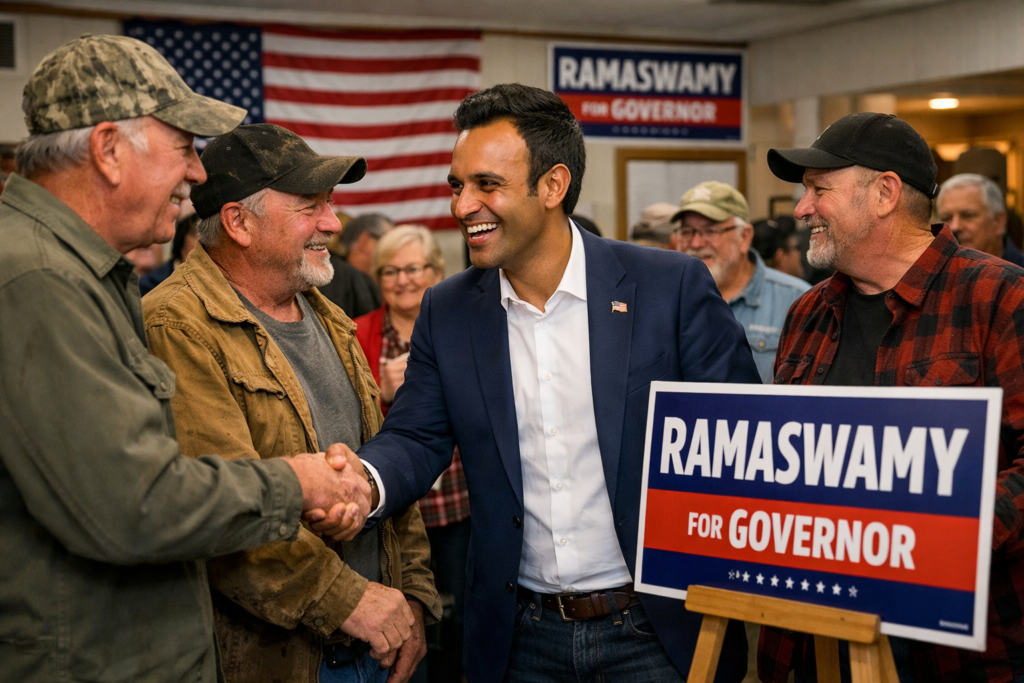
CLEVELAND, OHIO — Once known as a brash outsider charging through the Republican presidential primaries with a mix of provocation and social media spectacle, Vivek Ramaswamy has turned a new page in his political career — one that he insists is rooted in the “real world” concerns of everyday Ohioans. The biotech entrepreneur’s campaign for Ohio governor has increasingly emphasized ground-level interaction with voters, listening tours and personal engagement, rather than the pageantry and online theatrics that marked his rise to national prominence.
Ramaswamy — a Cincinnati native who built a multi-hundred-million-dollar fortune in biotechnology before pivoting to politics — filed to run for governor in early 2025 and officially announced his candidacy in February of that year. Since then, his campaign has been bolstered by major endorsements, including from former President Donald Trump and the Ohio Republican Party’s central committee, which endorsed Ramaswamy unusually early, well before the 2026 primary season.
But beyond endorsements and billboards, Ramaswamy says the most important phase of his campaign is happening face-to-face — and it’s reshaping both his message and his political identity.
Trading Tweets for Town Halls
In a recent interview with NBC News, Ramaswamy explained that his approach to the Ohio campaign is intentionally different from his national presidential bid in 2024. After a high-velocity run for the GOP nomination — driven by viral moments, televised debates and social-media buzz — he says the slower, more personal rhythm of state politics has “returned [him] to the real world.”
“I ran for president in an environment that was relentless, nonstop momentum, and that has its place — but it’s not the life that voters themselves experience,” Ramaswamy told NBC. “Here in Ohio, I meet people at diners, union halls, construction sites and small business gatherings. There’s no substitute for actual real-world interaction.”
Part of that strategy includes deleting social media apps from his personal phone — a move Ramaswamy says is designed to separate himself from the online polarization that dominates national politics and to give him more time to connect with voters directly. He still allows his campaign team to post on X (formerly Twitter) and Instagram, but he believes in-person conversations offer a clearer picture of what Ohioans truly care about.
Building a Grassroots Presence
In late 2025 and early 2026, Ramaswamy made his way to all 88 counties in Ohio, a campaign tactic that mirrors the boots-on-the-ground strategy of retail politics long used by presidential contenders. The candidate has laid out policy proposals and vision statements in community centers, union halls, barbershops and small-town pancake breakfasts — settings that contrast sharply with the big-ticket rallies and national media appearances of his Trump-endorsed presidential bid.
At one such event in a Cleveland suburb, where about 60 blue-collar workers gathered to hear him speak, Ramaswamy described his pivot as an effort to “get out of the echo chambers of the internet” and truly understand what families and workers are experiencing. “There’s no substitute for real world interaction,” he said — a phrase he reportedly repeated multiple times during the NBC News interview.
It’s a subtle but meaningful shift in tone: rather than relying on viral social media soundbites or bold national policy declarations, Ramaswamy’s message is increasingly framed around pragmatism, local issues and a common-sense approach to governance. His campaign focuses on lowering property taxes, phasing out the state income tax, improving Ohio’s business climate and raising educational standards — policies geared toward voters’ day-to-day priorities.
Campaign Dynamics and Challenges
Despite his efforts to engage voters on the grassroots level, the Ohio governor’s race remains competitive. Recent polling has shown Democratic candidate Dr. Amy Acton, former Ohio Director of Health, gaining ground and polling closely with Ramaswamy in some surveys, suggesting a tightening contest.
Political analysts point out that Ramaswamy’s transition from national celebrity candidate to state executive hopeful involves balancing high-profile endorsements with the reality that Ohio voters want leaders who can address schools, jobs, infrastructure and community health — issues with tangible impacts on everyday life.
Ohio Governor Mike DeWine, a fellow Republican whose term is ending due to term limits, also weighed in by offering his eventual endorsement of Ramaswamy after extensive discussions with him about policy and vision. That endorsement — coupled with the early backing from the state GOP and national conservative figures — has strengthened Ramaswamy’s campaign even as he refocuses his engagement locally.
From Outsider to Statesman?
Political strategists say Ramaswamy’s evolving campaign style reflects a broader tension in modern American politics: the need for charismatic messaging that grabs headlines, versus the long, steady work of earning voter trust through personal contact and substantive dialogue. In a swing state like Ohio — one viewed as pivotal not just for gubernatorial control but for national politics — candidates can’t ignore either side of that equation.
Ramaswamy seems to recognize as much. By stepping away from constant online engagement and investing his time in in-person town halls and county tours, he’s attempting to craft an image of a leader who listens and adapts — qualities often cited as essential for state governance.
Whether this “real world” approach will pay political dividends in November 2026 remains to be seen. But for now, the Ohio governor’s race is shaping up as one of the most watched and potentially competitive contests in the country’s midterm election cycle.