Violent Clashes Rock Aleppo as Syrian Government Forces and Kurdish Fighters Trade Blows in Northern City
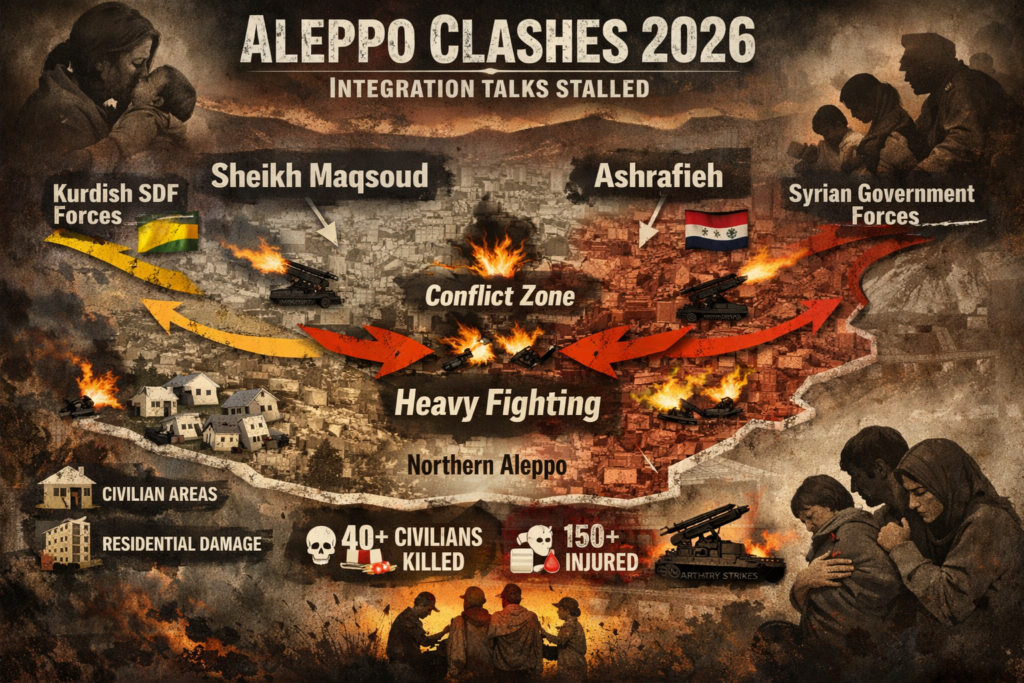
ALEPPO, SYRIA — Renewed fighting between Syrian government troops and Kurdish fighters has erupted in the northern city of Aleppo, leaving scores of civilians dead or wounded and highlighting the fragile state of peace efforts in a war-torn nation struggling to move beyond years of conflict. The latest clashes come amid stalled negotiations for integrating Kurdish forces into Syria’s national army and ongoing disputes over territorial control.
On Jan. 6, 2026, an escalation in Aleppo’s contested Kurdish-majority neighborhoods — particularly Sheikh Maqsoud and Ashrafieh — saw intense exchanges of artillery, shelling and drone strikes between the Syrian government forces and the Kurdish-led Syrian Democratic Forces (SDF). Local media and international reporting confirm that at least seven people were killed — including mostly civilians — and dozens more were injured as the violence intensified.
The government’s official state media outlets reported that the SDF fired on Syrian army positions, resulting in casualties among military personnel. In contrast, Kurdish sources categorically denied responsibility for civilian deaths and instead accused pro-Damascus factions of indiscriminate shelling that struck residential areas of the Kurdish neighborhoods. These conflicting narratives further deepen distrust between the sides.
⚔️ Background: A Fragile Agreement and Rising Tensions
The recent clashes mark the most serious uptick in violence since a March 2025 agreement was signed in Damascus to integrate the U.S.-backed SDF into the Syrian national army — an effort intended to unify the country’s armed factions after the fall of longtime president Bashar al-Assad in late 2024. Under the deal’s terms, SDF fighters would merge with central forces by the end of 2025, but substantive progress has stalled, and disagreements over the terms of integration — including how Kurdish units would be absorbed — have simmered for months.
Earlier in December 2025, diplomatic efforts had appeared to make headway when both sides agreed to a temporary ceasefire after clashes and authorities attempted to halt fighting in Aleppo. However, that truce did not hold for long, and combat resumed in early January, leaving communities already struggling with years of war even more vulnerable.
The city of Aleppo — Syria’s largest and one of its most symbolically important urban centers — has been a battleground for multiple factions throughout the country’s turbulent Civil War. With its diverse neighborhood makeup and strategic importance, Aleppo has become a flashpoint where local grievances intersect with national power disputes, and Aleppo’s Kurdish neighborhoods have remained a focal point in the broader competition for influence across Syria.
🧑🤝🧑 Civilians Bear the Brunt of Fighting
In the latest conflict, most of the casualties reported have been civilians — women, children and noncombatants — caught in the crossfire as heavy weapons and rockets hit residential districts. Reports say residential buildings, local businesses and public infrastructure have been damaged or destroyed in areas where Kurdish and government forces have traded fire.
Local hospitals in Aleppo scrambled to treat the wounded, and humanitarian workers described scenes of chaos as families sought refuge and medical assistance amid a sudden breakdown in security. This latest flare-up adds to a grim tally of lives disrupted by violence that continues to plague communities even as leaders profess a desire for stability.
🪖 Political and Military Stalemate
The inability to fully implement the 2025 integration agreement has left both sides increasingly suspicious of each other’s intentions. For the Kurdish-led SDF and its leadership — including commander Mazloum Abdi — concerns over autonomy, command structure and control of territory have complicated trust with Damascus. Meanwhile, Syrian authorities — now led by interim President Ahmad al-Sharaa — insist that integration must proceed on terms that respect central control and national unity.
Political and military tensions are compounded by the presence of various factional groups within the newly formed Syrian army, some of which were previously aligned with Turkish-backed insurgents. These former opposition fighters have a long history of conflict with Kurdish forces, making reconciliation and cooperation even more difficult.
The lack of agreement has broader regional implications. Turkey, a key actor in Syria with its own security interests, views Kurdish forces — especially those linked to the Kurdistan Workers’ Party (PKK) — as a terrorist threat. Turkish pressure on both Damascus and the SDF further complicates efforts to settle disputes peacefully.
🕊️ International Implications and Peace Prospects
Analysts warn that the repeated eruptions of violence in Aleppo could undermine already tenuous peace efforts across Syria. A settlement that fails to address Kurdish concerns over autonomy, participation in governance and fair representation in state institutions risks perpetuating cycles of unrest and localized conflict. With hundreds of thousands of civilians already displaced by years of war, renewed fighting threatens to intensify the humanitarian crisis.
International organizations and humanitarian groups have called for an immediate cessation of hostilities and a return to dialogue. However, the conflicting narratives on who instigated the latest attacks make such diplomacy difficult. Both government and Kurdish statements reflect polarized views on accountability, and each side’s version of events complicates outside mediation efforts.
🧭 The Human Cost of a Stalled Transition
For ordinary residents of Aleppo — many of whom hoped that the integration deal would bring lasting peace — the recent escalation is a bitter disappointment. Civilians in the Sheikh Maqsoud and Ashrafieh neighborhoods have lived with insecurity for months, and renewed fighting has forced many to reconsider whether it’s safe to stay in their homes. Humanitarian agencies continue to track displacement and immediate needs, raising alarms about food security, shelter and access to medical care.
The clashes also reflect the deeper divisions within Syria’s transitional political landscape. Even as Damascus seeks to assert control and restore national unity, Kurdish fighters still wield significant influence in large parts of northeastern Syria. The failure to merge these forces into a cohesive national military underscores the broader struggle to build a post-Assad Syria that satisfies diverse ethnic, political and military interests.