Venezuela Releases Detained U.S. Citizens After Maduro’s Capture as Political Prisoner Freedoms Expand
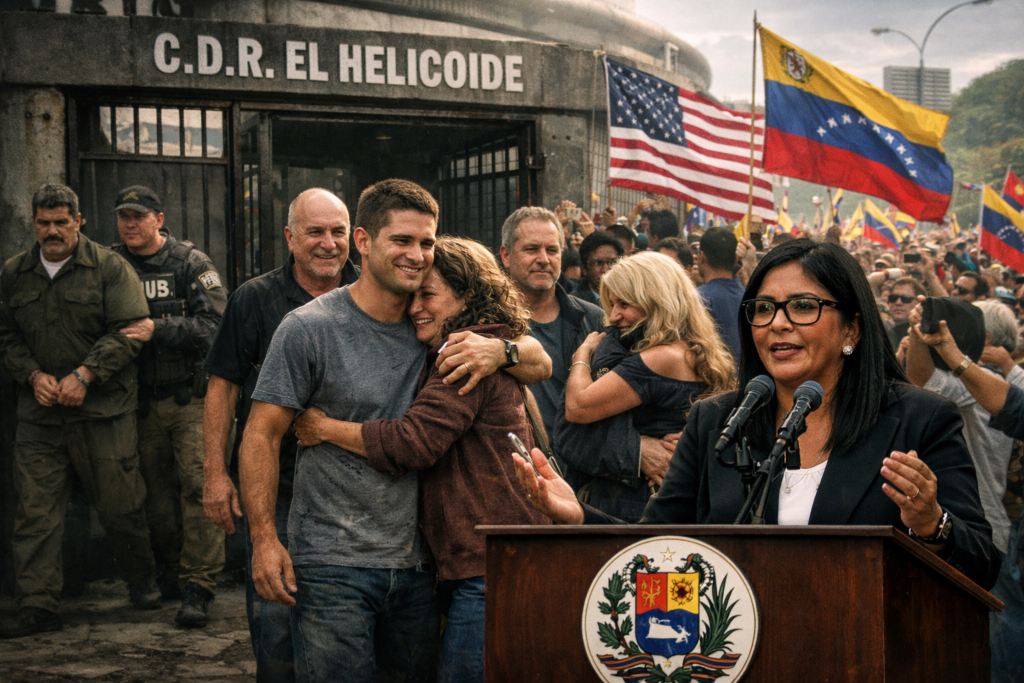
CARACAS / WASHINGTON, D.C. — In a notable shift amid Venezuela’s ongoing political upheaval following the dramatic U.S. capture of former President Nicolás Maduro, the interim government led by Delcy Rodríguez has released multiple American citizens who were imprisoned under the previous regime. This development marks the first known release of U.S. detainees in the country since the coup-like operation that ousted Maduro and placed him into U.S. custody on federal charges.
The release unfolds as part of broader, albeit uneven, efforts by Caracas’s new leadership to ease political tensions and respond to domestic and international pressure — even as more than 800 political prisoners remain behind bars.
First Known American Releases Since Military Operation
According to U.S. officials and multiple news outlets, at least four American citizens previously detained in Venezuela have been freed in recent days. Marcelo Hansler of CNN reported that this is the first known release of U.S. nationals since the overthrow of Maduro by U.S. military forces earlier this month. In an official statement Tuesday, a spokesperson for the U.S. State Department called the actions an “important step in the right direction” by Venezuela’s interim authorities. The statement welcomed the freed Americans and reaffirmed ongoing efforts to locate and repatriate other U.S. citizens still detained. While the exact identities of those released have not been officially disclosed, multiple American citizens had been known to be held in various Venezuelan facilities in recent months — often under accusations that they were used as bargaining chips in tense negotiations with Washington. Maduro’s government had a history of detaining U.S. citizens on politically charged charges.
Delcy Rodríguez’s Interim Government and Prisoner Releases
Delcy Rodríguez — Venezuela’s vice president under Maduro who assumed power as interim president following his capture — announced earlier that a “significant number” of Venezuelan and foreign prisoners would be freed as part of a gesture toward peace and national reconciliation. The announcement was made by Jorge Rodríguez, president of Venezuela’s National Assembly and Delcy Rodríguez’s brother. The releases have been described as part of efforts to “seek peaceful coexistence” and respond to international calls for human rights reform. However, observers note that the figures announced by the Venezuelan government have sometimes outpaced independent verification by human rights groups. Human rights organization Foro Penal reported confirming at least 56 political prisoners released in the first wave, though state figures have claimed that hundreds were freed. The discrepancy highlights the challenges of monitoring prisoner rights in Venezuela, where access and transparency remain limited.
Political Prisoner Situation Still Dire
Despite the celebrated releases, the broader situation for incarcerated Venezuelans remains fraught. Rights groups estimate that more than 800 political prisoners — including activists, opposition figures, and journalists — remain detained, often without due process or access to legal counsel. Many are held in notorious facilities such as El Helicoide, where reports of mistreatment and restricted access have been common.
Family members of political detainees have gathered outside prisons in Caracas and other cities, demanding transparency and the freedom of their loved ones. The slow pace of releases and lack of clear criteria for who qualifies for release have fueled frustration among relatives and rights advocates alike. The intermittent release of prisoners has also reopened painful memories for many Venezuelans with past experience of arbitrary detention. One human rights activist noted that inmates often ask each other, “Who is your jailer?” — reflecting the personalized nature of political detention under previous regimes.
U.S. Diplomatic and Political Implications
The release of American detainees is being viewed in Washington as a positive, yet tentative, development. Officials say this step could signal a pathway toward better cooperation between the interim Venezuelan leadership and the United States following months of estrangement and tension. The U.S. government has been actively pushing for the release of not just American citizens, but a wider group of political prisoners. President Donald Trump has publicly praised the interim authorities for their cooperation and hinted that such steps influenced U.S. decisions to temper further military action in the region. Trump’s administration had previously prioritized the liberation of detained Americans in negotiations with Maduro’s government, including during a prisoner swap last year that saw more than two hundred Venezuelans exchanged for freedom. Nonetheless, U.S. officials caution that the release of Americans does not signify a wholesale improvement in Venezuela’s human rights landscape. Rather, it underscores the complexities of diplomatic engagement during political transitions, especially after what critics call a controversial military operation against Maduro.
Mixed Reactions Inside Venezuela
Reactions within Venezuela have been mixed. Some opposition supporters and families of prisoners have celebrated the initial releases, seeing them as a breakthrough after years of repression under Maduro. Others, however, express skepticism about the interim government’s commitment to broad political reform, pointing to the many still imprisoned and the often opaque nature of the release process. International human rights and legal organizations continue to demand full transparency and the immediate release of all individuals detained on political grounds, arguing that partial releases fall short of meeting Venezuela’s obligations under international law.
Looking Ahead
The release of U.S. detainees represents a noteworthy shift in Venezuelan politics in early 2026, highlighting how international pressure and diplomatic engagement can yield tangible results even amid deep political fractures. But the slow pace of broader prisoner releases, and the ongoing detention of hundreds more, underscores the unfinished nature of Venezuela’s transition.
As negotiations over embassy reopenings, oil revenue control, and reconstruction aid continue between U.S. and Venezuelan officials, the fate of political prisoners — American and Venezuelan alike — will remain a key barometer of progress and of the interim government’s willingness to enact meaningful reform.