Ukraine Strikes Deep Inside Russia: Drones Target Major Missile Factory, Injuries Reported
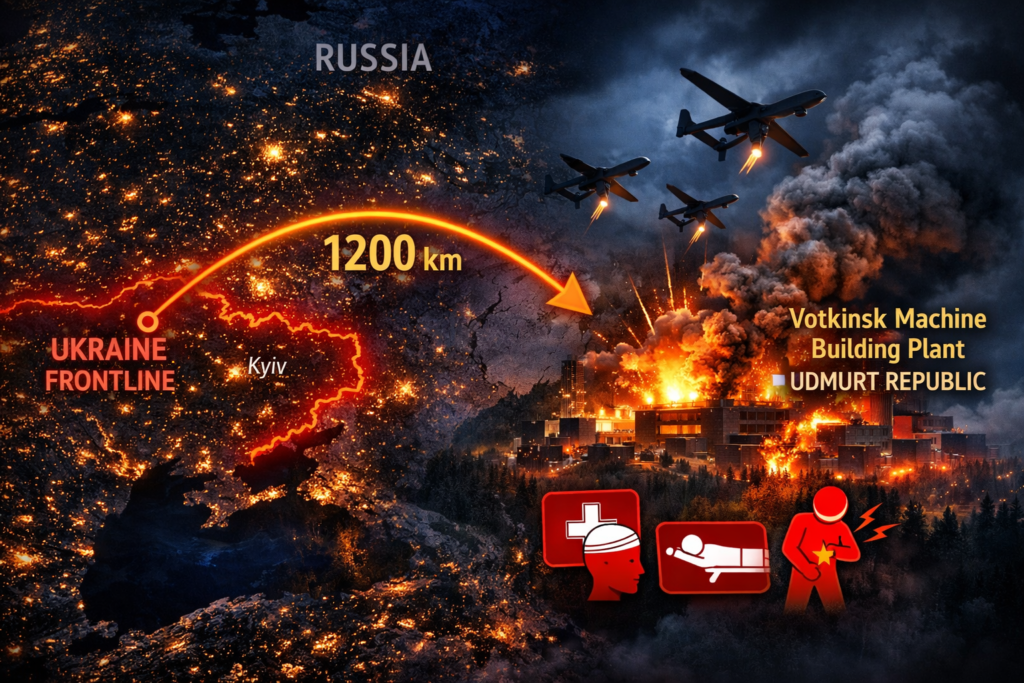
In a bold and rare escalation of its long-range campaign against Russia’s war machine, Ukraine launched a drone strike deep inside Russian territory on Saturday night, hitting a major industrial facility in the Udmurt Republic that produces strategic weapons. The attack — part of Kyiv’s expanding effort to disrupt Moscow’s military-industrial complex — has stirred both geopolitical tension and profound concern over the widening reach of the nearly four-year-long war.
According to local Russian officials, the strike injured 11 people, three of whom were hospitalized, and caused significant damage to the facility. Ukrainian authorities have not yet commented publicly on the incident.
What Happened: Strike on Udmurt Industrial Site
Late on Feb. 20, 2026, Ukrainian drones penetrated deep into the Russian heartland and struck an industrial complex in the Udmurt Republic, a region more than 1,400 kilometers (about 870 miles) from Ukraine’s eastern frontlines. Russian authorities confirmed the drone attack but did not officially name the location.
However, independent Russian Telegram channels and local analysts quickly identified the target as the Votkinsk Machine Building Plant, a major state-owned missile factory that is central to Russia’s defense industry. Locals shared videos and images on social media showing thick black smoke rising and parts of the facility damaged in the aftermath of the overnight assault.
The Votkinsk plant is known to manufacture Iskander ballistic missiles, a weapon used repeatedly by Russian forces against Ukrainian cities and infrastructure — and it also produces intercontinental ballistic missiles (ICBMs) capable of carrying nuclear payloads.
The Human Toll
Russian regional authorities acknowledged that at least 11 people were wounded, including three who were hospitalized with injuries caused by the strike. Residents reported hearing loud explosions and observed drone activity shortly before the attack, according to local Telegram posts.
For many Russians living near the facility, the strike came as a grim reminder that the war’s reach has expanded far beyond the frontlines. While military installations are expected to be targets, the human impact — even in sparsely populated areas — has left families shaken and local officials scrambling to account for the injured and assess infrastructure damage.
Strategic Implications: Why This Matters
Ukraine’s strike represents a significant escalation in its long-range drone and aerial campaign inside Russia, a strategy that Kyiv has steadily expanded over the course of the conflict. While the Ukrainian military has previously struck military airfields, ammunition depots and energy infrastructure deep inside Russia, targeting a key missile production facility is widely seen as both symbolic and tactical.
Military analysts say crippling production hubs like Votkinsk could slow Russia’s ability to manufacture weapons that are used directly against Ukrainian forces and civilian targets. It also signals Ukraine’s growing confidence in its unmanned aerial capabilities, which have become increasingly sophisticated since the war began in 2022.
This strike follows a broader pattern of precision targeting by Ukrainian forces — from oil refineries and energy terminals to industrial plants critical to Russia’s defense logistics — as Kyiv seeks to degrade its rival’s industrial advantage and diminish Moscow’s war-waging capacity.
Russian Reaction and Defense Challenges
The Udmurt Republic lies deep inside the Russian Federation, far from the frontlines of the battlefield in eastern Ukraine. That the Ukrainian military could reach such a distant industrial site highlights limitations in Russia’s air defense systems and raises questions about Moscow’s ability to protect its strategic infrastructure.
Russian officials have condemned the attack as a violation of sovereignty and a dangerous escalation. Moscow’s defense ministry may pursue a diplomatic push at international forums to condemn Ukraine and call for increased support from allies, emphasizing the risk posed to civilian infrastructure and non-combatants.
Broader Context of the War
This latest strike is part of a broader escalation in Ukraine’s long-range offensive operations that have extended well beyond its own borders. In recent months and years, Ukrainian drones and missiles have struck Russian energy infrastructure, ammunition depots and industrial complexes deep inside Russian territory. These operations are often framed by Kyiv as necessary to dismantle Russia’s ability to wage war and to send a clear message that distance does not mean immunity.
At the same time, Russia’s continued missile and drone attacks on Ukrainian cities, energy grids and civilian areas have exacted a heavy toll on communities, prompting widespread humanitarian concerns. Both sides have hardened their tactics as the war has entered its fourth year, and diplomatic efforts for ceasefires have repeatedly faced setbacks.
International Response and Future Risks
International leaders and policymakers are watching these developments closely. The United States and European allies have repeatedly reaffirmed support for Ukraine’s right to self-defense, while also urging restraint and dialogue where possible. However, attacks on industrial and military infrastructure deep inside Russia pose serious questions about escalation and regional security. Confrontations at this scale have the potential to widen the conflict or provoke stronger counter-measures by Moscow.
For the Ukrainian people, every strategic strike carries a mix of hope and heavy cost. Many see these operations as crucial to defending their homeland and reducing attacks on civilian lives — but also fear that escalation at home and abroad could have dangerous consequences.