U.S. Sets June Deadline for Ukraine-Russia Peace Deal, Zelenskyy Says
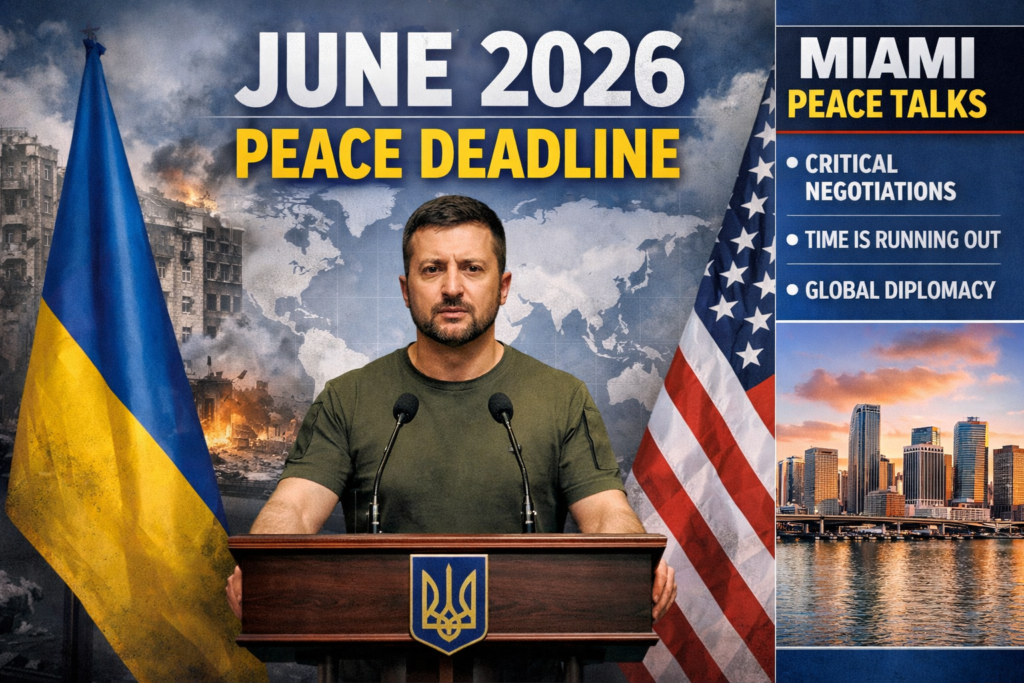
The United States has informed Ukraine and Russia that it wants a peace agreement to end the ongoing war by June 2026, Ukrainian President Volodymyr Zelenskyy said this week — a diplomatic timeline that adds urgency to stalled negotiations and sharpens global focus on efforts to resolve one of the most consequential conflicts of the 21st century. Zelenskyy’s comments reflect renewed American involvement and political pressure aimed at coaxing both sides toward a negotiated settlement before summer, even as fighting and geopolitical tensions persist.
Speaking to reporters in Kyiv, Zelenskyy said that Washington has proposed a clear schedule for ending the war by June and would escalate diplomatic pressure on both Kyiv and Moscow if that deadline is not met — a timeline that underscores the intensifying role the U.S. intends to play in brokering a ceasefire and broader peace agreement.
A Diplomatic Push Amid a Long-Running War
The war, which began with Russia’s full-scale invasion of Ukraine in February 2022, has now entered its fourth year, with tens of thousands killed, millions displaced, and widespread destruction across Ukraine. Efforts to negotiate a lasting peace have previously faltered over conflicting demands, territorial disputes and security guarantees, despite multiple international mediation attempts.
Zelenskyy said the June deadline follows a series of U.S.-brokered trilateral talks, most recently in Abu Dhabi, that failed to produce a breakthrough as Ukraine and Russia remained far apart on key issues. Russia has repeatedly demanded Ukrainian concessions, including withdrawal from the Donbas region, a condition Kyiv has firmly rejected.
“The Americans are proposing the parties end the war by the beginning of this summer and will probably put pressure on the parties precisely according to this schedule,” Zelenskyy told reporters. “And they say that they want to do everything by June.”
The Role of U.S. Diplomacy and Pressure
Under this renewed American timeline, the U.S. administration — led by President Donald Trump — has positioned itself as a key arbiter in pushing both sides toward a negotiated end to hostilities. Zelenskyy said the next round of trilateral negotiations — involving the U.S., Ukraine and Russia — is expected to take place in the United States, likely in Miami, and that Kyiv has confirmed its participation.
The June target carries political undertones, as Washington may be seeking diplomatic progress ahead of U.S. midterm elections, which often reshape foreign policy priorities. Should the deadline pass without an agreement, officials in Kyiv and Washington expect increased pressure on both Ukraine and Russia to show concrete steps toward compromise, though exactly what form that pressure might take remains unclear.
Analysts say that America’s push reflects not only geopolitical strategy but also a desire to stabilize a volatile conflict zone that has wide-ranging implications for European security and global energy markets. Finding common ground between Ukraine and Russia on core issues such as territorial integrity, peace terms and security guarantees remains central to any deal.
Key Obstacles to Peace
Despite the high-level push from Washington, reaching a comprehensive peace agreement by June faces formidable hurdles:
Territorial Demands and Security Guarantees
One of the most intractable issues is territory — particularly the status of Donetsk, Luhansk, Crimea and the Zaporizhzhia nuclear power plant region, which remains under Russian control. Russia continues to press for Ukrainian concessions that would leave it with control over these strategic areas, while Ukraine insists on restoring sovereignty over all its territory.
Ukraine has also emphasized the need for long-term security guarantees, possibly including extended U.S. protection commitments, to prevent future aggression. Kyiv has hinted it may seek decades-long security assurances rather than short-term ceasefires, a demand that complicates negotiations but speaks to deep mistrust between the parties.
Military and Tactical Stalemates
On the battlefield, intense fighting continues, especially around contested eastern regions, and recent Russian aerial strikes have targeted Ukrainian energy infrastructure, causing widespread blackouts and hardship for civilians. Zelenskyy has noted that these attacks underscore the difficulty of negotiating under ongoing hostilities.
Previous Negotiations and Partial Progress
Efforts to negotiate peace have not been entirely futile. The latest round of trilateral talks saw a prisoner exchange agreement, with roughly equal numbers of prisoners from each side released, representing a rare diplomatic breakthrough that helped break a months-long stalemate in broader talks.
These incremental steps suggest that, while a peace treaty remains elusive, there is space for cooperation on limited issues. However, major roadblocks — especially territorial controls and ceasefire enforcement mechanisms — have so far prevented comprehensive progress toward ending the war.
U.S. Goals and Global Implications
The U.S. diplomatic push illustrates Washington’s strategic interest in resolving the conflict before the mid-year deadline, not just for regional stability but also to strengthen NATO unity and manage global geopolitical tensions. A successful peace deal would remove one of the most volatile flashpoints between Moscow and Western capitals and could set a precedent for resolving other long-standing disputes.
However, critics argue that setting a firm deadline might backfire, as it could incentivize negotiation posturing rather than genuine compromise, especially if one side believes it can extract further concessions under pressure. The challenge lies in balancing diplomatic urgency with realistic expectations of what can be achieved in complex peace negotiations.
What This Means for War-Torn Ukraine
For Ukrainians on the ground, the June deadline offers a glimmer of hope for peace but also reflects anxieties about whether a negotiated settlement can protect their sovereignty, rebuild devastated regions and secure lasting security. While negotiation steps continue, fighting and strikes remain part of daily life for many citizens, complicating the broader picture of what “peace” might look like.
Zelenskyy’s public acknowledgment of the American deadline reinforces that Kyiv remains engaged in diplomatic channels while defending its core principles. For many Ukrainians, the balance between peace and justice — ending the war without sacrificing territorial integrity — remains the central concern as the world watches.