U.S. December Jobs Report Shows Sluggish Hiring and Mixed Signals for Labor Market
WASHINGTON, D.C. — The latest December labor market data paints a complicated picture of the U.S. economy as it heads into 2026, with hiring remaining broadly subdued, unemployment holding near multi-year highs, and economists questioning whether the labor market’s resilience is fading amid broader economic headwinds.
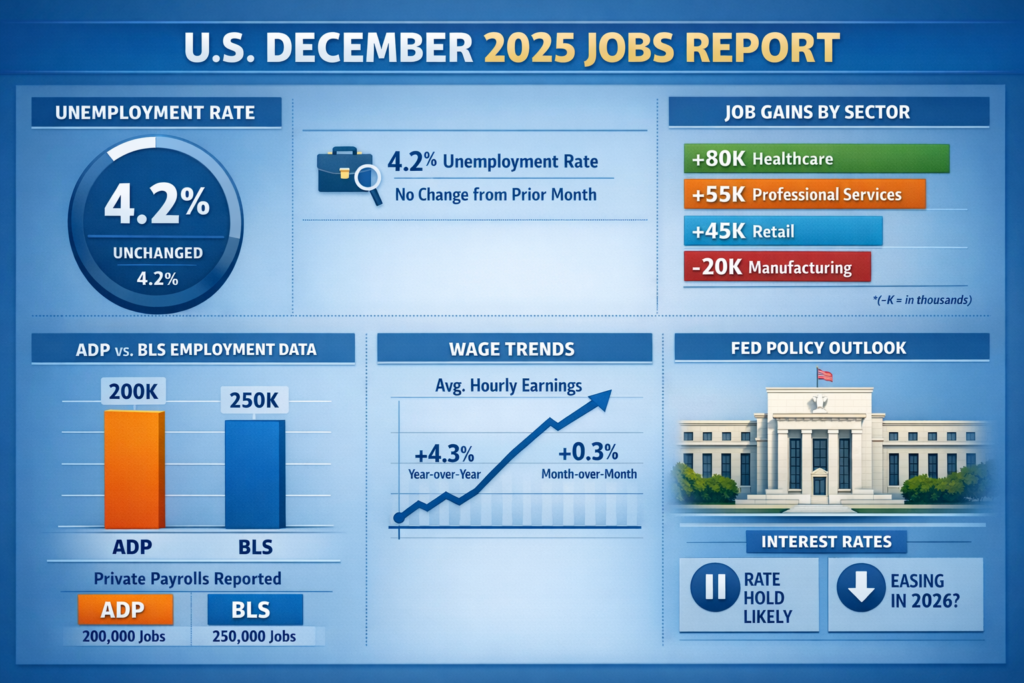
Preliminary estimates from the Federal Reserve Bank of Chicago put the U.S. unemployment rate at 4.6% in December — roughly unchanged from November’s elevated level — even as analysts forecast a slight drop to 4.5% once official numbers are released. This modest improvement, if confirmed, would still leave joblessness near its highest point in years, underscoring persistent weakness in hiring trends.
Modest Job Growth Signals Labor Market Cooling
Private sector data released by payroll processor ADP shows that U.S. employers added just 41,000 jobs in December, an increase that erased November’s job losses but remains well below levels seen earlier in the year. Healthcare, hospitality, and food services accounted for a majority of the gains, while wage growth remained muted. Economists surveyed ahead of the government’s official Bureau of Labor Statistics (BLS) report expect roughly 55,000 to 60,000 new jobs in December — an indicator that hiring remains far below historical averages. After a strong recovery from pandemic-era disruptions, job creation this past year has faltered, with weak employment figures signaling that employers are exercising caution amid rising costs, tariff uncertainty, and other economic pressures.
Unemployment Rate Holds Steady Despite Weak Hiring
While the unemployment rate edged only slightly lower in December, the broader labor market conditions highlight that many Americans are still struggling to find work at a meaningful pace.
The unemployment rate’s stickiness reflects a combination of factors, including slower hiring in key sectors, a reduction in government jobs after federal workforce reductions, and an overall hesitation by employers to expand payrolls. Additionally, continued layoffs earlier in 2025 contributed to a higher baseline of joblessness entering the final month of the year.
Economists often look at the unemployment rate alongside job creation to gauge labor-market health. In this case, the mixed signals — with unemployment stubbornly high and job additions historically low — suggest that many workers remain on the sidelines of economic recovery.
Layoffs and Claims: A Mixed Picture
Even as job gains remain modest, planned layoffs dropped sharply in December, according to a report from Challenger, Gray & Christmas. The number of announced layoffs hit its lowest level in 17 months, offering a rare positive data point amid otherwise tepid employment activity. At the same time, initial claims for unemployment benefits ticked up slightly in the final week of December, signaling that more workers are filing for jobless assistance. However, claims remain relatively low compared to historical norms, suggesting employers are not aggressively shedding labor at mass levels.
Markets and Federal Reserve Watch Closely
Financial markets have reacted cautiously to the jobs data. U.S. stock futures remained subdued in early trading as investors awaited both the jobs report and a major Supreme Court ruling on tariffs that could create volatility across equities. Analysts warned that weak hiring figures, coupled with legal uncertainty around trade policy, may continue to weigh on market sentiment.
For the Federal Reserve, the latest jobs figures come at a crucial time. With inflation still above target in key categories, policymakers have been cautious about cutting interest rates. A labor market that shows weak job creation but persistent unemployment could influence future decisions on rate adjustments.
Chicago Fed estimates suggest that the labor market’s limited hiring and firmer unemployment rate may reduce the likelihood of immediate rate cuts, though markets have partially priced in the possibility of reductions later in the year.
Sector Insights: Where Jobs Are (and Aren’t) Growing
Despite the broader slowdown, certain industries continue to show pockets of resilience. Healthcare services have consistently added jobs, driven by demographic demand and aging population needs. Similarly, hospitality and food services saw continued hiring as consumer mobility and spending on leisure activities remain relatively strong.
In contrast, sectors such as manufacturing and traditional retail have struggled to expand their payrolls. Automation, supply chain pressures, and tariff-related costs weigh heavily on these industries, limiting their ability to hire at robust levels.
Economists note that part-time work and multiple job-holding — often signs of underemployment — have increased, indicating that while some employment exists, workers may not be securing full-time or stable positions that support long-term financial security.
What This Means for Workers and the Economy in 2026
The December labor report highlights that while the U.S. economy continues to generate jobs, the pace of hiring remains weak compared to historical standards. Persistent unemployment and modest payroll gains could impact consumer confidence and spending, slowing broader economic growth if conditions persist.
Policymakers face a delicate balance: stimulate job growth without stoking inflation or over-easing monetary policy. As 2026 unfolds, economists will closely monitor incoming employment data, wage trends, and labor participation rates to assess whether the economy can regain momentum or if structural weakness is taking hold.
For millions of American workers, the key concern remains not just finding a job, but securing stable work with steady income growth — a challenge that the latest December report suggests has yet to be fully resolved.