Trump’s NATO Afghanistan Comments Ignite International Outrage and Veteran Backlash
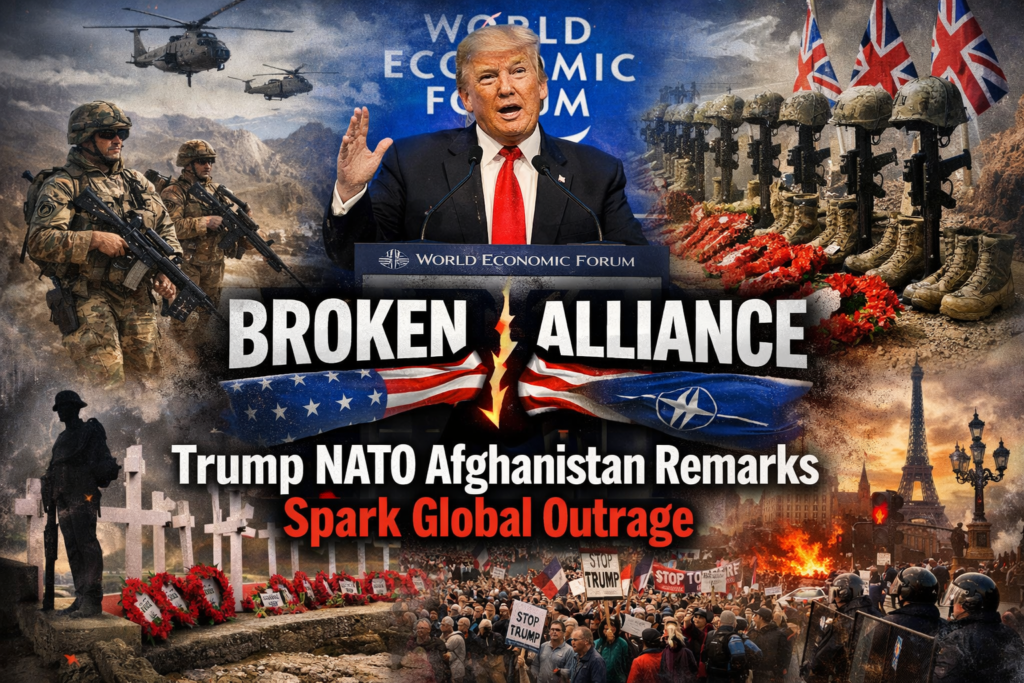
WASHINGTON, D.C. — Former U.S. President Donald Trump is at the center of a transatlantic controversy after making disparaging remarks about NATO troops’ combat roles in the Afghanistan War, prompting sharp criticism from political leaders, veterans, and allied nations across Europe. The dispute has exposed deep sensitivities about the history of the 20-year conflict and reignited debate over the value and sacrifices of NATO’s multinational forces.
The issue stems from comments Trump made in a televised interview at the World Economic Forum in Davos, Switzerland, where he claimed he wasn’t “sure” NATO allies would support the United States if needed and suggested that non-U.S. NATO troops “stayed a little back, a little off the front lines” during the Afghanistan conflict.
The remarks quickly drew widespread condemnation — particularly in the United Kingdom, Denmark, France, Canada, and other NATO countries that fought alongside U.S. forces after the September 11, 2001 attacks. Veterans and political leaders called Trump’s characterization of allied troops inaccurate, disrespectful, and deeply offensive.
A Diplomatic Outrage: Leaders and Veterans Respond
In London, British Prime Minister Keir Starmer publicly rebuked Trump’s remarks, describing them as “insulting and frankly appalling” and urging the former president to apologize to the families of service members who died or were wounded in Afghanistan. Starmer’s strong language underscored the depth of anger within the U.K. government and military communities.
The Prime Minister highlighted that the United Kingdom suffered significant losses during the conflict — with 457 British troops killed and many more wounded — and played a leading combat role, especially in Helmand Province, one of the campaign’s fiercest theaters.
Across the English Channel in Paris, France honored its fallen soldiers in an impromptu ceremony as a symbolic response to Trump’s comments. A wreath was laid at a monument for the 90 French soldiers who lost their lives, and defense officials emphasized the unity and shared accountability of NATO forces during the Afghanistan campaign.
In Denmark, where the per-capita military death toll was especially high, hundreds of veterans and supporters gathered at the U.S. Embassy in Copenhagen to protest Trump’s remarks and honor Danish troops who died in Afghanistan. Participants read aloud the names of the fallen as a gesture of solidarity and remembrance.
Veterans Speak Out: Pain and Pride on the Front Lines
Beyond official statements, veterans themselves voiced profound dismay. Former members of allied forces — including British, Australian, Canadian, and Polish troops — rejected the notion that NATO countries “held back.” They described months and years of frontline combat, mortar attacks, improvised explosive device (IED) strikes, night ambushes, and long, dangerous patrols alongside U.S. forces.
One British veteran recalled how coalition units faced punishing combat operations in Helmand, where NATO troops were routinely exposed to intense enemy fire and perilous conditions. Veterans emphasized that NATO’s collective defense commitment — enshrined in Article 5 of the Treaty after 9/11 — catalyzed a unified multinational effort that extended across Afghanistan for two decades.
Critics also pointed out that beyond battlefield engagements, NATO allies and partner countries contributed to training, base security, medical support, and stabilization efforts that were integral to the mission’s success, placing thousands of servicemembers in harm’s way.
Trump’s Partial Backtrack and Ongoing Fallout
Amid the rising backlash, Trump sought to temper the criticism by posting on social media that British soldiers in Afghanistan were “great and very brave” and highlighting the deep bond between U.S. and U.K. forces. He acknowledged the sacrifices of the 457 British troops who died and many more wounded, calling them “among the greatest of all warriors.”
While his statement was seen as a partial retreat, many allied officials and veterans noted that Trump stopped short of a formal apology and did not address broader concerns about his original characterization of NATO contributions.
In Washington, some political allies defended Trump’s remarks as part of a broader critique of NATO’s defense spending and its future role. However, detractors argue that attacking the sacrifices of allied soldiers undermines the historical cooperation that defined NATO’s longest war and risks eroding mutual trust.
Context: Afghanistan, NATO and the Collective Defense Legacy
The NATO-led campaign in Afghanistan — launched in response to the 9/11 attacks — was unique in alliance history. The U.S. invoked Article 5, the collective defense clause, for the first and only time, prompting dozens of partner nations to join the military effort.
Between 2001 and 2021, NATO and coalition forces engaged in counterterrorism, stabilization, and training missions across Afghanistan. Thousands of European and allied troops served in frontline capacities, suffering casualties in engagements that spanned remote provinces and intense combat zones like Helmand.
Despite fluctuating troop levels and evolving mission mandates, evidence from official records and veteran accounts consistently shows that allied soldiers fought in direct combat, faced severe danger, and shared in the long, often grueling operations that characterized the war’s two decades.
Broader Diplomatic and Political Implications
Trump’s comments have also resurfaced historical tensions about NATO’s future role and burden-sharing among member states. Debates over defense spending, strategic priorities, and alliance cohesion have long simmered in transatlantic forums, but diminishing the historical sacrifices of coalition partners adds a personal and emotional dimension that many leaders find unacceptable.
In Britain, the controversy became a domestic political matter, with lawmakers of all parties joining veterans in decrying the remarks, and even members of the royal family — including Prince Harry, a veteran who served two tours in Afghanistan — publicly criticizing the tone and substance of Trump’s statements.
Allied governments have emphasized that respectful acknowledgment of shared history and sacrifice is essential to sustaining NATO’s credibility as a security alliance, even amid political disagreements.
What’s Next: Healing Rift or Deepening Divide?
As the controversy continues, experts predict that discussions over alliance history and future commitments will remain politically charged, especially as the next generation of NATO leaders contends with emerging global threats, defense reforms, and public sentiment on both sides of the Atlantic.
For now, the debate sparked by Trump’s remarks underscores a broader truth: military alliances are not only legal and strategic arrangements — they are also moral and emotional bonds built on shared sacrifice, mutual respect, and the memory of those who served.