Trump’s “Board of Peace” Holds First Meeting With Promise of Billions for Gaza — But Deep Divisions and Uneasy Talks Mark the Start
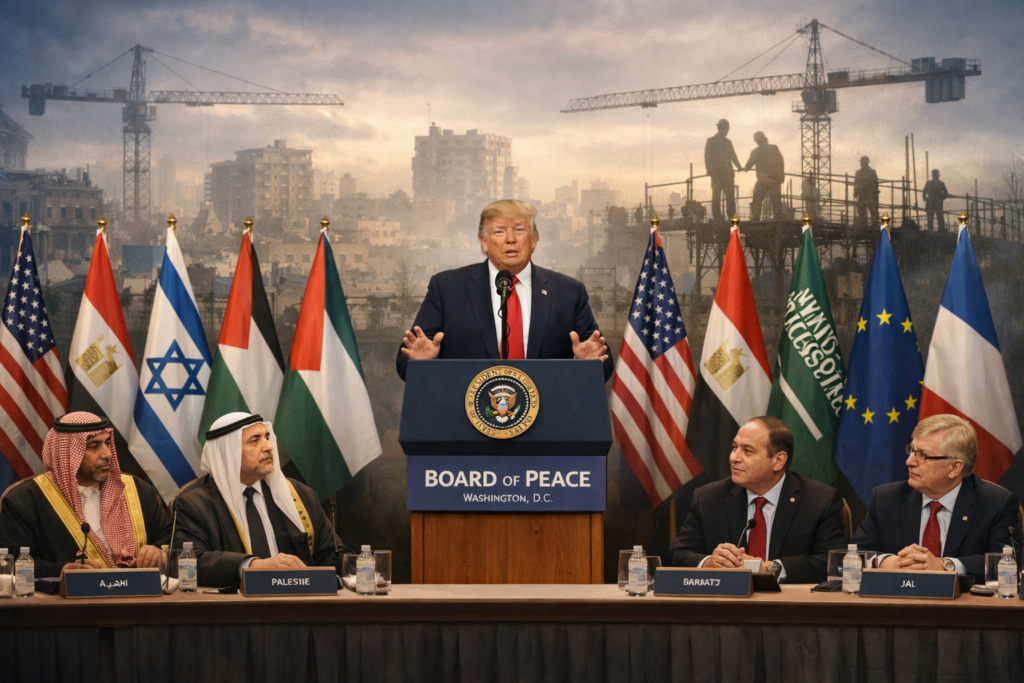
WASHINGTON, D.C. — In a sprawling conference room at the newly renamed Donald J. Trump U.S. Institute of Peace on Thursday, President Donald Trump convened the inaugural meeting of his controversial “Board of Peace” — an international body created to steer recovery, stability and eventual governance in the war-torn Gaza Strip. The event marked the first major gathering of a deeply ambitious plan whose reach extends far beyond one region, but whose reception has been marked by skepticism, division and diplomatic unease.
The meeting comes more than a year after a fragile ceasefire was negotiated between Israel and Hamas in October 2025 as part of a broader U.S.-brokered peace framework. Trump — who leads the board and has described it as a mechanism not just for Gaza but for global peace efforts — called the assembly a “historic moment” and a test of whether traditional diplomacy can be re-shaped for a new era.
What the Board of Peace Is — and What It Aims to Do
The Board of Peace was announced in January at the World Economic Forum in Davos, Switzerland, as part of Trump’s 20-point plan to bring lasting calm to Gaza and beyond. It was established under United Nations Security Council Resolution 2803, which authorized a temporary international stabilization force and peace mechanism in the enclave.
At its core, the board is meant to:
- Coordinate billions of dollars in humanitarian aid and reconstruction funding for Gaza
- Oversee a transitional governance structure until local authorities are ready to resume control
- Support the deployment of an International Stabilization Force (ISF) to keep peace and security
- Serve as a model for future crisis response and peace-building efforts around the world
Trump and White House officials have painted the board as a next-generation diplomatic initiative, one that could correct perceived weaknesses in the United Nations system and bring quicker results to areas devastated by conflict. Trump wrote that the board has the potential to be “the most consequential international body in history.”
Billions Pledged — But Far From Enough
Before the meeting, Trump announced that more than $5 billion in pledges had been secured from participating countries to restore Gaza’s shattered infrastructure and provide humanitarian aid. He also said member states had committed thousands of personnel to the stabilization force and local police efforts in the Palestinian territory.
But that figure, while substantial, is a stark contrast to the estimated $70 billion needed to rebuild Gaza according to international economic assessments — a gap that underscores the scale of the challenge ahead.
Participants were expected to announce more details at the meeting about how funds will be disbursed, which countries will contribute personnel, and what timeline will guide the reconstruction process. But many of those commitments are still being negotiated, and several major Western partners have not fully embraced Trump’s vision.
Who Came — and Who Stayed Away
Representatives from more than two dozen nations showed up in Washington, but attendance varied widely in tone and level of engagement. Some countries sent top ministers, while others — including key European powers like France, Germany and the United Kingdom — chose to attend only as observers or not at all.
The European Union, for example, informed Washington that it would participate in discussions but would not become a formal board member, reflecting unease about the structure and leadership of the initiative.
Indonesia has emerged as the first nation willing to commit troops — possibly up to 8,000 personnel by June — to the stabilization force in Gaza, a notable operational promise but still a small piece of a larger security puzzle.
Some countries in the Middle East, Turkey, Qatar and a handful of others have also engaged, often expressing hope for peace but stressing that any solution must involve Palestinian voices and reflect a negotiated settlement with all parties.
Diplomatic Debate and Uneasy Politics
While Trump and his supporters praised the gathering’s energy and commitments, critics — from both international capitals and civil society voices — voiced concern that the Board of Peace could undermine the role of the United Nations and set a precedent for a new type of U.S.-led global institution.
Even before the meeting convened, some European leaders characterized the board as an *“alternative” rather than a complementary peace mechanism, asking whether it respects internationally agreed processes already in place.
The Vatican — long a respected moral voice in global diplomacy — notably declined the invitation to participate, citing fears that a U.S.-centric body might distract from the U.N.’s multilateral role.
These debates play out against a backdrop of lingering violence in Gaza, where more than 600 Palestinians have been killed since the October 2025 ceasefire, according to local health officials, and where humanitarian needs remain urgent.
The Challenge of Hamas and Security
A central and deeply unresolved issue facing the board is Hamas’s disarmament and the political future of governance in Gaza. Trump’s plan calls for the militant group to disarm fully and for an internationally supported transitional administration to be established.
But Hamas has continued to push back, arguing that any peace plan must address the end of the long-running siege and ensure greater freedom of movement and dignity for Gazans. Palestinian leaders have publicly called for the board to facilitate a broader humanitarian response and lifting of restrictions that have choked the territory.
Israel, meanwhile, remains a key stakeholder — but its official participation in the board has been complicated, and Israeli leadership has prioritized its own security concerns. The first meeting included some Israeli officials, but not all top decision-makers.
What This Means for Gaza — and the World
For ordinary people in Gaza — families who have lost homes, loved ones and livelihoods — the board’s promises could feel both hopeful and distant. Reconstruction and stabilization require not just money and troops but trust, local ownership and a peace process grounded in the will of those directly affected.
International experts say the board’s success hinges on whether it can *deliver tangible improvements *on the ground — from safe streets to functioning schools and hospitals — and whether it can navigate deep political divides with transparency and fairness.
For the broader world, the meeting signals a bold experiment in reimagining global peace-building, with the U.S. president at its helm. But it also raises essential questions about the limits of national leadership in international conflict resolution and the importance of inclusive diplomacy that respects existing international institutions.