Trump’s 2026 State of the Union: A Nation on Edge — What You Need to Know Before the Big Speech
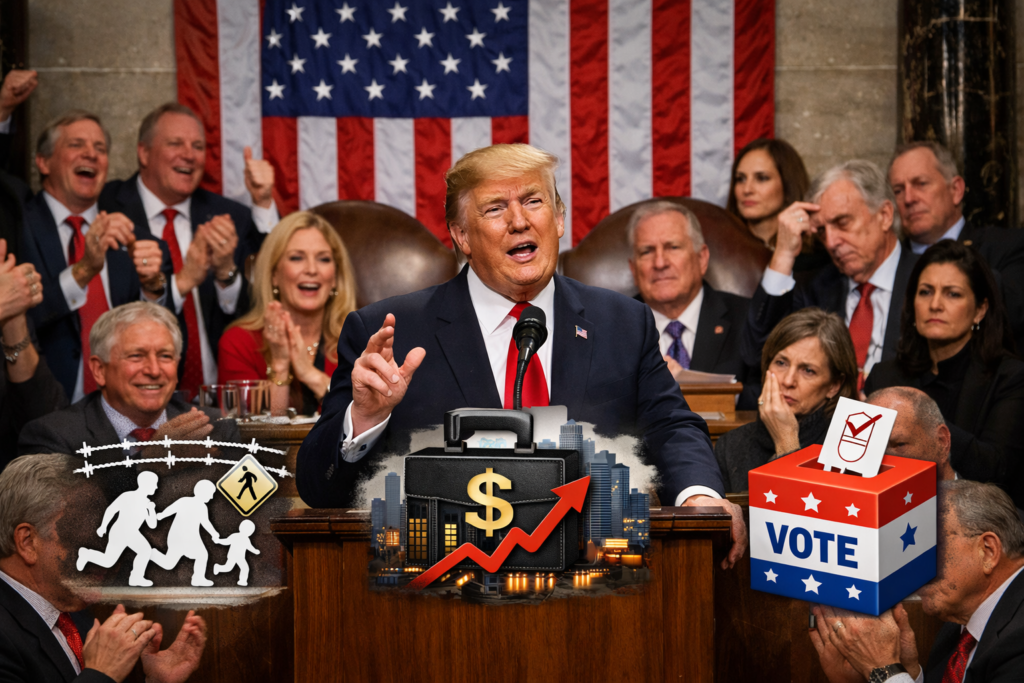
WASHINGTON, D.C. — On Tuesday night, President Donald J. Trump delivered his 2026 State of the Union address — one of the most important moments of his second term and a defining political event as the nation heads into the 2026 midterm elections. For many Americans, this wasn’t just another presidential speech. It unfolded as an emotional, polarizing moment that reflected deep divides about the direction of the country, concerns about immigration, unrest over the economy and trust in government — all against the backdrop of simmering global tensions and domestic controversy.
This address was his first formal State of the Union speech of the second Trump presidency, broadcast live from the U.S. Capitol before a joint session of Congress and millions of viewers across the nation.
A Speech at a Critical Moment
For weeks, the Capitol had been preparing for one of the year’s most consequential speeches in American politics. Donald Trump was set to stand before Congress at 9 p.m. ET on February 24, 2026 — the traditional time when a president outlines his priorities for the year and defends his record to the nation.
This address came at a moment marked by:
- A partial government shutdown affecting critical agencies, including Department of Homeland Security operations.
- A Supreme Court decision overturning key tariff policies — a legal blow to Trump’s economic strategy.
- Rising tensions on the global stage, with disputes involving Iran and trade relations.
- A poll showing a majority of Americans believe the country is moving in the wrong direction, and low approval ratings for Trump.
Republicans positioned the speech as a chance to rally voters and define Trump’s legacy ahead of November’s elections, while Democrats prepared rebuttals and counterprogramming events.
What Trump Promised and Portrayed
In his address, President Trump leaned into the themes that have defined his leadership style: strength, security, economic nationalism and patriotism. Trump spoke in broad, confident terms about his achievements — emphasizing that “America is strong again, respected again on the world stage” — language his allies had previewed in campaign materials and social media posts ahead of the speech.
As part of his address, Trump highlighted:
- Border security and immigration policies, emphasizing law enforcement and strict deportation measures.
- Economic priorities, including tax policy, deregulation and his vision for American jobs and industry.
- Foreign policy, touching on diplomatic challenges and threats abroad.
- National pride, invoking the country’s 250th anniversary of founding principles.
His delivery was unmistakably designed for a broad political audience — supporters hopeful about nationalistic agendas and critics hoping for a more unified message were both listening closely. But beneath the broader rhetoric were policy ambitions bound tightly to political survival as midterm voters weigh the nation’s direction.
Public Opinion: Support Strange Bedfellows
The timing of the address was politically significant: just weeks after a poll showed 60 % of Americans disapproved of Trump’s performance as president — with nearly half of Americans saying they strongly disapproved.
Republican support remained solid — with roughly 85 % of GOP voters backing Trump’s leadership — but independents and swing voters showed erosion in confidence.
Even among some of his own base, the momentum behind Trump’s policies showed signs of strain: a separate poll found that a majority of U.S. adults said Trump was moving the country in the wrong direction, a stark reflection of the deep partisan divides that now define American political life.
These statistics added pressure on Trump to deliver not just a speech, but a narrative strong enough to inspire confidence in his leadership ahead of the key November contests.
Support and Protest Outside the Chamber
Not all Americans chose to watch the speech from their living rooms. As Trump fans tuned in, counterprogramming events and protests took shape around Washington and beyond — running in parallel with the official address.
From “People’s State of the Union” rallies to alternative broadcasts like “State of the Swamp: The Rebuttal,” progressive commentators and activists used the evening to voice dissenting views and craft an alternative narrative to Trump’s message.
On the other side of the political spectrum, Republicans and conservative media framed the speech as a defining moment of resilience and revival. The contrast made clear that the State of the Union in 2026 was as much about perception as policy.
How America Watched
Millions of Americans tuned in as Trump stood at the podium in the historic House Chamber at the U.S. Capitol in Washington, D.C. — a venue loaded with symbolic weight and political significance.
Broadcast and streaming coverage spanned every major news outlet and platform: from ABC, CBS and NBC to Fox News and PBS — many with live commentary, expert analysis and post-speech breakdowns.
PBS, for instance, began its live coverage early in the evening, offering context and political reporting in the hours leading up to the speech and continuing with extended analysis afterward.
The Democratic response — delivered by Virginia Governor Abigail Spanberger — was also featured across networks, adding contrast and critique to Trump’s address.
The Emotional Pulse of the Moment
Beyond politics, the State of the Union touches something deeper: the hopes, fears and frustrations Americans carry about their future.
For supporters, the address was an affirmation of a vision centered on security, national pride and strong borders. For critics, it was a reflection of a nation still deeply divided — grappling with questions about immigration, economic equity, civil rights and the very meaning of American unity.
Among independents and undecided voters — a key bloc in the midterms — the speech was a litmus test, offering cues about whether to lend confidence to the president’s direction or to seek alternatives.
And for millions of everyday families, workers, students, immigrants and community leaders, the State of the Union was a moment to pause, listen and reflect on what matters most to their lives and livelihoods in a nation facing turbulence at home and abroad.