Trump Threatens Tariffs on European Allies Over Greenland Dispute, EU Responds
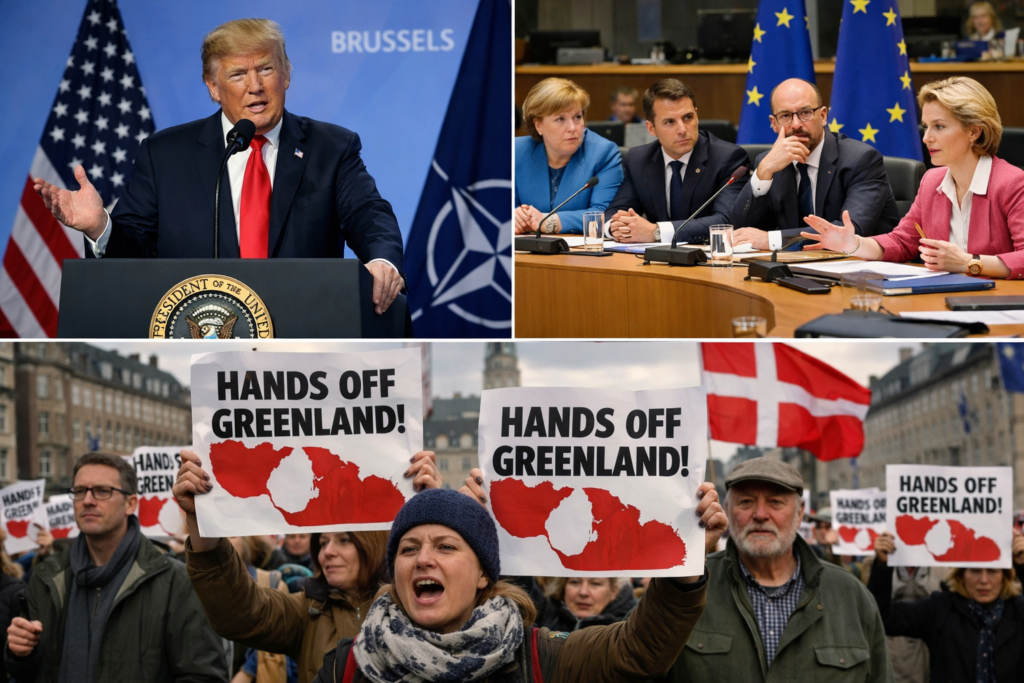
WASHINGTON, D.C. — President Donald Trump has ignited a transatlantic political and economic firestorm after threatening punitive tariffs on key European allies over their refusal to support his controversial bid for influence — and potentially control — of Greenland, an autonomous Danish territory strategically located in the Arctic.
In a flurry of social media posts and public statements over the weekend, Trump called for tariffs on imports from eight European countries that have openly opposed U.S. attempts to assert dominance over Greenland. The move has triggered unusually blunt condemnation from European leaders, prompted an emergency meeting of European Union ambassadors in Brussels, and produced warnings of a dangerous downward spiral in NATO relations and global markets.
Tariff Threats: Timeline and Targets
Trump’s tariff ultimatum, first circulated on his social platform Truth Social, outlines a schedule of escalating import taxes unless a deal is reached to satisfy his Greenland agenda. Beginning Feb. 1, the United States will impose a 10% tariff on all imported goods from the following nations:
- Denmark
- Norway
- Sweden
- France
- Germany
- United Kingdom
- Netherlands
- Finland
If no agreement has been secured by June 1, Trump says the tariffs will rise to 25% — a dramatic increase designed, he asserts, to pressure allies into reconsidering their stance.
Trump has repeatedly stated that Greenland’s strategic location and vast mineral resources are vital to U.S. national security. He also suggested that if America does not step in, rivals like China or Russia may capitalize on the island’s geopolitical significance.
European Response: Rare Unity Against U.S. Pressure
European leaders reacted with swift condemnation. In Brussels, EU member states confirmed they would hold an emergency political summit this week to formulate a unified response to Trump’s tariff threats — an extraordinary step reflecting the severity of the dispute.
In Berlin and Paris, officials warned that Trump’s tariff escalation risked undermining decades of diplomatic cooperation. A joint statement from several capitals said that the U.S. move “undermines transatlantic relations and risks a dangerous downward spiral” in diplomatic and economic ties.
French President Emmanuel Macron explicitly rebuffed Trump’s tactics, stating that “no amount of intimidation will influence us,” and stressing the importance of respecting international law and alliance solidarity. U.K. Prime Minister Keir Starmer similarly condemned the tariff threats as “completely wrong” and inconsistent with shared NATO objectives.
The European Commission also signaled that it could respond with its own countermeasures — including the possible use of the so-called Anti-Coercion Instrument (ACI), known as Europe’s “big bazooka” for trade retaliation. That tool allows sweeping sanctions, export restrictions, or other penalties proportionate to the economic damage inflicted.
Greenland’s Reaction and Arctic Security Stakes
The tariff controversy unfolded amid wider tension over Greenland’s future. Thousands of citizens in Greenland and Denmark participated in “Hands off Greenland” protests last weekend, urging America to respect the island’s autonomy and reject any attempts at U.S. control. The protests marked the largest demonstrations in Greenland’s modern history.
In response to the standoff, Denmark has reaffirmed its commitment to protecting Greenland’s self-determination and invited NATO military exercises on the island to underscore its sovereignty and European security cooperation.
Meanwhile, the European Commission announced plans to enhance Arctic security cooperation, including investments in regional defense infrastructure and collaboration with Nordic partners. This initiative is viewed as a direct response to the uncertainty generated by Trump’s claims.
Domestic Backlash and Political Divisions
Trump’s tariff initiative has encountered criticism at home as well. A faction of Republican lawmakers publicly rebuked the president’s strategy, warning that threatening tariffs against longstanding NATO allies could weaken American diplomatic influence and empower strategic adversaries like Russia and China. Some GOP senators argued the move was “bad for America” and risked damaging U.S. national security positioning.
A recent Reuters-Ipsos poll showed that a large majority of Americans — beyond party lines — disapprove of Trump’s Greenland acquisition efforts, and only a small fraction support using coercive tariffs or force to achieve that goal.
Trade Deal Fallout and Global Market Impact
The fallout from Trump’s tariff threats has also extended to broader economic relations. Negotiations over a stalled U.S.–EU trade agreement — announced in July 2025 and expected to lower tariffs on transatlantic commerce — have stalled as European leaders reassess cooperation amid deepening mistrust.
Global markets have reacted nervously to the unfolding tensions. Analysts cited in financial news reports noted volatility in European equities, a dip in U.S. stock futures and increased appetite for safe-haven assets like gold as traders weighed the risk of prolonged trade and geopolitical conflict.
Will Diplomacy Prevail? What’s Next
With Trump’s deadline for tariff implementation just weeks away, diplomatic efforts are intensifying on multiple fronts.
European Union officials are coordinating emergency talks to formulate joint responses, including potential retaliatory tariffs or legal action through the World Trade Organization. Non-European voices, including China’s foreign ministry, have also weighed in, urging respect for international law and condemning coercive economic tactics.
Back in Washington, discussions continue among U.S. lawmakers and foreign policy experts about the long-term implications of the Greenland behavior. Critics argue that pursuing territorial ambitions through tariff threats — particularly with allies — could weaken NATO’s cohesion and set dangerous precedents. Supporters within the Trump administration frame the gambit as bold leadership necessary to protect U.S. strategic interests in the Arctic.
As the global community watches closely, the coming weeks may determine whether economic diplomacy can avert an escalating trade conflict — or whether Trump’s controversial approach will reshape transatlantic relations for years to come.