Trump Officials Warn Congress That U.S. Strikes Will Unleash ‘Overwhelming’ Firepower on Iran
WASHINGTON — As the already escalating **U.S.–Israel military campaign against Iran continues to shift into a bigger war, top Trump administration officials told members of Congress this week that Americans should brace for an even more intense barrage of strikes on Tehran in the coming days. The classified briefing, delivered amid deep partisan unease over the conflict’s scope and legality, left lawmakers on both sides of the aisle facing the stark reality of a war that could stretch far beyond initial expectations.
In closed-door sessions Tuesday, Secretary of State Marco Rubio, Defense Secretary Pete Hegseth and other senior national security advisers outlined a rapidly evolving offensive against Iran — one they repeatedly described as broad, forceful and likely to expand. They told senators and representatives that what has already been unleashed is only the beginning, with an “overwhelming” wave of firepower ready to strike Iranian military infrastructure, missile systems and other strategic targets within the next several days.
According to lawmakers who emerged from the briefing, the administration characterized the campaign as part of a larger operation it is calling “Operation Epic Fury,” a sustained military push involving U.S. air and sea power coordinated with Israeli forces. Trump officials said they expect this phase of strikes to far exceed the initial blows dealt in the first days of conflict, potentially defining the next chapter of a war that has already drawn in Persian Gulf partners and drawn global concern.
Sen. Lindsey Graham, a Republican from South Carolina and key Trump ally, walked out of the session portraying the administration’s strategy as decisive. “This regime is in its death throes,” he told reporters. “What’s coming in the next day or two from us is going to be overwhelming.” Graham also suggested that Arab partners are increasingly involved in the campaign, a development that could broaden the regional reach of the conflict.
But not all lawmakers shared Graham’s optimism. Sen. Andy Kim of New Jersey, a former State Department official, described the message from the administration as “ominous,” warning that stronger strikes could create greater risk for American personnel and civilians alike. “This is only just the beginning… this is a war. This is the Iran war,” he told reporters, underscoring how the briefing reframed the military campaign for many in Congress.
Rubio echoed that tone outside the secure briefing room, urging U.S. citizens still in the Middle East to leave immediately as conditions deteriorate. The State Department has already issued travel advisories urging Americans in nearly a dozen countries across the region to depart due to rising tensions and direct Iranian retaliatory actions, including missile and drone attacks targeting U.S. embassies and allied facilities.
The classified nature of the briefing — a move meant to give lawmakers a full picture of military intent without revealing sensitive intelligence — did not dampen political debate. Republicans largely signaled continued support for Trump’s approach, with some anticipating that the White House will soon request additional supplemental funding from Congress to sustain the campaign. Several GOP lawmakers acknowledged they would back such a funding request if it comes, even as debates over war duration and cost swirl.
But there was palpable unease from some corners, including lawmakers who cautioned against the risks of an open-ended military conflict without clear congressional authorization. A few conservatives who had previously criticized extended wars in the Middle East warned against transforming a high-intensity air campaign into a grinding fight resembling past U.S. engagements in Iraq and Afghanistan. “My antenna starts going up” the longer it drags on, said one House Republican, underlining concerns that prolonged conflict could erode public support and strain resources.
House Democrats, too, remain skeptical about the administration’s legal authority to conduct a campaign of this magnitude without express congressional approval. Some are preparing measures to limit Trump’s war powers under the War Powers Resolution, though such legislation faces long odds to overcome presidential vetoes and partisan resistance.
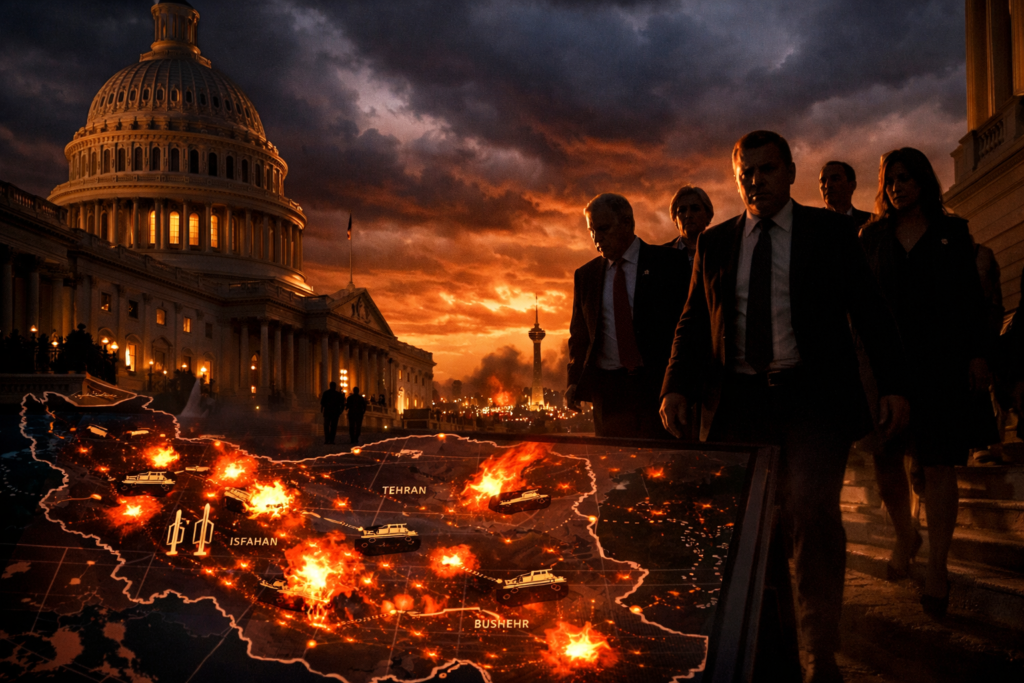
The military situation on the ground is already volatile. Joint U.S. and Israeli strikes in recent days have targeted hundreds of locations within Iran, inflicting heavy damage on air defenses, missile sites, naval assets and command centers. Iran has retaliated with missile and drone attacks on American and allied positions across the Gulf, including direct strikes on U.S. facilities in Kuwait and embassy compounds in Saudi Arabia, killing U.S. service members. These actions have dramatized the dangers lawmakers are now grappling with.
At the same time, major Sunni Arab partners in the Gulf — historically wary of Iranian influence — are reportedly participating in coordination, raising both strategic and political questions about the broader regional footprint of the conflict. With airspace disruptions, attacks on critical energy infrastructure and threats to global shipping routes like the Strait of Hormuz, the economic stakes of the campaign extend well beyond military objectives.
Despite the deepening war, Trump has been steadfast in his public messaging, telling international counterparts this week that Iranian military capabilities have been severely diminished and that the regime is on the brink of collapse. While administration officials stopped short of confirming any timeline, they hinted of a continued effort to cripple Iran’s capacity to threaten the region and beyond.
Domestic political reactions reflect the sharp divide in Washington. Supporters of the administration argue that decisive force is necessary to protect American interests and deter Iranian aggression, framing the offensive as a defensive necessity. Critics counter that without clear objectives, legal authorization and defined end states, the U.S. risks becoming embroiled in a wider war with no clear exit.
As lawmakers return to their districts this week and prepare public statements on the conflict, the message delivered in the classified briefing — that even more intense military operations are imminent — has underscored how dramatically the war with Iran has already shifted from theory to reality. For many Americans watching from home, political debates in Washington now carry an urgent resonance, reminding the nation that far-off battlefields can quickly translate into deeply personal political battles on Capitol Hill.