Trump Arrives in Davos Amid European Tensions, Supreme Court Fed Firing Case
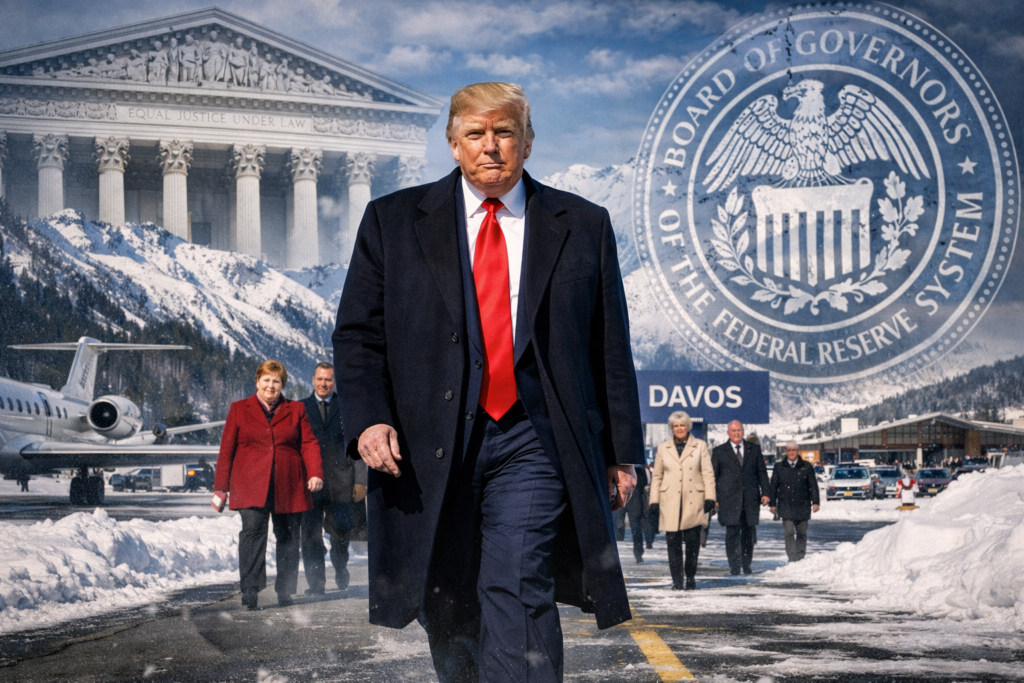
DAVOS, SWITZERLAND — U.S. President Donald Trump landed in the Swiss Alps on Wednesday to attend the 2026 World Economic Forum (WEF), stepping into one of the most contentious global gatherings in years. His arrival comes at a moment of rising transatlantic tensions over his unconventional foreign policy, tariff threats against NATO allies over Greenland, and a separate legal battle back home that’s capturing national attention: the Supreme Court’s consideration of Trump’s bid to fire Federal Reserve Governor Lisa Cook.
The annual Davos summit — traditionally a forum for cooperation among world leaders, top CEOs, and global policymakers — is instead being shaped by friction between Washington and longtime U.S. allies. Trump’s aggressive positions on Greenland, trade, and global governance have left European leaders uneasy and the broader Western alliance on edge ahead of his high-profile address at the forum.
Trump’s Tense Entry into the Global Spotlight
Trump’s arrival was slightly delayed after Air Force One returned to Joint Base Andrews due to what the White House described as a “minor electrical issue,” forcing him onto a different aircraft before taking off for Switzerland. Once in Davos, Trump emphasized his priorities — from global economic concerns to domestic affordability challenges — but critics say his foreign policy flashpoints are dominating headlines.
Rather than entering Davos as a unifying statesman, Trump stepped into a forum where his leadership style and agenda are being openly debated by world powers. Over the weekend, Trump threatened tariffs on eight European nations unless they support his goal of acquiring Greenland — a semi-autonomous Danish island — stirring fierce pushback from Europe’s political leadership.
French President Emmanuel Macron and European Commission President Ursula von der Leyen have criticized Trump’s tariff threats and expansionist rhetoric, with von der Leyen calling proposed tariffs a “mistake” and Macron warning against principles of unilateral dominance in international affairs.
Out of Europe’s Comfort Zone
The arrival of President Trump in Davos has reshaped what is usually a collaborative global economic dialogue into a more strained diplomatic exchange. Traditional Davos discussions — spanning climate change, innovation, trade frameworks, and economic growth — are now interlaced with debates about American unilateralism and the future of the transatlantic alliance.
Although Trump has sought to emphasize domestic policy issues like housing affordability and economic growth during his planned speeches, few expect these themes to eclipse the controversy surrounding Greenland and looming tariffs that could reach 25% by June. Markets have already reacted to these threats, with volatility rising as investors weigh geopolitical risk.
Amid these diplomatic ripples, world leaders are also watching another major front in Trump’s campaign: his attempt to fire Federal Reserve Governor Lisa Cook, a case now before the U.S. Supreme Court. That battle underscores deep tensions between the White House and America’s central bank over presidential authority and institutional independence.
A Supreme Court Tug-of-War Over Fed Independence
Back in Washington, the Supreme Court is scheduled to hear arguments this week in the case of Trump v. Cook, which could determine whether the president can remove a Federal Reserve governor without clear legal cause. Cook — appointed by President Joe Biden in 2022 and the first Black woman to serve on the Fed board — was targeted last August when Trump announced her dismissal via social media, citing allegations of mortgage fraud. Cook has denied any wrongdoing and challenged her removal in court, accusing the administration of violating her constitutional rights.
Legal experts and economists say that a Supreme Court decision favoring the president could weaken the Fed’s institutional independence and set a powerful precedent for future control over independent agencies. Federal Reserve Chair Jerome Powell plans to attend the arguments in person — a rare move that highlights how seriously the central bank’s leadership views the case.
Lower courts previously blocked Trump’s attempt to fire Cook, ruling it likely violated the Federal Reserve Act’s “for cause” protections and her due process rights. Now, the Supreme Court’s conservative majority faces a legal test that could define the balance between presidential authority and the insulation of key economic institutions from political influence.
European Leaders on Edge
While the U.S. legal system debates the Fed case, Trump’s foreign policy posture has left many European counterparts unsettled. European Union officials have called the tariff threats and Greenland push an encroachment on allied sovereignty and warned of potential retaliation if pressure tactics persist. Amid the summit’s packed agenda, EU leaders have repeatedly underscored the enduring importance of respecting international norms and national autonomy.
Canada’s Prime Minister Mark Carney — also in Davos — added his voice by highlighting what he characterized as a fracture in the U.S.-led global order, while urging middle powers to collaborate to preserve a rules-based system rather than capitulate to coercive economic strategies.
At the same time, California Governor Gavin Newsom — a vocal critic of Trump — reached out to the forum and global leaders, urging them to stand up more firmly to the president’s approaches and rhetoric. Many allies, from business leaders to policymakers, find themselves balancing between economic cooperation and outright disagreement with Trump’s methods.
What Trump Hopes to Achieve at Davos
Despite the diplomatic friction, Trump arrives at Davos with a clear agenda: to project American leadership, promote U.S. economic interests, and present his vision for global cooperation on issues like economic growth, housing affordability, and geopolitics in the Middle East. He’s expected to address thousands of global elites and leaders, including CEOs, ministers, academics, and civil society representatives from more than 130 countries.
But Trump’s presence will be measured not only by what he says from the podium, but by how global leaders respond in the room and in bilateral meetings. For many Europeans, this year’s Davos summit may mark a turning point — a moment where the traditional post-World War II partnership with the United States is tested under open debate rather than diplomatic consensus.
The Bigger Picture
As the world watches, Trump’s visit to Davos encapsulates the sharply divided state of global diplomacy in early 2026. On one hand, the U.S. stands ready to engage on major global issues. On the other, aggressive unilateral moves — from threatening tariffs on allies to challenging the Fed’s independence — highlight widening fissures within and beyond Europe. Whether Trump’s Davos appearance will unify global leaders or deepen geopolitical divides remains to be seen, but there’s no question that his presence and policies have reshaped this year’s agenda in significant and unexpected ways.