South Korea Relaunches Truth Commission to Investigate Adoption Fraud and Human Rights Abuses
In a move that has resonated deeply with communities around the world, South Korea has relaunched its Truth and Reconciliation Commission, this time with a sharp focus on unraveling decades-old controversies tied to the nation’s foreign adoption program and other historical injustices. The new initiative marks a renewed effort to address claims of adoption fraud and human rights violations in South Korea’s history, drawing particularly strong interest from overseas adoptees and their families.
The commission officially reopened its doors in Seoul earlier this week, picking up where its predecessor left off after that body’s mandate expired in November with over 2,100 complaints still unresolved. The earlier investigation into the country’s intercountry adoption practices, which once shipped tens of thousands of Korean children abroad, had stalled amid disagreements over which cases truly warranted recognition as problematic.
Now, under a new law passed in January that expands its powers, the third Truth and Reconciliation Commission is authorized to dig deeper into allegations of fraud, coercion and manipulation tied to foreign adoptions — and into a broader sweep of human rights abuses in South Korea’s modern history. Many of the unresolved complaints that the previous body could not finish will be inherited by the new commission, including 311 filed by adoptees living in Western nations, especially the United States, where Korean children were most frequently placed.
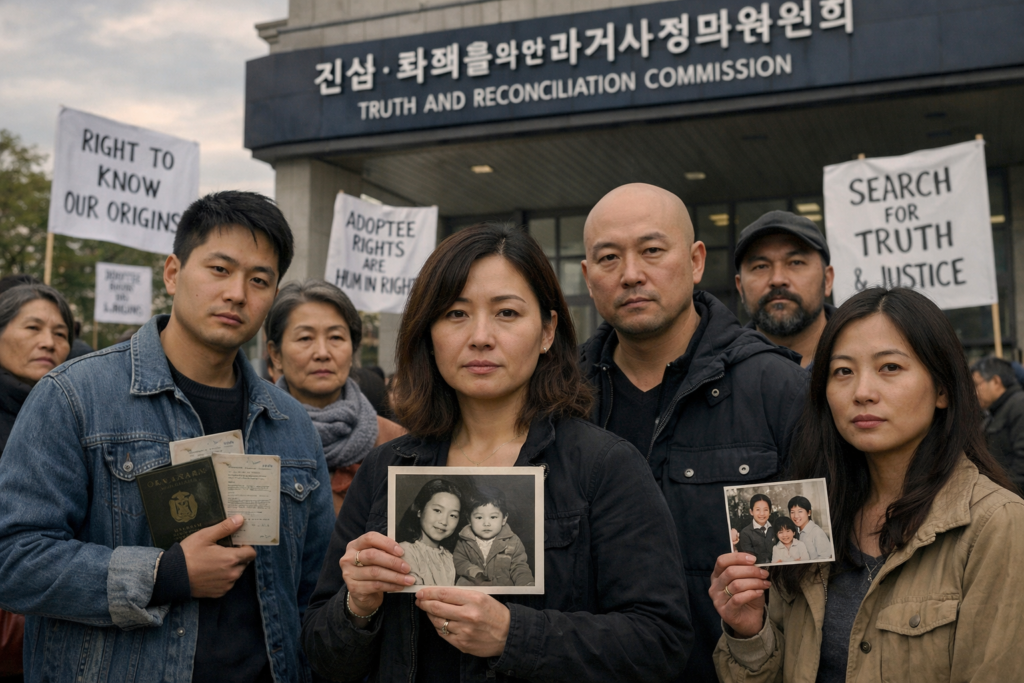
The reopening has galvanized activists and adoptees alike. On the first day that new cases were accepted, more than 300 overseas adoptees submitted documentation and petitions calling for thorough investigations. These 300-plus complaints, delivered along with boxes of records to the commission’s office in Seoul’s Jung District, represent just the beginning of what advocates predict will be a wave of inquiries into systemic adoption malpractice in South Korea.
One of the earliest submissions, designated “Case No. 1,” was filed by the daughter of a woman who died by suicide. She alleges that her mother’s official records were tampered with or falsified to make her eligible for overseas adoption, a charge that highlights the emotional trauma and identity struggles that many adoptees contend with decades after being sent abroad.
The commission is operating under a three-year mandate, with the legal authority to extend its investigations for up to five more years. At present, the government has yet to appoint a permanent chair or form the specialized investigative teams that will be tasked with reviewing the mountain of complaints. Until those appointments are made, civil servants will register and organize cases for future inquiry.
South Korea’s foreign adoption system, once one of the largest intercountry programs in the world, sent roughly 200,000 children to homes in Europe, the United States and other Western nations between the 1960s and early 2000s. The trend peaked in the 1980s, when more than 6,000 Korean children were adopted abroad each year. Many of these children grew up in loving families, but others have spent a lifetime grappling with questions about their origins, identity and the circumstances that brought them into adoption.
The historical backdrop is important: South Korea was then under military governments that viewed adoption as a way to address perceived social problems and reduce welfare costs. Critics now describe the program as rife with corruption, fraud and insufficient oversight. In many cases, children were listed as abandoned or orphaned even when records suggest relatives existed but were not documented. Some adoption agencies are accused of paying hospitals for referrals, falsely registering children as eligible for international adoption or even switching identities when families surfaced.
These troubling revelations led to a rare interim report from the previous commission acknowledging that the government bore responsibility for many of the abuses tied to the foreign adoption system. That report challenged long-held narratives propagated both in South Korea and abroad — including the belief that adoptions were motivated primarily by humanitarian concern. It also prompted a public apology from South Korea’s president and a government plan to phase out most foreign adoptions by 2029.
Despite that milestone, many adoptees and their advocates felt the prior investigation did not go far enough, and they applauded the country’s decision to reestablish the commission with broader powers. The expanded mandate now allows investigators to subpoena documents or seek search warrants through prosecutors if parties refuse to cooperate — a stronger tool to confront entrenched institutional resistance and potential cover-ups.
The scope of the commission’s work also reaches beyond adoption. It will look into other alleged human rights violations, such as civilian killings around the 1950-53 Korean War, political repression during decades of military rule, and long-term abuse of people in welfare facilities. This wider lens reflects a societal reckoning with painful chapters of South Korea’s past, even as the nation remains a major economic and technological power.
For many American families affected by intercountry adoption, the commission’s reopening represents a chance to finally gain answers. U.S. adoptees — who make up a significant portion of the global Korean adoptee community — have long been underrepresented in investigations, despite being among the largest groups that received Korean children overseas. Their voices are now central to this renewed push for truth, justice and reconciliation.
Yet the process will not be swift. Investigators who served on the previous commission anticipate it may take several months, or even into late spring and early summer, before substantive probing begins — especially as the new leadership and teams are put in place. Meanwhile, advocates are urging South Korea and foreign governments to ensure that adoptees can submit cases even through embassies and consulates abroad, making the process more accessible to those who live halfway across the world.
This renewed effort underscores how historical wounds can echo across generations. For adoptees, questions about identity, belonging and justice are not abstract academic issues — they are deeply personal and, for many, unresolved. The relaunch of the Truth and Reconciliation Commission offers a potential pathway toward clarity, accountability and, for some, a measure of closure that has remained elusive for far too long.