Protests Erupt in Denmark & Greenland Against Trump’s Greenland Takeover Push
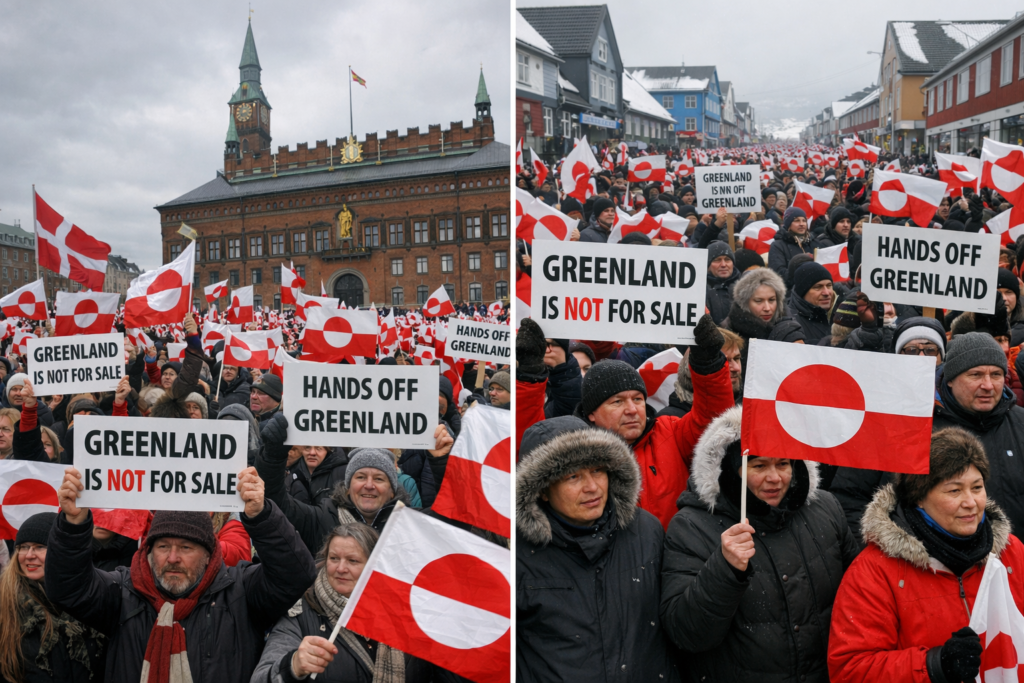
Tens of thousands of demonstrators took to the streets across Denmark and Greenland this weekend in a powerful show of opposition to former President Donald Trump’s renewed push to acquire control of the Arctic territory of Greenland, a semi-autonomous Danish region with strategic military and mineral significance.
The protests, held under the banner of “Hands off Greenland,” brought together citizens, political leaders, and grassroots organizers who demanded respect for Greenland’s sovereignty and threw their support firmly behind the island’s continued association with Denmark.
Massive Rallies Sweep Denmark
In Copenhagen, Denmark’s capital, an estimated crowd of more than 20,000 people gathered in City Hall Square and marched toward the U.S. Embassy, waving red-and-white flags and chanting slogans such as “Greenland is not for sale” and “Hands off Greenland.”
Protesters came not only from Copenhagen but also from other major Danish cities including Aarhus, Aalborg and Odense. The demonstrations were organized by several Greenlandic and Danish civil rights groups in coordination with NGOs like ActionAid Denmark.
Many marchers carried handmade signs rejecting foreign interference and asserting the right of Greenlanders to determine their own political future. Some demonstrators even donned modified red caps with phrases like “Make America Go Away,” a play on Trump’s signature campaign slogan.
Demonstrations in Nuuk, Greenland
Meanwhile, in Nuuk, Greenland’s capital, thousands joined a parallel rally led by Greenland’s Prime Minister Jens-Frederik Nielsen, who stood with citizens to denounce any attempt to transfer Greenland’s governance to the United States.
Standing before a sea of Greenlandic flags and passionate citizens, Nielsen reiterated a central message: “This is our home — not a bargaining chip in international politics.” Organizers reported that roughly 5,000 people took part in the Nuuk march — a significant share of Greenland’s population.
What Sparked the Protests?
The demonstrations were triggered by comments from former President Donald Trump, in which he reaffirmed his long-standing interest in acquiring Greenland, citing the island’s strategic location for U.S. defense and its valuable mineral resources. Trump did not rule out the use of force and threatened to impose tariffs on European countries that oppose his Greenland plan unless a deal is reached.
Officials from eight European nations, including Denmark, France, Germany and the United Kingdom, have vocally opposed any U.S. attempt to control Greenland, underscoring concerns about sovereignty and international law. In response, Trump unveiled plans for a 10% import tariff against these nations, raising fears of a potential trade rift.
A Diplomatic Flashpoint
The escalating situation has created an unprecedented diplomatic crisis between the United States and its long-time NATO partner, Denmark. While Greenland has self-rule, Denmark retains responsibility for its defense and foreign affairs. Many in Denmark view Trump’s rhetoric as a direct challenge to NATO solidarity and international norms.
European leaders have publicly condemned the tariff threats and insisted Greenland’s future must be decided by its people and the Danish Realm. The movement has nationwide support in Denmark, with more than 20,000 people in Copenhagen alone turning out to oppose external pressure.
Voices From the Streets
Protesters expressed deep frustration with what they see as political intimidation. One Copenhagen march attendee, Naja Holm, a Danish civil servant, told VOXENEWS, “We’re here because we believe in democracy and respect for human rights. Greenland is not a commodity to be bought.”
In Nuuk, another demonstrator echoed the same sentiment: “Our land, our choice. No outside power will take it from us,” she said, waving the Erfalasorput — Greenland’s red, white and green flag.
U.S. Reaction and American Public Opinion
The protests have carried over into American political discourse. A recent Reuters-Ipsos poll found only about 17 % of Americans support Trump’s Greenland plan, with broad opposition across party lines when it comes to using military force or economic coercion to acquire the territory.
Some members of the U.S. Congress, including both Republicans and Democrats, have publicly disagreed with Trump’s stance and emphasized the importance of respecting international allies and Greenland’s autonomy.
What’s Next?
As protests continue to gain momentum and European leaders stand united with Greenland, the standoff raises serious questions about future U.S. foreign policy in the Arctic and the limits of presidential influence over allied relations.
Diplomats from Denmark and Greenland are expected to engage in negotiations with American officials to cool tensions and discuss security cooperation — but officials have made clear that Greenland’s political future will not be decided under pressure or through coercion.