Poland Exits Anti-Landmine Pact, Clearing Path to Deploy Mines on Eastern Border Amid Russia Threat
WARSAW — In a move that marks a major shift in European defense strategy and has stirred global concern, Poland has officially withdrawn from the 1997 Ottawa Convention, the international treaty banning anti-personnel mines, saying the step is necessary to protect its borders against a growing and unpredictable threat from Russia. The decision reflects deep anxieties about regional security as Russia’s war in Ukraine continues with no end in sight — and it raises urgent questions about the trade-off between deterrence, international law, and civilian safety.
Poland’s government says the move will allow it to produce, stockpile and deploy anti-personnel land mines — weapons many countries once vowed never to use again — as part of a fortified defense structure along its eastern frontier with Belarus and Russia’s Kaliningrad enclave.
Why Poland Left the Ottawa Convention
The Ottawa Convention on the Prohibition of Anti-Personnel Mines has been one of the most widely supported arms-control treaties in modern history, with 164 countries committing to eliminate and never use these mines after decades of indiscriminate harm to civilians in conflicts from Cambodia to Bosnia.
Poland ratified the treaty in 2012 and finished destroying its own stockpiles by 2016 — a milestone that once demonstrated the nation’s commitment to both humanitarian norms and post-Cold War European security.
But in recent years, Warsaw and several of its neighbors have reversed course, saying that the security landscape on NATO’s eastern flank has fundamentally changed. Facing a Russia that never joined the treaty and has repeatedly used land mines in its invasion of Ukraine, Poland, Finland, Estonia, Latvia and Lithuania have all moved to withdraw from the pact, arguing that rigid prohibitions now limit their ability to defend sovereign territory.
Poland formally completed its exit from the Ottawa Convention on Feb. 20, 2026, after a six-month withdrawal period that began in August 2025.
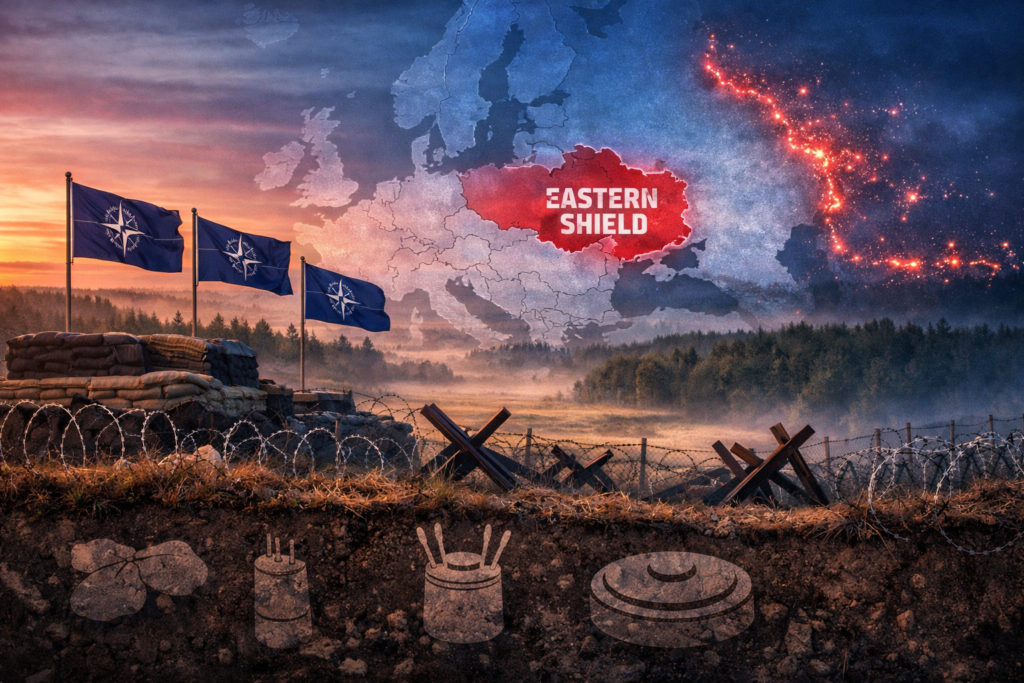
A New Vision for “Eastern Shield”
Polish leaders, including Prime Minister Donald Tusk and Deputy Defense Minister Paweł Zalewski, say the change is about defensive readiness, not aggression.
In public statements, Tusk underscored that Poland will be able to lay defensive minefields along its eastern borders within 48 hours of a credible threat, part of an overarching defensive initiative dubbed “Eastern Shield.”
Zalewski explained that Poland plans to resume domestic production of anti-personnel mines for the first time since the Cold War — a capability the government says is necessary to deter Russia while NATO’s eastern flank remains vulnerable.
“We are not aiming to be an aggressive country,” he said, “but we must use every means to deter Russia and protect our people.”
Poland also plans to integrate anti-tank mines and advanced mine-laying systems, like the Bluszcz unmanned vehicle, into its defense network — though those weapons are not banned by the treaty and were never covered by the Ottawa Convention.
The Humanitarian Cost of Land Mines
Despite Warsaw’s assurances that mines would only be used if a real threat materializes, human rights groups have condemned the decision, warning that anti-personnel mines are among the world’s most indiscriminate weapons. Civilians returning to previously mined lands often face deadly dangers long after conflicts end — as seen in Angola, Cambodia and Bosnia — where mines have maimed or killed thousands of innocent people.
Critics argue that mines can linger underground for years, capturing the lives of farmers, children, travelers and displaced families — and that modern defensive technologies can provide alternatives without such long-lasting impacts on civilian life.
Poland and its neighbors counter that their populations could be directly in harm’s way if national defenses remain constrained. Still, the ethical debate remains intense: security planners and humanitarian advocates are now at odds over whether deterrence justifies returning to weapons once widely condemned by the global community.
Broader Regional Implications
Poland’s decision is emblematic of a broader shift in European security thinking since Russia’s full-scale invasion of Ukraine. Other nations — including Finland, the Baltic states and even Ukraine itself — have cited existential military threats as the key factor in reconsidering long-standing disarmament commitments.
This shift reflects a grim calculation: treaties crafted in the 1990s assumed a world gradually moving away from large-scale territorial wars. The war in Ukraine has shattered those expectations, prompting Poland’s leaders to argue that defensive minefields could be life-saving deterrents rather than relics of outdated tactics.
Yet the move also underscores a paradox: while the Ottawa Convention was designed to protect civilians worldwide, the modern security environment is pushing nations to reassess those protections in favor of immediate sovereignty and territorial defense.
Poland’s Official Stance: Defense, Not Offense
Throughout the public debate, Polish officials have repeatedly stressed that the reintroduction of anti-personnel mines would be strictly defensive — used only in the event of an actual attack.
Prime Minister Tusk has framed the mining capability as part of an integrated border defense, not a resort to offensive warfare, and has emphasized that residents would not lose unrestricted access to their communities unless a legitimate and imminent threat exists.
This framing attempts to strike a balance between deterrence and everyday safety for citizens living near Poland’s long border with Russia, Belarus and the Russian exclave of Kaliningrad.
What Comes Next
Poland’s exit from the Ottawa Convention will likely accelerate discussions among NATO members about the role of controversial weapons in modern conflict — especially on the alliance’s eastern edge. Some nations may view Poland’s move as a necessary response to Russian aggression; others may see it as a step backward in humanitarian progress.
For civilians in conflict zones and supporters of global disarmament, the announcement is a stark reminder of the persistence of war’s ethical dilemmas: How do nations protect their people without repeating the horrors of past battlefields? And what price is acceptable for security?
As Warsaw’s leaders prepare new defense plans under the Eastern Shield rubric, the world watches closely — a mix of cautious support and deep concern shaping the debate on land mines, borders and the future of armed conflict in Europe.