OpenAI to Test ChatGPT Ads in U.S.: What It Means for Users
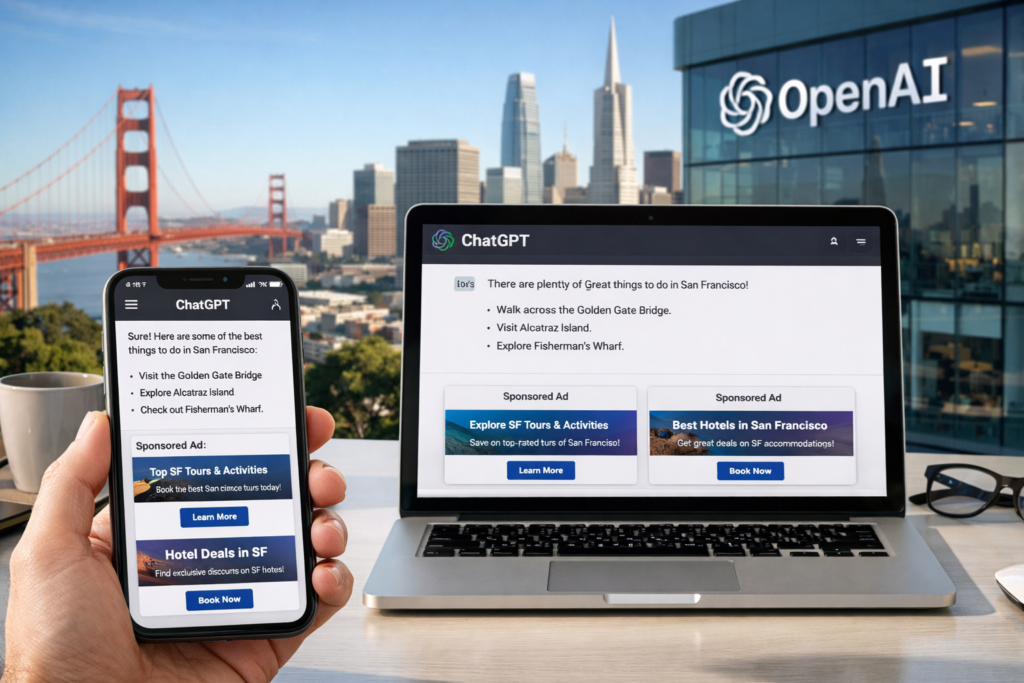
OpenAI, the Silicon Valley startup behind the wildly popular artificial intelligence chatbot ChatGPT, announced this week that it will begin testing advertisements within the ChatGPT experience for U.S. users — a major shift in the company’s business strategy that could redefine how billions interact with AI.
The experiment will initially target adult users in the United States who are using ChatGPT’s free tier or its lower-cost subscription plan, ChatGPT Go — a recent addition to the AI company’s lineup. Ads will not appear in paid tiers like Plus, Pro, Business, or Enterprise, which remain strictly ad-free.
A Major Shift in ChatGPT’s Business Model
For years, OpenAI resisted placing advertisements inside ChatGPT, favoring a predominantly subscription-driven model. But as the company invests heavily in advanced AI infrastructure — with costs that run into the billions — leadership says it’s exploring new ways to keep advanced AI accessible while balancing revenue requirements.
In a blog post outlining the changes, OpenAI explained that ads will be clearly labeled and separated from the chatbot’s responses. They will appear at the bottom of a conversation or answer, and only when they are relevant to the user’s query or context. Importantly, ChatGPT’s AI output itself will not be influenced by advertisers, according to company officials.
“This is not about manipulating our users,” one OpenAI spokesperson said in a statement. “Ads will support broader access to AI tools without compromising privacy or the integrity of the answers ChatGPT provides.”
How ChatGPT Ads Will Work
According to OpenAI’s outline:
- Ads will be clearly marked as sponsored content, separate from the AI’s response text.
- They will appear for adults in the U.S. using ChatGPT’s free version or the ChatGPT Go plan.
- Conversations will remain private, with no sharing of private dialogues with advertisers.
- Users will be able to turn off personalized ads and clear data used for advertising personalization.
- Ads will not be shown to users under 18, nor will they be displayed alongside sensitive topics such as health, mental health or politics.
For example, if a user asks ChatGPT for travel advice about visiting New York City, the AI will first generate its answer. Then, relevant ads — like sponsored suggestions for hotels or tours — could appear below the response.
Why OpenAI Is Adding Advertising
ChatGPT boasts an astounding user base: hundreds of millions of weekly active users worldwide, most of whom access the platform for free. While subscription revenue from Plus and higher tiers brings significant income, it still doesn’t cover the immense expenses tied to developing cutting-edge models and supporting large-scale infrastructure.
Chief among these expenses are data centers, GPU hardware and bandwidth costs — investments that are expected to continue rising as AI grows more sophisticated. Ads are seen as one way to monetize a giant free user base without forcing everyone to pay subscription fees.
OpenAI’s leadership emphasizes that this approach is designed to strike a balance between broad accessibility and financial sustainability. CEO Sam Altman and other executives have said the company will monitor user feedback closely during the rollout and refine ad placement based on what users want and industry standards.
Industry Reactions and User Concerns
The news has sparked mixed reactions across the tech world. Some analysts argue that integrating ads — even in a carefully controlled manner — may be a pragmatic step toward profitability for a company valued at hundreds of billions but still operating at a loss. Others raise concerns that advertisements could erode user trust and degrade the clean, distraction-free experience that drew millions to ChatGPT in the first place.
Digital rights advocates warn that even clearly labeled ads can create ethical questions about AI recommendations, especially when users depend on ChatGPT for sensitive tasks like healthcare research or legal guidance. To mitigate this, OpenAI has pledged to keep ad visibility away from sensitive topics and intends to prioritize user trust over maximizing advertisement exposure.
Major competitors — including Google’s Gemini and Anthropic’s Claude — are watching closely, as changes to ChatGPT’s ad strategy may ripple across the AI industry. Some expect that successful implementation could encourage rival AI platforms to explore similar monetization strategies.
What It Means for Users
For millions of ChatGPT users, the change will be noticeable but not intrusive — at least in the initial testing phase. Ads are expected to be clearly marked and limited to relevant content, rather than embedded within AI responses. Paid tiers will remain without ads, giving users the option to pay for a clean experience.
Users under 18 will be spared from seeing any ads — a major consideration given ChatGPT’s widespread educational and student use — and sensitive subject areas like health and political discussions will also be protected from monetization.
OpenAI’s approach attempts to strike a middle ground: keeping the core product useful and trustworthy while generating revenue from users who choose not to pay, thus supporting broader and more equitable access to AI tools.
Looking Ahead
As ChatGPT’s advertisements begin testing across the U.S., the digital world will be watching to see how users respond. Will ads become a staple of AI interactions? Or will users migrate to platforms that remain entirely ad-free? Only time will tell. For now, OpenAI’s pivot into advertising marks a watershed moment in the evolution of AI platforms, as developers and users alike rethink how artificial intelligence fits into a subscription-driven, ad-supported digital economy.