Oklahoma Set to Execute Man in 2006 Drive-By Killings — A Family’s Pain, A State’s Justice, and a Broader Debate on the Death Penalty
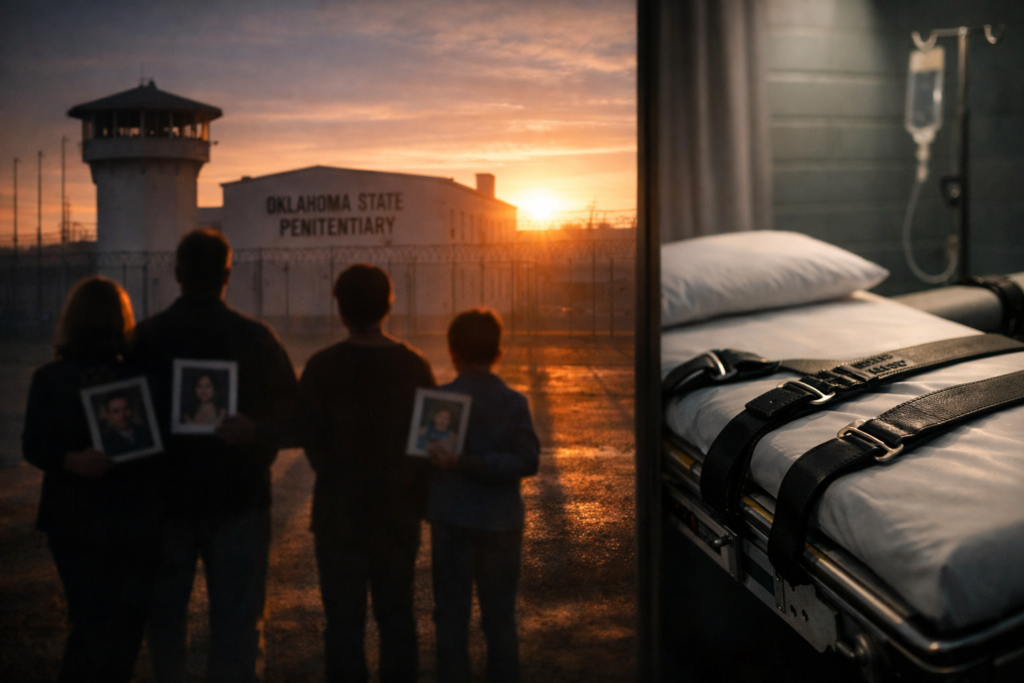
MCALESTER, Okla. — On a chilly morning in February, a hush settled over the Oklahoma State Penitentiary as authorities prepared to carry out one of the most talked-about executions in the state’s recent history. Kendrick Antonio Simpson, 45, was scheduled to receive a lethal injection Thursday for the 2006 drive-by shooting deaths of two young men — a crime that shocked Oklahoma City and set in motion a long legal and emotional journey for the victims’ families and Simpson himself.
This execution was not just another entry on the state’s death-row roster. It was the first in Oklahoma in 2026 and only the second in the United States this year, placing a familiar and fraught national issue — capital punishment — back in the spotlight.
A Crime That Altered Lives
The violent episode that led to Simpson’s death sentence began late one January night in 2006, after an altercation at a nightclub in northwest Oklahoma City. According to prosecutors, Simpson had placed an assault rifle in the trunk of a vehicle driven with friends and, after the dispute, followed two young men — 19-year-old Anthony Jones and 20-year-old Glen Palmer — from a gas station.
What followed was chilling and swift: Simpson allegedly raised the gun out the car window and fired about 20 rounds into their vehicle, striking both victims multiple times and killing them. A third man in the car survived but was wounded.
For the families of the victims, the events of that night have never been a distant memory. “When Kendrick Simpson took my brother’s life, he took all our lives,” said a relative during post-trial proceedings — words that echo with deep emotional weight years later.
Simpson’s Apology and the Fight for Mercy
In the years since his conviction, Simpson’s case became one rooted in both accountability and complexity. At a clemency hearing in January 2026, Simpson stepped forward and offered a rare public apology — not just to the families of Jones and Palmer but also to the third man who was in the car that night.
“I apologize for murdering your sons,” Simpson said. “I don’t make any excuses. I don’t blame others, and they didn’t deserve what happened to them.”
His legal team argued that Simpson’s background — including exposure to chronic trauma, post-traumatic stress disorder, and hardships stemming from his upbringing in New Orleans — merited mercy and compassion. They urged that his case, while tragic, didn’t fit the traditional model of “the worst of the worst” offenders for whom the death penalty was designed.
Despite this plea, the five-member Oklahoma Pardon and Parole Board narrowly denied clemency, and a last-ditch appeal to the U.S. Supreme Court was also rejected without comment, clearing the way for the execution to proceed.
Victims’ Families and Calls for Justice
For the grieving families of the victims, the hearing did more than revisit old wounds — it affirmed their belief in justice served. Several relatives wrote letters and spoke out in support of Simpson’s execution, expressing that his actions that night took something irreplaceable from them.
“Do I believe this man should live and be able to breathe and take out the rest of his life behind a cell?” asked Glen Palmer’s sister, Crystal Allison, in a heartfelt letter to the parole board. “He made the choice for him so I stand here today to make the choice for my family.”
Their voices reflect a deep emotional truth: that when lives are cut short in violent ways, the pain for loved ones can last decades and never truly fade.
How the Execution Would Unfold
Oklahoma’s plan for Simpson’s execution followed the state’s three-drug lethal injection protocol, beginning with midazolam (a sedative), then vecuronium bromide (to halt breathing), and finally potassium chloride (to stop the heart). This combination, designed to render the inmate unconscious before ceasing vital functions, has been standard in many states for years.
This process would mark the first use of the state’s death chamber in 2026, after Florida carried out an execution earlier in the week — continuing a broader national pattern where some states press ahead with capital punishment while others pause, debate, or abolish it.
Capital Punishment in America: A Broader Context
Simpson’s scheduled execution underscores the ongoing debate over the death penalty in the United States. In 2025 alone, 47 people were executed nationwide, with Florida carrying out a record 19 — followed by Alabama, South Carolina and Texas. Oklahoma, long known for its use of capital punishment, remains a major actor in this controversial system.
Critics of the death penalty point to concerns about fairness, the possibility of wrongful convictions, and racial disparities in sentencing. Supporters argue it serves justice for the most heinous crimes and closure for victims’ families. In cases like Simpson’s, these debates are not abstract — they’re lived realities for people who have lost loved ones or watched someone change behind bars over years.
Moral and Emotional Ripples
Among death-penalty opponents and advocacy groups, Simpson’s case reignited long-standing questions about whether states should continue executing inmates, especially when mental health and traumatic backgrounds play a role. Some observers noted that a death sentence removes any possibility of future rehabilitation or redemption, raising ethical questions even in cases with seemingly clear guilt.
But for families who have endured decades of grief and loss, the execution remains, for many, a moment of resolution — a visible sign that the justice system has reached what they see as its natural conclusion.