North Korea’s Kim Yo Jong Warns U.S. and South Korea Over Military Drills, Escalating Regional Tensions
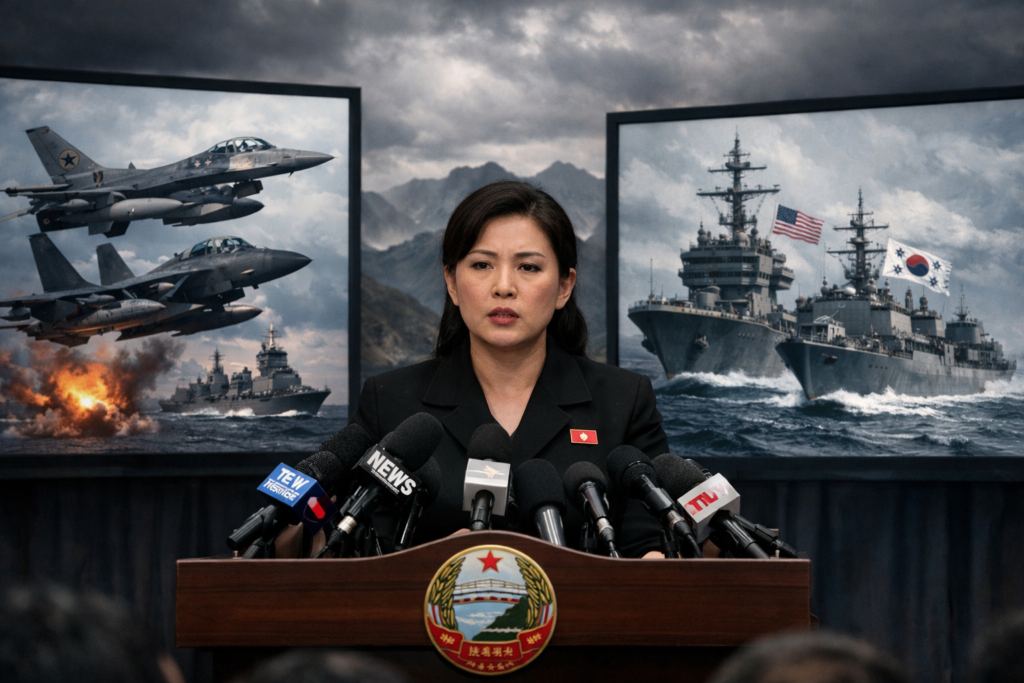
Tensions on the Korean Peninsula are rising again after a powerful voice inside North Korea sharply criticized joint military exercises conducted by the United States and South Korea.
The warning came from Kim Yo Jong, the influential sister of North Korean leader Kim Jong Un. Her remarks have drawn global attention because she is widely viewed as one of the most powerful and trusted figures in Pyongyang’s leadership circle.
Kim Yo Jong accused Washington and Seoul of increasing regional instability by continuing their annual joint military drills. The exercises, she said, represent a serious provocation that could intensify the already fragile security situation on the Korean Peninsula.
Her comments come during a period of heightened geopolitical tension across Asia, where military activities and strategic competition are increasingly shaping diplomatic relations.
Military Drills Spark Renewed Confrontation
The United States and South Korea regularly conduct joint military exercises designed to strengthen their defense alliance and prepare for potential security threats in the region.
These exercises typically include air operations, naval maneuvers, and ground-based training designed to improve coordination between the two militaries.
Officials in Washington and Seoul argue that the drills are purely defensive. They say the exercises are necessary to maintain readiness and ensure the stability of the Korean Peninsula.
But North Korea has long viewed the exercises as hostile.
Pyongyang frequently condemns the drills as rehearsals for invasion, and it often responds with strong rhetoric or military demonstrations.
Kim Yo Jong’s latest criticism reflects that long-standing stance.
She warned that continued military cooperation between the United States and South Korea could push the region toward greater confrontation.
Kim Yo Jong’s Growing Political Influence
Although Kim Jong Un remains the undisputed leader of North Korea, his sister has become one of the most visible and influential voices in the country’s political system.
Over the past several years, Kim Yo Jong has taken on a more prominent role in public messaging and diplomatic signaling.
Her statements are often interpreted as direct reflections of the leadership’s strategic thinking.
Political analysts say her involvement in high-profile announcements suggests she plays a significant role in shaping North Korea’s foreign policy messaging.
When she speaks publicly about military issues or international relations, global observers pay close attention.
Her remarks frequently signal how the North Korean leadership views developments involving the United States and its allies.
A Long History of Tension
The Korean Peninsula has remained technically at war since the Korean War ended with an armistice rather than a formal peace treaty.
For decades, the region has experienced cycles of confrontation and diplomatic engagement.
At times, negotiations between Washington, Seoul, and Pyongyang have raised hopes for progress on issues such as nuclear disarmament and regional security.
At other times, missile tests, military drills, and political rhetoric have heightened tensions.
North Korea’s nuclear weapons program has been a central source of international concern.
The country has conducted multiple nuclear tests and ballistic missile launches over the years, prompting sanctions and diplomatic pressure from the international community.
The United States and its allies argue that military preparedness is necessary because of these security risks.
North Korea, meanwhile, insists that its weapons programs are defensive and necessary to deter foreign threats.
Regional Security Concerns
The latest dispute over military exercises comes at a time when security concerns in the Asia-Pacific region are already elevated.
Strategic competition among major powers has intensified in recent years, particularly as countries strengthen military alliances and expand defense capabilities.
South Korea and the United States maintain one of the region’s most significant defense partnerships.
Tens of thousands of American troops are stationed in South Korea as part of a long-standing security agreement designed to deter aggression from the North.
The joint military drills are an important component of that partnership.
However, they often trigger strong reactions from North Korea.
Analysts say the cycle of drills followed by warnings or military responses has become a recurring pattern in regional security dynamics.
Diplomatic Challenges Ahead
Efforts to restart diplomatic negotiations with North Korea have faced significant obstacles in recent years.
Previous talks focused on reducing North Korea’s nuclear program in exchange for sanctions relief and economic cooperation.
While those discussions briefly showed promise, they ultimately stalled without a comprehensive agreement.
Since then, relations between North Korea and the United States have remained largely frozen.
The latest warnings from Kim Yo Jong highlight the continuing difficulty of finding common ground on security issues.
Diplomatic experts say progress will likely require renewed engagement and careful negotiation among regional powers.
The Global Implications
Developments on the Korean Peninsula have far-reaching implications beyond the region.
Any escalation in tensions could affect international security, global markets, and diplomatic relations among major powers.
The United States continues to emphasize its commitment to defending South Korea and maintaining stability in the region.
At the same time, leaders in Washington and Seoul have repeatedly stated that they remain open to diplomatic dialogue with North Korea.
Whether those diplomatic opportunities emerge remains uncertain.
For now, Kim Yo Jong’s warning underscores the fragile balance of power in one of the world’s most sensitive geopolitical regions.
As military drills continue and political rhetoric intensifies, the international community will be watching closely to see whether the situation moves toward confrontation or renewed dialogue.