North Korea’s Kim Jong Un Gifts Sniper Rifles, Puts Spotlight on Daughter at Military Event
In a rare and striking display of military symbolism, North Korean leader Kim Jong Un handed out a new generation of sniper rifles to top political and military officials this week, an event that state media framed as a sign of deep trust — and that highlighted his teenage daughter in an unusual and highly public way. The images and details emerging from Pyongyang have sparked fresh international curiosity about the future of leadership in the isolated, nuclear-armed state and cast light on a carefully choreographed moment of political theatre.
The distribution of the rifles took place on Friday, near the end of the 9th Workers’ Party of Korea Congress, the country’s most important political gathering that occurs roughly every five years. In state media coverage, Kim presented the weapons to members of the Central Military Commission, senior commanders in the Korean People’s Army, and other high-ranking officials — including his influential sister, Kim Yo Jong, who was identified for the first time as director of the party’s General Affairs Department.
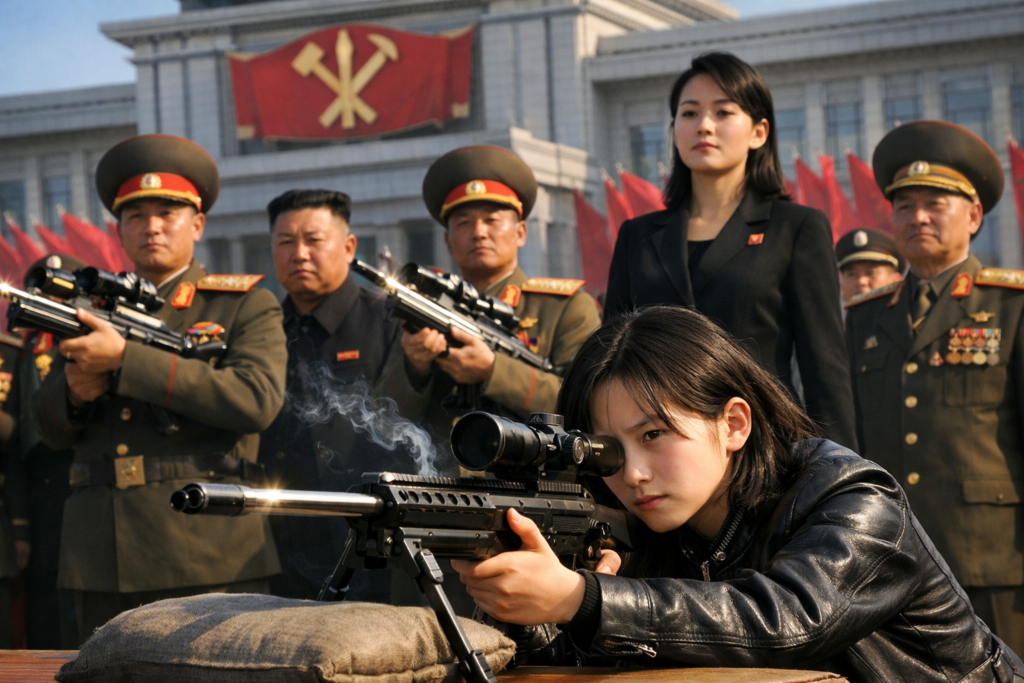
State television footage and photographs released by the Korean Central News Agency (KCNA) showed the new sniper rifles being handled by Kim himself and the officials he honored, who were formally introduced to the weapons after receiving certificates. The rifles — described by Kim as “wonderful weapons” developed by the country’s Academy of Defence Science — were depicted as both practical tools and symbolic badges of loyalty.
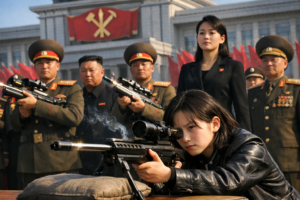
But what captured the world’s attention was not just the weapons themselves, but the presence of Kim’s teenage daughter, widely known as Kim Ju Ae, who was shown taking aim and firing a rifle at a shooting range with adults nearby. In one image, she stood alone at a target, peering through a scope with smoke trailing from the barrel, clad in a leather-style coat that echoed her father’s well-documented fashion and political image.
Ju Ae — believed to be in her early teens — has increasingly appeared alongside her father in state media coverage and at high-profile events since her public debut at a missile test site in late 2022. Her latest outing at the firing range and during the gifts ceremony has reinforced speculation among analysts and intelligence officials that North Korea may be positioning her gradually for a future leadership role beyond her teenage years.
South Korea’s National Intelligence Service (NIS) has publicly assessed that Ju Ae appears to be moving toward a formal role within the regime’s leadership succession planning. Earlier this month, the agency suggested she might already be offering policy input and is perceived internally as something like a second-in-command in preparation for eventual leadership. Though no formal post has been announced — in part because party rules technically require members to be adults — her increasing visibility has been unmistakable.
While analysts caution that speculation about succession in Pyongyang is inherently uncertain, the optics are hard to ignore: state releases show her handling weapons and standing proudly beside her father during key moments of the party congress, including a massive military parade earlier in the week that underscored North Korea’s expanding arsenal and technological ambitions.
The choice of a rifle is particularly notable. In most nations, military-grade firearms are symbols of combat readiness, elite capability and national defense — and in authoritarian states like North Korea, they can also serve as powerful symbols of legitimacy and authority. In that context, Ju Ae’s presence at the shooting range suggests a very specific narrative: that she is being introduced publicly as someone versed in the martial ethos at the heart of the regime’s identity.
Kim Yo Jong’s elevated role also stands out. Once considered a close advisor and outspoken defender of her brother’s positions — particularly in confrontations with the United States and South Korea — she now carries a formal party title that places her at the center of internal administration. Her promotion signals that Kim Jong Un is consolidating authority within trusted family lines and loyalists, even as external speculation turns toward Ju Ae’s future trajectory.
The rifle ceremony capped a week of orchestrated events meant to reinforce the regime’s image of unity and strength. The party congress itself laid out ambitious goals for expanding North Korea’s military and nuclear capabilities, while reiterating a defiant stance toward South Korea and conditions for possible dialogue with the United States. This blend of hardline rhetoric and ceremonial symbolism was echoed in every official broadcast and ceremony during the gathering.
Observers outside the country note that state media in Pyongyang rarely mishandles messages about succession and loyalty. The spotlighting of Ju Ae at this moment — even without an official title — suggests a deliberate strategy to acclimate domestic and military audiences to her presence in positions associated with power and responsibility. In tightly controlled North Korean society, images like her firing a rifle carry far more weight than a simple family appearance; they are meant to convey lineage, capability and continuity.
International reactions have largely focused on interpreting these images as part of the opaque choreography of North Korean politics. Some analysts point out that succession in Pyongyang has always been presented through carefully calibrated symbolism rather than overt announcements, and that Ju Ae’s increasing visibility aligns with that pattern. Others warn that foreign governments may read more into the situation than the leadership intends, underestimating how tightly scripted every public moment is in the hermit kingdom.
Whether Ju Ae will one day inherit her father’s mantle remains an open question, but for now, her presence at the rifle ceremony and the broader party events highlights how North Korea continues to weave family, military authority and political ritual into its public narrative. For analysts watching closely, these moments offer rare clues about how one of the world’s most secretive regimes manages power and prepares for its uncertain future.