North Korea Test-Fires Long-Range Cruise Missiles, Signalling Military Buildup Before Party Congress
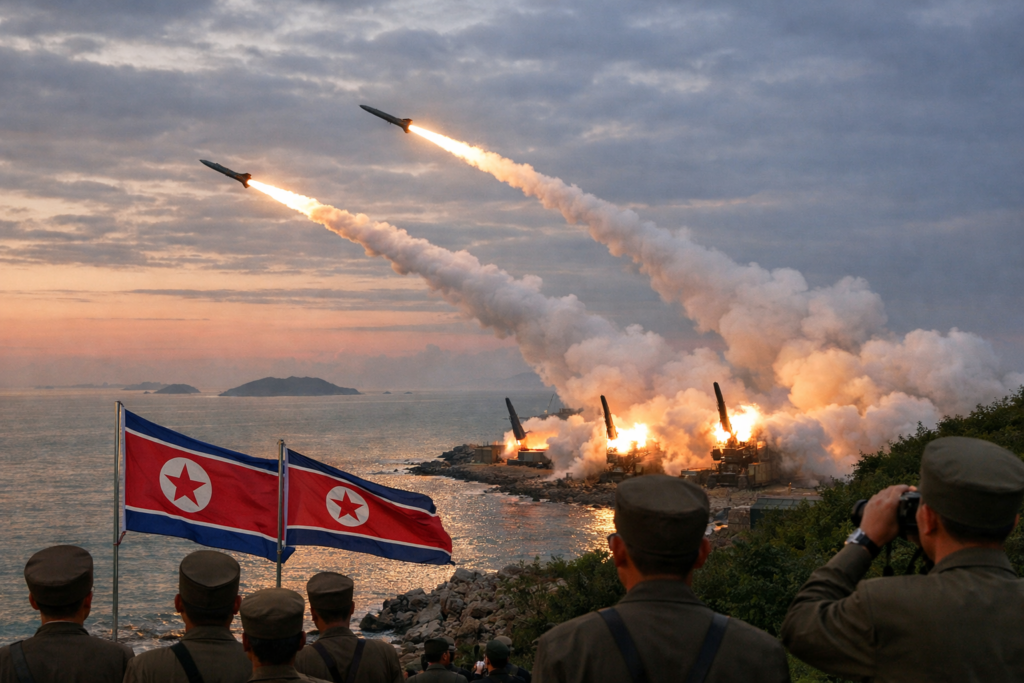
SEOUL — North Korea announced on Sunday that it successfully test-fired long-range strategic cruise missiles over the Yellow Sea, a show of strength that state media insist reinforces the country’s nuclear deterrence and defense posture amid ongoing regional tensions. The launches come as Pyongyang prepares for the ruling Workers’ Party of Korea’s congress — its first in five years — and are likely intended to signal both domestic unity and external resolve.
State-run Korean Central News Agency (KCNA) reported that leader Kim Jong Un personally oversaw the missile drills on Sunday, which involved multiple cruise missiles that flew precise trajectories before striking designated targets over open waters. Kim expressed “great satisfaction” with the operation, describing it as a demonstration of North Korea’s improved nuclear deterrent capabilities and combat readiness in the face of what he called ongoing security threats.
North Korea’s long-range cruise missiles are designed to fly at low altitudes and use advanced guidance systems that make them difficult to detect on radar, raising concerns among defense analysts about their potential use in future conflicts. While United Nations Security Council resolutions ban most ballistic missile tests, these cruise missile launches are not explicitly prohibited — yet they still represent a significant escalation of North Korea’s weapons testing program.
South Korea’s Joint Chiefs of Staff confirmed detection of the launches from the Sunan area near the North Korean capital, with some missiles heading out over the West Sea on Sunday morning. Seoul reiterated its commitment to maintaining readiness in close coordination with the United States, underscoring ongoing alarm in Seoul and Washington about Pyongyang’s expanding military capabilities.
The missile tests come shortly after North Korea displayed progress on other defense projects, including the construction of a nuclear-powered submarine capable of launching strategic weapons, a development that has also attracted global scrutiny. With many observers watching closely ahead of the January 2026 party congress, questions remain about whether Pyongyang might use such displays to seek leverage in future diplomatic talks with Washington and other countries.
Analysts said the latest cruise missile drills demonstrate North Korea’s dual emphasis on deterrence and technological advancement, though they also increase geopolitical tensions in the Asia-Pacific region. The tests are expected to feature in assessments of Pyongyang’s nuclear capabilities and strategic ambitions at regional security forums later this year.