National Redistricting Battle Intensifies as States Prepare for 2026 Midterm Elections
WASHINGTON, D.C. — A major political battle over congressional map boundaries is expanding across the United States as lawmakers, activists and courts jockey for advantage ahead of the pivotal 2026 midterm elections. What began this year with a controversial redrawing of Texas’s U.S. House districts has grown into a nationwide struggle over partisan control and electoral influence that could reshape the balance of power in Congress.
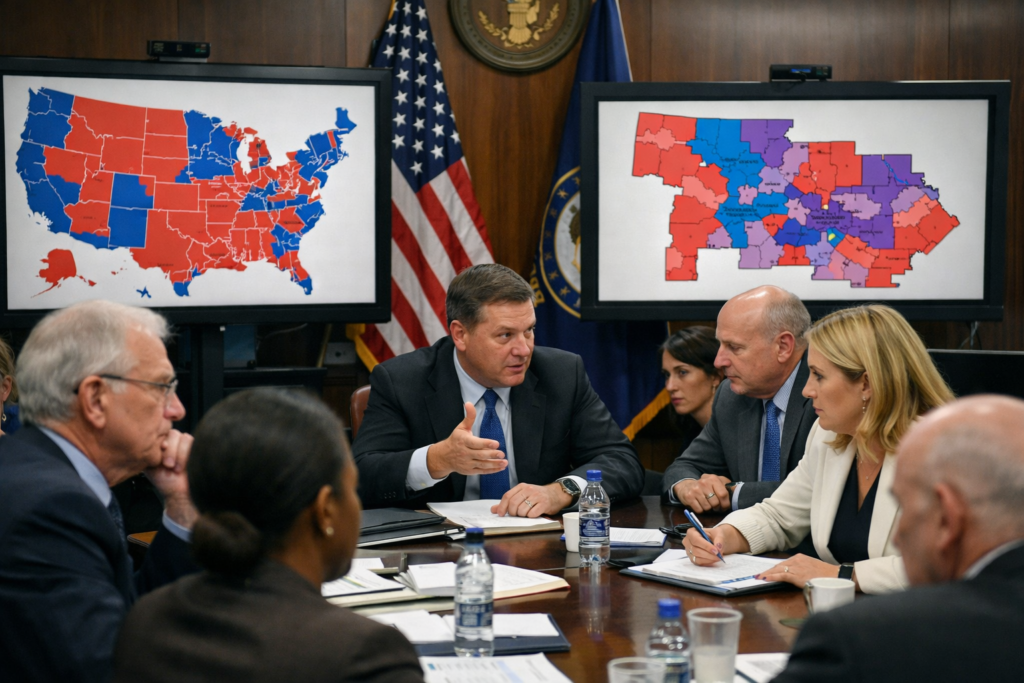
The uproar began in July 2025 after Republican leaders in Texas adopted a new congressional map — a mid-decade change pushed by former President Donald Trump — intended to boost Republican chances by creating up to five additional GOP-leaning seats. That move, unusual because redistricting typically takes place once every ten years after the census, sparked immediate legal challenges and aggressive political reactions across multiple states.
A federal judge later blocked Texas’s new map from being used in next year’s midterms, ruling that the proposed lines were likely an unconstitutional racial gerrymander. The court’s decision boosted critics of partisan redistricting and underscored how courts are becoming central players in resolving these high-stakes disputes.
California voters also entered the fray when they approved Proposition 50, empowering Democratic lawmakers to redraw that state’s congressional maps. Supporters argue the changes will help protect and expand Democratic representation, potentially gaining up to five new seats — a direct counter to Republican efforts elsewhere.
In Missouri and North Carolina, legislatures have passed new congressional maps that could increase Republican representation, even as lawsuits and citizen petitions seek to delay or block their implementation. Meanwhile, legislative bodies in states such as Maryland and Florida have begun preliminary talks on redistricting, and New York could see judicially imposed changes if ongoing legal challenges succeed.
One of the most dramatic developments occurred in Indiana, where state senators rejected a Trump-backed redistricting plan that would have significantly altered the state’s congressional map. That rare intra-party split highlights how redistricting has become a flashpoint not only between Democrats and Republicans but even within party ranks.
Political analysts say this mid-decade redistricting battle represents one of the most aggressive attempts by both parties to shape electoral terrain beyond the traditional census cycle. With control of the U.S. House hinging on a handful of seats, who draws the congressional lines could determine the next balance of power in Washington.