NASA’s Artemis II Moon Mission Delayed: Giant Rocket Heads Back to Hangar for Repairs
CAPE CANAVERAL, Florida —In a twist that has NASA teams and space fans alike holding their breath, the long-awaited Artemis II mission — set to send astronauts beyond Earth’s orbit for the first time in more than five decades — has hit another challenge that will delay its historic launch.
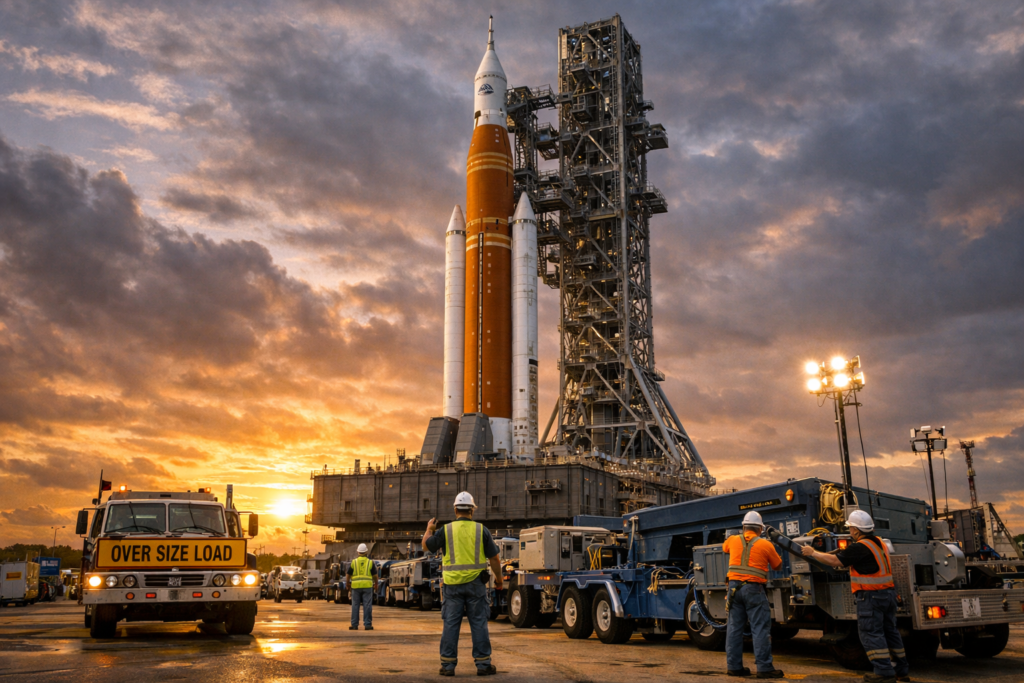
Instead of blasting off from Launch Complex 39B at the Kennedy Space Center in Florida this March, the Space Launch System (SLS) rocket carrying the Orion spacecraft is now being rolled back to the Vehicle Assembly Building (VAB) for repairs after engineers uncovered a critical technical issue.
This setback means that the launch window NASA had been targeting — March 6 — is no longer viable, and the earliest possible opportunity is now early April, a shift that has softened national excitement even as engineers work tirelessly behind the scenes.
A Near-Historic Moment Paused
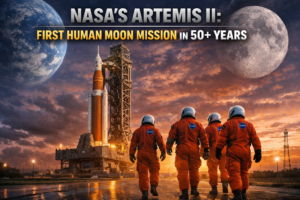
The Artemis program marks America’s ambitious return to lunar exploration more than 50 years after the last Apollo mission in the early 1970s. Artemis II was poised to be the first crewed NASA mission to travel around the Moon since then, carrying four astronauts — three Americans and one Canadian — on a roughly 10-day journey that will push human spaceflight deeper into space than ever before.
But that dream has been temporarily put on hold.
During a routine series of tests following a recent wet dress rehearsal — a careful simulation of fueling and launch procedures — teams detected an interruption in the helium flow to the rocket’s upper stage, a part of the spacecraft essential for pressurizing fuel tanks and clearing critical lines before liftoff.
Without that flow behaving exactly as planned, NASA simply cannot risk proceeding — not with four lives, or decades of scientific and engineering progress, on the line.
Why Helium Matters More Than You’d Think
If you picture a rocket as a finely tuned orchestra, then helium is one of its most unsung instruments. Though it doesn’t power engines like liquid hydrogen or oxygen, helium plays a vital supporting role: it helps pressurize fuel tanks and ensures propellants are properly routed and ready for ignition.
During normal launch operations, helium is pumped through valves and lines in the upper stage. If this system becomes blocked or inconsistent, the whole rocket can’t safely advance through its countdown checklist.
This latest glitch didn’t show up during earlier test rehearsals — but it showed up at the worst possible moment. Engineers say the only way to access and fix it is to bring the rocket out of its launch configuration and back to the controlled environment of the Vehicle Assembly Building.
The Slow Road Back to Repairs
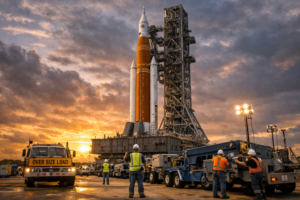
Rolling a rocket of this size is an extraordinary logistical feat. Standing more than 322 feet tall — taller than the Statue of Liberty — the SLS is one of the largest rockets ever built.
To move it safely, NASA uses massive crawler-transporters — mechanized platforms that carry the rocket and its mobile launch platform at a pace of approximately 1 mile per hour.
The journey from the launch pad back to the Vehicle Assembly Building will be slow, steady and cautious, taking up to 12 hours under close weather monitoring.
This isn’t a simple turn-around; it’s a deliberate maneuver that showcases NASA’s commitment to safety and precision, even when it means pushing back a much-anticipated mission.
Disappointment and Determination
Understandably, the news has sparked an emotional response from space enthusiasts across the nation.
“I know that people are disappointed by this development,” NASA Administrator Jared Isaacman wrote in a message shared online. “That disappointment is felt deeply by the team at NASA who have been working tirelessly for this great endeavor.”
Those words echo not just professional resolve but a very human sense of both pride and frustration. For the engineers, scientists and mission specialists who have poured their lives into Artemis II, this pause is a reminder that space travel remains unforgiving and unpredictable — even as it pushes the boundaries of human achievement.
Looking Toward April and Beyond
While March is no longer an option, NASA officials are hopeful the team can complete repairs in time for a launch attempt in early April, provided weather conditions and technical milestones align.
Reaching deep space isn’t just about raw power — it’s about timing, teamwork and precision. After all, Artemis II is not just one mission; it’s a crucial stepping stone toward Artemis III, which aims to land humans on the lunar surface again by the end of the decade.
The astronauts assigned to Artemis II are currently on standby near Houston, training and preparing for the moment they can finally leave Earth’s orbit and make history.
What This Means for America
In a time when global competition in space exploration is increasing, every milestone — and every setback — carries weight not only for NASA but for public imagination and national pride.
The Artemis program has become a symbol of American innovation and curiosity. And though this delay is disappointing, it also underscores one of the most essential truths of space exploration: we go because it is difficult, not because it is easy.