Minneapolis Family Tear-Gassed During ICE Protest: Infant Hospitalized, Outcry Grows
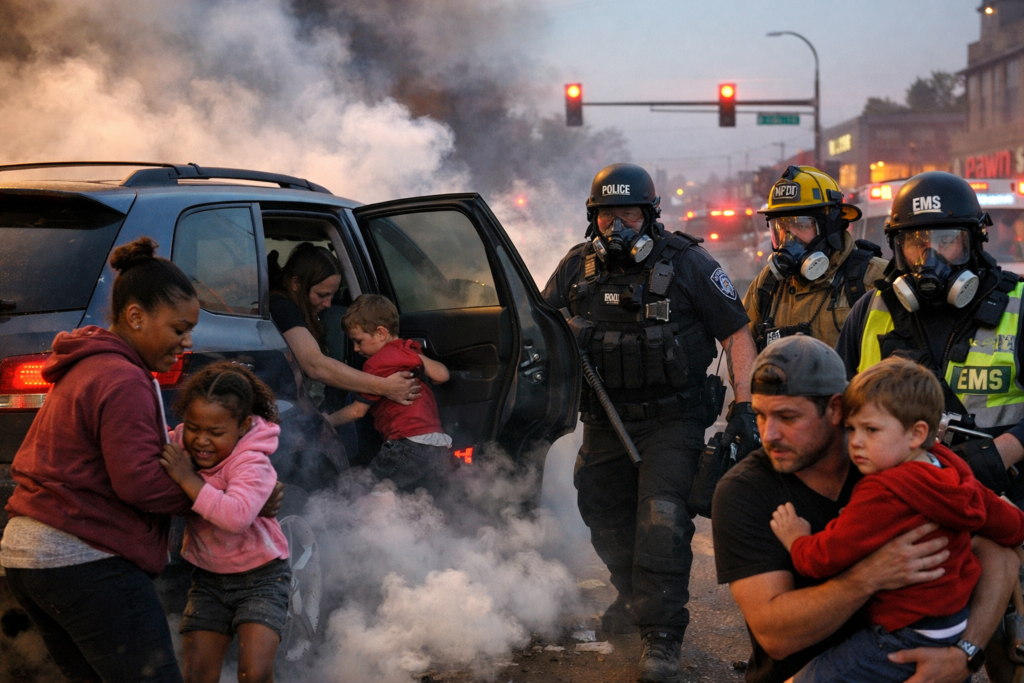
MINNEAPOLIS — A Minneapolis family’s drive home turned into a nightmare Wednesday night after a cloud of tear gas filled their SUV during a clash between federal Immigration and Customs Enforcement (ICE) agents and protestors, leaving their 6-month-old infant in medical distress and sparking new outrage over federal enforcement tactics in civilian neighborhoods.
The Jackson family — parents Shawn and Destiny and their six children ranging in age from 6 months to 11 years — were returning from an evening outing near North Minneapolis when they became trapped between protest activity and federal officers deployed under what the Department of Homeland Security (DHS) calls Operation Metro Surge, an immigration enforcement operation that has drawn widespread criticism.
Caught in the Crossfire
According to Destiny Jackson, her family was driving slowly through a section of blocked-off streets peppered with demonstrators and federal officers when the situation escalated. Jackson says an ICE agent emerged and ordered them out of the area, even as she told officers repeatedly that the family was merely trying to go home.
“I told him, ‘We’re trying to get out of here,’” Jackson recalled. “We weren’t protesting. We just wanted to go home.”
Video footage reviewed by VOXENEWS shows smoke canisters and flash-bang devices detonating near the vehicle, and within moments, a tear gas canister shot onto the street rolled beneath the SUV, quickly filling the cabin with choking fumes.
“I felt it hit the car — like a ball of smoke,” Jackson said. “In seconds, we couldn’t breathe. Everything turned black.”
The doors auto-locked, trapping them inside. The children began screaming amid the acrid haze. Jackson crawled into the backseat, finding the locks by touch and unlocking them so the family could escape. Strangers in the crowd helped pull the children free and shepherded the family into a nearby house for shelter.
Infant in Critical Condition
Emergency crews eventually reached the location, where fire and medical personnel encountered the family. The infant had stopped breathing, according to local officials. Jackson performed CPR on her son until first responders arrived, and he was transported to a local hospital along with several of his siblings.
The Minneapolis Office of Community Safety later confirmed that the infant and another child were hospitalized for respiratory issues after inhaling the gas. The younger child was breathing and in serious but stable condition.
“He was lifeless when we got him out,” Jackson told reporters. “I was praying with every breath I gave him.”
Three of the Jackson family members, including the infant, were treated at the hospital, where they underwent decontamination to remove chemical residue. City officials said that all children were expected to recover, but the incident has left lasting emotional trauma.
Federal Response and Public Outcry
DHS issued a statement defending the actions of its officers, saying the tear gas deployment was aimed at “rioters and agitators” and not specifically at the Jackson family. A department spokesperson also noted that federal agents were following training protocols for crowd control.
However, a now-deleted post on social media from a DHS account initially suggested the family had put their children at risk by driving into the protest zone, a message that was quickly removed amid public backlash.
Local officials and advocacy groups have sharply criticized the federal response. Minneapolis leaders noted that the family was simply trying to leave the area when the gas was released. “This should never have happened to a family with children, especially an infant,” a city statement said.
Civil rights advocates argue that the incident underscores broader concerns about federal enforcement tactics in urban communities, especially when protests and law enforcement operations occur near residential areas.
Community Support and Aftermath
In the wake of the incident, neighbors and community members have rallied around the Jackson family. Bystanders who helped the family escape smoke inhalation have been called heroes by local activists, and several residents have organized support efforts for the family’s recovery.
Shawn Jackson described the emotional toll of the event: “They just didn’t seem to care that there were kids in the car. We trusted they would protect us, and now our lives are changed.”
The episode adds to rising tensions in Minneapolis after a recent ICE-related shooting and ongoing protests against federal immigration enforcement. Federal, state and local officials continue to respond to the unrest with a mix of legal action, public statements and calls for de-escalation.
As the Jackson family recovers physically and emotionally, the broader community grapples with questions about civil liberties, law enforcement boundaries and the safety of families caught in the middle of protest zones.