Jack Smith Testifies to Congress, Warns Americans Not to Take Rule of Law for Granted
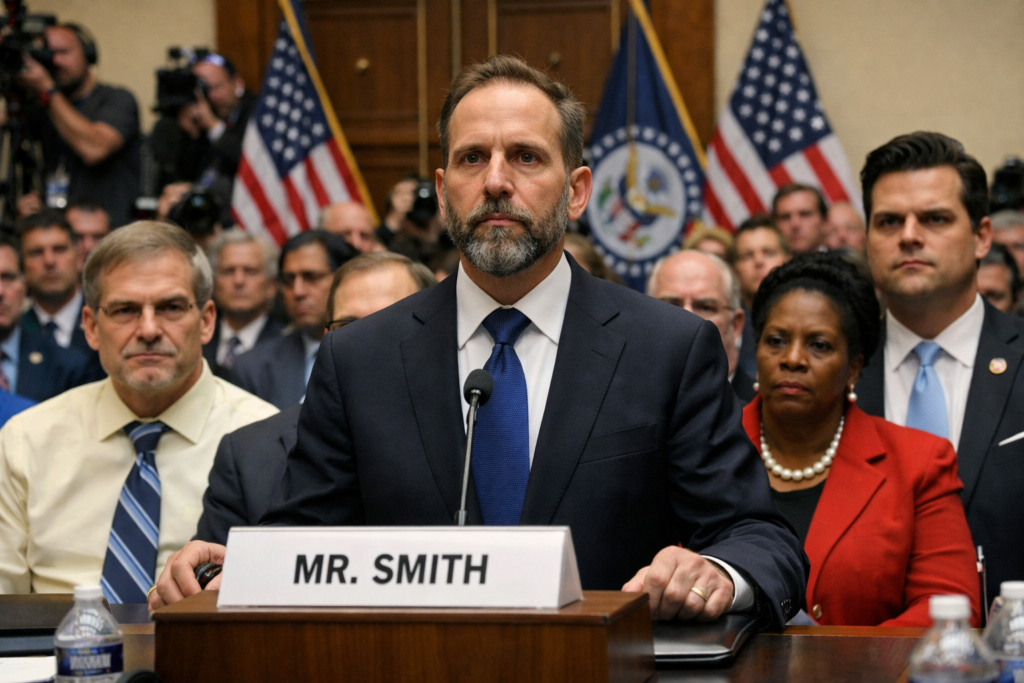
WASHINGTON, D.C. — Former U.S. Special Counsel Jack Smith delivered powerful and historic testimony before the House Judiciary Committee this week, warning Americans that the rule of law — the foundation of the U.S. justice system — is not automatic and should never be taken for granted. Smith’s remarks come as he publicly defended his once-high-profile criminal investigations into President Donald Trump, placing the nation’s democratic norms and legal principles at the center of a fraught political moment.
In a public forum that highlighted deep partisan divisions in Washington, Smith — who led two major investigations into Trump — argued that rule of law depends on collective commitment, dedication and courage, especially when prosecutions unfold amid intense political controversy. His testimony underscores broader tensions over how justice is applied at the highest levels of government and raises urgent questions about public confidence in legal institutions.
The Heart of Smith’s Message: Rule of Law Matters
In prepared remarks obtained by NBC News ahead of his testimony, Smith said he had “seen how the rule of law can erode” and expressed concern that Americans might assume legal protections and accountability would always be upheld without vigilance. He emphasized that the justice system depends on the willingness of public servants and citizens alike to defend it, even when doing so is difficult and carries personal or political cost.
Smith noted that legal systems do not function by themselves. “The rule of law is not self-executing — it depends on our collective commitment to apply it,” he said, according to his prepared statement. He added that a functional democracy requires dedicated service on behalf of others and a willingness to uphold legal standards regardless of political pressures or popularity.
His message was clear: Americans should reflect on how precarious legal norms can be when tested by politics, power and public opinion.
Defending His Investigations Into Trump
Smith’s testimony focused in part on the two major criminal investigations he led as special counsel: one into Trump’s alleged efforts to overturn the 2020 presidential election, and the other into unlawful retention of classified documents at Trump’s Mar-a-Lago estate after he left office. These investigations resulted in historic criminal cases — the first of their kind targeting a former president — though both were dropped after Trump’s reelection in 2024, in line with Justice Department policy against indicting a sitting president.
In his testimony, Smith asserted that his team had developed proof “beyond a reasonable doubt” that Trump committed criminal wrongdoing, including orchestrating a “criminal scheme” to overturn the lawful results of the 2020 election and obstructing government efforts to retrieve classified documents. Smith emphasized that investigative decisions were based on facts and legal standards, not political considerations.
Smith has previously argued — including in closed-door settings before Congress — that his team acted independently and made decisions based entirely on the evidence, irrespective of the political affiliation of those involved. “We took actions based on what the facts and the law required,” he said, calling it a lesson he learned early in his career.
Partisan Divide Over Justice and Accountability
The hearing underscored the deeply partisan landscape in Washington. Republican lawmakers on the Judiciary Committee, led by Chairman Jim Jordan (R-Ohio), have criticized Smith’s investigations as politically motivated and accused the Justice Department of targeting Trump and his allies unfairly. They have probed aspects of the investigations, including the decision to obtain phone records from Republican senators related to the January 6 Capitol attack probe and the firing of FBI and DOJ personnel tied to the cases.
Meanwhile, Smith’s supporters — including many Democrats — argue that the investigations were essential in holding powerful figures accountable and defending democratic norms. They contend that Smith’s warnings about the rule of law underscore why independent, non-partisan justice is vital to American democracy.
Smith also has criticized the erosion of career law enforcement expertise and respect for legal norms within the Justice Department, pointing to widespread turnover and dismissals under the Trump administration that have affected institutional knowledge and morale within the department. Others warn that this trend has contributed to weakening public trust in the system.
What Smith Warned Americans About
Central to Smith’s testimony was not only a defense of his own work, but a broader caution to the public about legal complacency. He told lawmakers that the justice system’s resilience relies on a collective commitment to uphold legal principles — and that when legal protections are viewed as guaranteed, they are vulnerable to erosion.
Smith’s remarks touched on fundamental themes of accountability, public confidence and institutional integrity, warning that complacency could weaken democracy’s foundations. He reminded Congress that legal rights, checks and balances, and fair application of justice must be consciously preserved — not assumed.
The Broader Context
Smith’s testimony comes amid broader debates over how federal law enforcement agencies operate, how political influence interacts with the justice system, and how Americans perceive accountability at the highest levels. Critics of the Trump administration have pointed to actions targeting political opponents and career officials as symptomatic of an attempt to undermine non-partisan legal norms, while supporters argue that critics are weaponizing the justice system for political ends.
This public hearing — the first of its kind for Smith — provides the American public with a rare window into decisions historically made behind closed doors. Many legal analysts view his warnings as an invitation for broader reflection on the importance of democratic institutions and the role they play in securing citizens’ rights.
What Happens Next
Smith’s appearance is expected to fuel further debate in Congress and across the nation about how justice should be administered in politically charged cases. As the political divide deepens, his testimony may influence discussions on congressional oversight, legal reforms and the preservation of the rule of law itself — key issues likely to shape public discourse as the 2026 midterms draw closer.
In a political environment marked by distrust and polarization, Smith’s testimony — and his warning that Americans should never take the rule of law for granted — will resonate with jurists, lawmakers and everyday citizens alike as the nation grapples with questions about fairness, accountability and the future of American democracy.