Iran Protest Crackdown Deepens as Death Toll Surpasses 2,500, Trump Warns of Strong Action
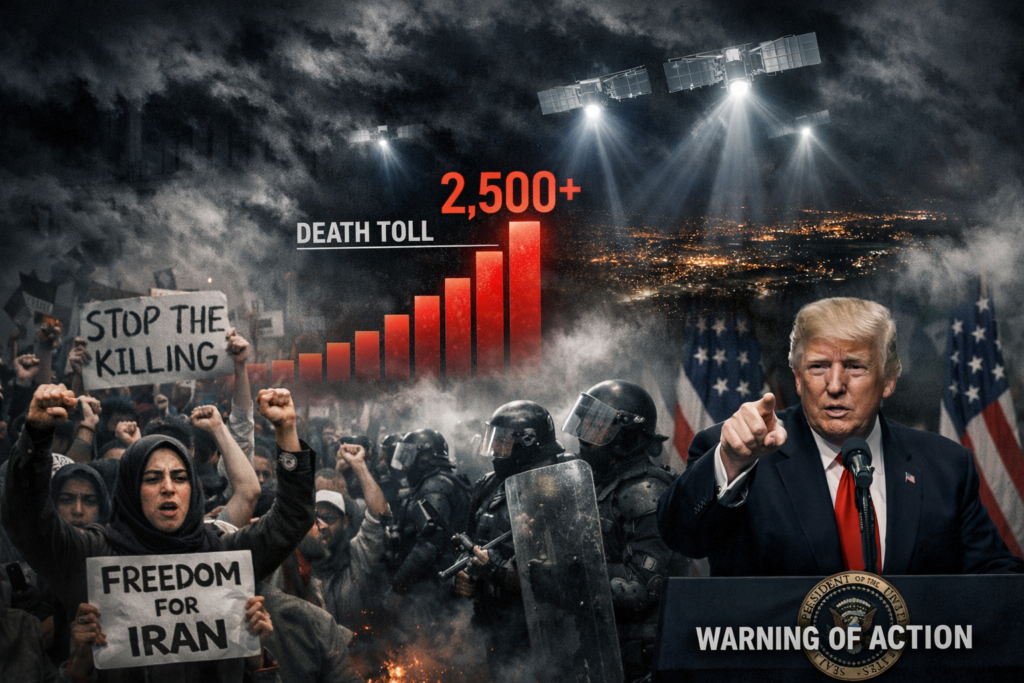
TEHRAN / WASHINGTON, D.C. — Violent crackdowns on nationwide protests in Iran have escalated dramatically, with at least 2,500 people killed and thousands more detained, according to figures released by rights groups tracking the unrest. As Tehran’s judiciary signals fast-track trials and executions for detained demonstrators despite international protest, U.S. President Donald Trump has issued stern warnings that Iran will face “very strong action” — potentially including military options — if executions of protesters proceed. The protests, which began in late December 2025 over economic hardship and quickly evolved into widespread anti-government demonstrations, now represent one of the deadliest episodes of internal dissent in Iran in decades. Even as Iranian officials claim the situation is stabilizing, the Human Rights Activists News Agency (HRANA) — a U.S.-based organization — says the death toll has surged past 2,571, with more than 18,000 people detained across the country.
Massive Loss of Life Reported Nationwide
Activists and human rights groups say the death toll from the protests — which began as a response to economic struggles, rising prices, and systemic injustice — has reached staggering levels unseen since the 1979 Iranian Revolution. According to HRANA, approximately 2,403 protesters have been killed, along with 147 government-affiliated security personnel. Civilians not involved in demonstrations, including at least 12 children, have also died amid the crackdowns. The toll dwarfs earlier rounds of unrest and reflects the ferocity of Iran’s response. Videos from inside the country — even with a government-imposed internet blackout making reporting difficult — have shown scenes of heavy force, burned buildings, destroyed ATMs, and roads blocked by security units. Hospitals in Tehran and other cities are described as overwhelmed, with bodies and injured civilians flooding facilities struggling to cope. Iran’s judiciary has responded by announcing expedited trials and possible executions for those arrested during the protests, drawing sharp condemnation from rights organizations and foreign governments. The head of Iran’s judiciary, Gholamhossein Mohseni-Ejei, said this week that those detained will face fast assessments of their cases — raising fears that capital punishment could be used to silence dissent.
Execution Threats Fuel International Outrage
Among those reportedly on death row is Erfan Soltani, a 26-year-old protester arrested in early January and charged with “waging war against God” — a capital offense under Iran’s penal code. Human rights organizations have condemned Soltani’s rapid sentencing without fair trial guarantees, warning that his execution could mark a bleak milestone in the regime’s response to civil unrest. President Trump has used the possibility of executions as a red line in his public remarks. On multiple occasions this week, Trump said that if Iran goes ahead with hanging protesters — a method historically used for political charges — the United States would respond with “very strong action,” though he has not specified what that would entail. The White House has also cancelled meetings with Iranian officials and urged Tehran to cease the violence before diplomatic relations are further strained. American policy figures have floated everything from economic sanctions to military options, keeping the possibility of escalation on the table.
Trump: “Help Is On Its Way” for Protesters
Trump has publicly encouraged Iranian demonstrators to keep protesting and even suggested that “help is on its way,” a statement that has drawn both support from opposition groups and harsh criticism from Tehran. In a social media post, Trump urged Iranians to “keep protesting” and “take over your institutions,” emphasizing that the Iranian regime could be held accountable for widespread killings. In addition to direct pressure on Iran’s leaders, the U.S. announced a 25% tariff on goods imported from countries trading with Iran, aiming to isolate Tehran economically and increase pressure for changes in policy. Critics argue this move could deepen hardships for ordinary Iranians already grappling with inflation and economic instability.
Iran’s Government Response and Regional Reaction
Iranian state media and officials have defended the crackdown, portraying protesters as “enemies of state” and invoking slogans against foreign interference. Iran’s UN Ambassador Amir Saeid Iravani has urged the United Nations to condemn both violence and what Tehran calls external attempts to destabilize the country. Tehran also blames the United States and Israel for fomenting unrest, warning that any U.S. military action would be met with force and potentially involve regional retaliation. Iranian leaders have emphasized that the protest movement is rooted in external influence rather than domestic grievances, framing the crisis as a geopolitical struggle rather than a purely internal human rights issue. Meanwhile, European governments and international organizations have condemned Iran’s human rights abuses while urging restraint and diplomatic solutions. Several European officials have called for further sanctions and coordinated pressure to curb the escalating violence and protect civilian lives.
As Internet Blackout Intensifies, Information Flows Through Starlink
One of the most significant tactics used by Iranian authorities has been the nationwide internet and communications blackout, effectively cutting off mass access to outside reporting and hindering independent verification of events on the ground. The disruption has lasted days, leaving families abroad unable to contact loved ones and obscuring the true breadth of casualties. In response, satellite internet providers such as Starlink have stepped in to restore limited connectivity, enabling restricted phone calls and data transmission to go through for the first time in days. Activists say this partial communications restoration has helped family members reconnect briefly and share information with international media, though texting and full internet access remain largely unavailable.
Looking Ahead: Diplomacy or Confrontation?
As the crisis deepens, Trump’s administration continues to weigh a complex array of responses — from further sanctions, diplomatic isolation, and economic pressure to potential military operations. Senior advisers have met to examine possible military options, including targeted strikes or increased U.S. presence in the region, should Tehran continue executions or expand repression. Iranian officials have signaled both defiance and openness to dialogue, with some reformist voices suggesting limited negotiation under certain conditions. Yet hardline leaders and security forces have shown little willingness to ease their grip on the streets, maintaining aggressive tactics against demonstrators and labels of foreign meddling. For now, the world watches a rapidly evolving and volatile situation where heavy casualties, contested narratives, and geopolitical tensions could push the region toward wider confrontation or, with careful diplomacy, a fragile de-escalation.