How Prediction Markets Took Off: The Economists, the Models, and the Rise of Kalshi & Polymarket
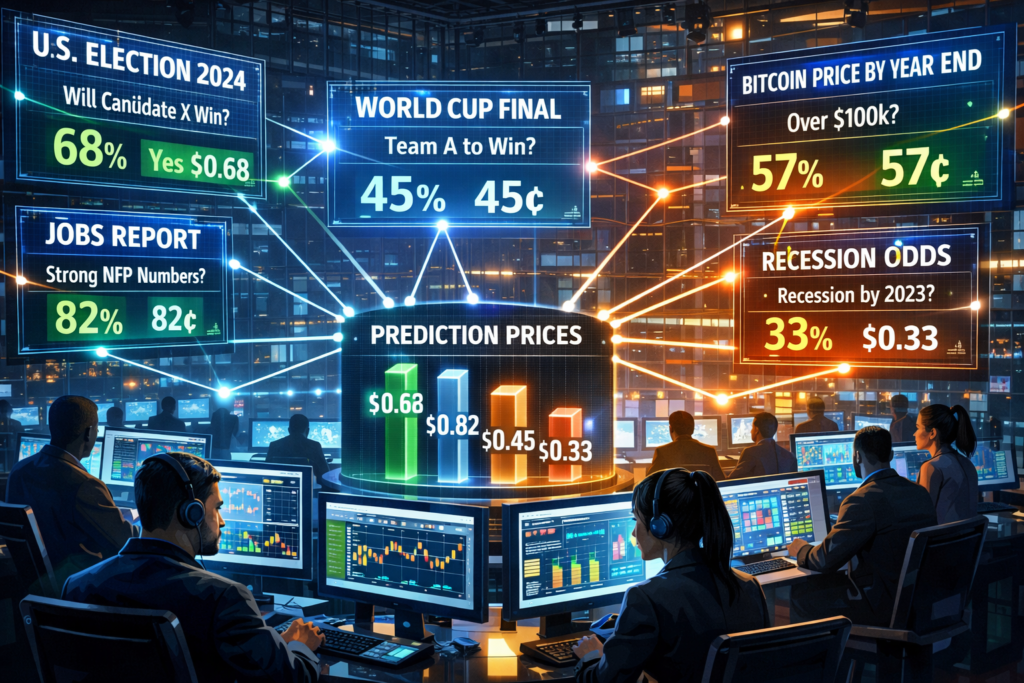
In the last few years, a quiet revolution has been underway in the financial world — one that brings forecasting into the marketplace and allows everyday people to place real money on the outcomes of elections, economic data, sports games, climate events, and even cultural moments. These aren’t your typical casino bets or stock trades — they are products of prediction markets, an innovative financial concept that merges mathematics, economics and human judgment to price the future itself.
This transformation didn’t happen overnight. At its roots lie brilliant thinkers and daring innovators who pushed economic theory into the real world — ultimately influencing the creation of platforms like Kalshi and Polymarket, which have become household names in financial forecasting and crowd-based insight.
From Theory to Marketplace
The idea behind prediction markets is deceptively simple: when many people put their money where their beliefs are — on things like will inflation rise next quarter? or who will win the next election? — the resulting prices are more than bets — they’re a consensus forecast. Economists have long theorized that markets are powerful aggregators of information, and early experiments showed that even small markets could out-predict traditional polls and expert forecasts.
As far back as the late 1980s, academic prediction markets created by economists beat conventional polling models in forecasting elections. Those early models laid the intellectual groundwork for real-money markets like Kalshi and Polymarket — platforms that trade contracts on future events and let probabilities evolve in real time as more people participate.
What Sets These Platforms Apart
Unlike traditional gambling or sports books, prediction markets operate more like financial exchanges. Users trade “yes” or “no” shares on event outcomes — and prices reflect the collective belief about what’s most likely to happen. In Kalshi’s model, for example, users trade contracts regulated by the Commodity Futures Trading Commission (CFTC) under federal rules, allowing it to operate legally across most of the United States.
Polymarket, originally a crypto-native platform, operates in a somewhat different regulatory space but successfully reentered the U.S. market after acquiring a CFTC-licensed clearing entity, bringing its global user base back under legal oversight and expanding access.
Together, these markets have grown from niche curiosities to major hubs of prediction activity. According to market observers, prediction market trading volumes soared into the tens of billions in recent years, showcasing their move from obscure tools into mainstream financial behavior.
A Surge of Participation and Innovation
This boom isn’t just about financial returns — it’s about a cultural shift. Millions of Americans — students, parents, retirees, and professionals — now participate regularly. They bet on outcomes from economic data releases to entertainment events, bridging information from their real lives into measurable probabilities. This blending of experience, expertise and instinct has reshaped how some people think about forecasting and decision-making in uncertain times.
Kalshi, for example, recently hit a landmark moment: on a major sports event weekend, the platform recorded over $1 billion in daily trading volume, a testament to how deeply prediction markets have seeped into public consciousness — transforming news events into financial signals that anyone can trade.
The Human Side of Forecasting
Behind every prediction market platform are stories of real people — not just institutional traders or algorithmic robots, but individuals who see truth and information as a source of value. Some use market forecasts as way to hedge risks, others as a tool to confirm instincts about global events. What unites them is a belief that collective wisdom can be distilled into real prices, offering a democratic way to make sense of an unpredictable world.
One early believer explained it like this: if people deeply care about an outcome — whether it’s climate change trends, economic numbers or political leadership — and are willing to back their beliefs with money, what emerges is more than a bet — it’s a reflection of community knowledge and conviction.
Economics Meets Human Judgment
Prediction markets owe much of their early theory to economists who broke ground by challenging how probability and belief are used in economic decision-making. Their models — initially academic — helped show that collective markets can outperform polls and expert panels in forecasting real-world outcomes, simply by harnessing the diverse wisdom of many minds instead of relying on a few.
This foundation undergirds today’s prediction platforms, where millions of data points are aggregated into prices that represent what people truly believe will happen next. Whether it’s a vaccine mandate, a rate hike, a championship game result, or a weather pattern — these markets offer a new way to see the future by betting on it together.
Regulation, Controversy and Growth
Despite their growth, prediction markets are not without controversy. Regulators, courts and legal experts have debated whether these markets are gambling or derivative exchanges. Some states have challenged platforms like Kalshi on sports betting laws, while others defend them as federally regulated financial marketplaces.
Platforms also wrestle with ensuring fairness, preventing insider trading and maintaining transparency — challenges that come with any fast-growing financial innovation. But proponents argue these markets add clarity to public debates and offer tools for better decision-making, especially when traditional models fall short.
What This Means for the Future
Today, prediction markets stand at an unusual crossroads — both financial and cultural. On one hand, they are powerful tools that economists, data scientists, and traders use to distill complex uncertainty into measurable odds. On the other hand, they are becoming part of everyday public life, translating headlines into numbers people can understand and engage with directly.
America — with its love of markets, innovation and informed debate — has become a fertile ground for this transformation. Whether you see these tools as betting platforms, forecasting engines, or collective intelligence systems, one thing is clear: prediction markets are here to stay, and their influence is growing by the day.