Gaza’s Rafah Border Crossing Reopens With Limited Movement Under Ceasefire Deal
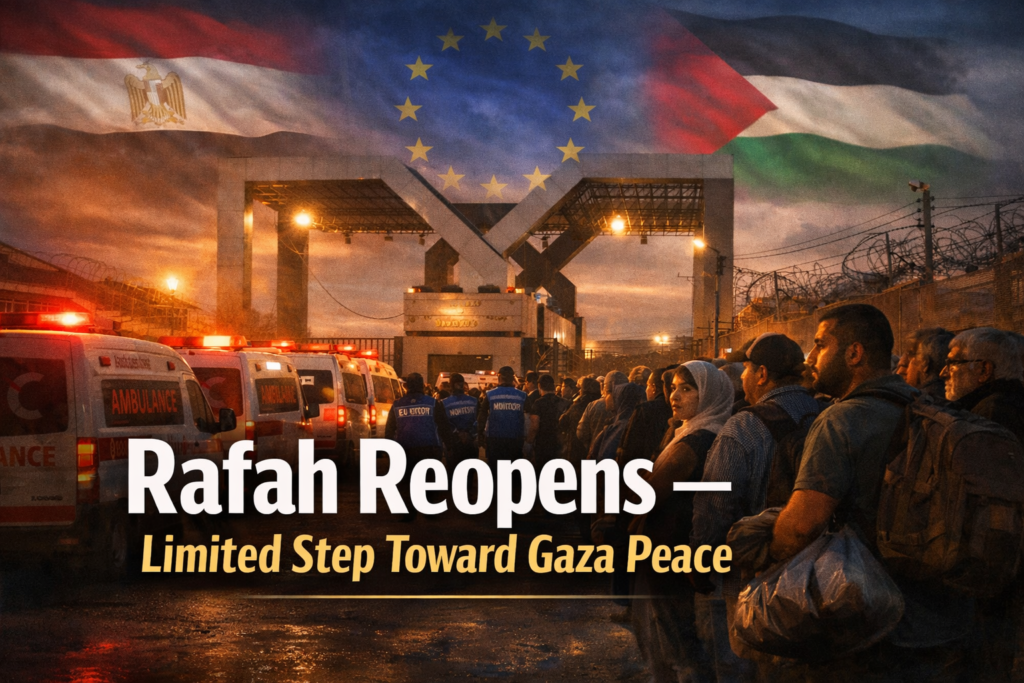
In a development that international diplomats are calling a key milestone in the fragile Israel-Hamas ceasefire, the Rafah border crossing between the Gaza Strip and Egypt reopened on Monday, February 2, 2026, for the first time in nearly two years. The move, closely tied to a U.S.-brokered ceasefire plan, allows limited pedestrian travel — a symbolic but hopeful step for civilians caught in the long and devastating conflict.
For months, global leaders, humanitarian organizations and ordinary Palestinians have urged the opening of Rafah — Gaza’s only access point to the outside world that does not require transit through Israeli-controlled territory. The crossing’s closure since May 2024 effectively isolated the already besieged enclave, compounding dire shortages of medical supplies, food, and essential services.
What Reopening Looks Like: Limited Travel, Major Hope
Under the new protocol, only up to 50 Palestinians will be permitted to cross daily in each direction at first, with stringent security screenings jointly managed by Israel, Egypt, and European Union monitors. Pedestrians must pass through a heavily controlled corridor and vetting points before entering or exiting Gaza.
Officials on both sides emphasize that the reopening for people — not for goods or large cargo — is primarily aimed at urgent needs, especially medical evacuations. The Egyptian Health Ministry says 150 hospitals across Egypt are prepared to receive Gazans who require treatment that isn’t available inside the shattered territory.
However, the initial daily quotas are small compared to the vast needs. About 20,000 Palestinian children and adults in Gaza are believed to need medical care abroad — a sobering figure that shows how limited crossings may take months, or years, to address. Civilian families anxiously await news of their loved ones, while others who fled earlier hope this signals a chance to return home.
Symbolism vs. Reality: A Step Forward, With Limits
Diplomats and analysts call the reopening a crucial proof of concept for the ceasefire, which has its roots in a U.S.-sponsored agreement that took effect in October 2025. The initial phase of that deal included hostage exchanges and temporary halts in fighting; the reopening of Rafah is central to the second phase, which envisions rebuilding infrastructure, easing humanitarian suffering, and, potentially, governance changes in Gaza.
But the crossing’s limited use also reflects the political and security constraints that continue to shape the conflict. As it stands:
- No goods or supplies enter through Rafah yet — a major shortfall for Gaza’s battered economy and infrastructure.
- Movement remains highly restricted, with priority given to medical cases and Palestinians who had previously left the territory.
- Foreign journalists remain barred from entering Gaza, complicating independent reporting on conditions inside.
For many Palestinians and human rights advocates, the reopening is welcome but insufficient. The tiny daily caps and lack of basic commercial movement highlight the gulf between political symbolism and on-the-ground needs in one of the most stressed humanitarian zones in the world.
Why Rafah Matters So Deeply
The Rafah border crossing was historically Gaza’s primary outlet to the world, connecting residents to Egypt and beyond. Before the war, it was the lifeline for people, commerce, tourism, and medical transfers. Since its closure in 2024 after Israeli forces seized control of the Gaza side, Gazans’ access to food, medicine and foreign travel has been severely curtailed.
Under the ceasefire plan, Rafah’s reopening is meant not only to ease human suffering but also to build confidence in a peace process that has been marred by repeated violations and mistrust. Egypt, a regional power with long diplomatic ties to both Israel and Palestinian leadership, has urgently called for restraint and respect for the truce, especially as renewed violence has accompanied the border reopening.
Some recent clashes — including reported Israeli strikes that resulted in civilian casualties — illustrate that violence continues even as diplomatic initiatives advance. This dual reality — cautious optimism mixed with ongoing insecurity — defines the current atmosphere in and around Gaza.
Health Crisis and Humanitarian Backlog
Gaza’s healthcare system was already near collapse before the war, and years of blockade and conflict have left it in ruins. Hospitals lack basic supplies, electricity is intermittent, and thousands of wounded still need specialized treatment outside the territory. The reopening of Rafah offers a narrow corridor of hope for critical medical evacuation.
At the same time, thousands of displaced Palestinians residing in Egypt and elsewhere long to return home. The crossing’s phased reopening raises complicated questions about who gets to go back, and under what terms, particularly since Palestinians fleeing for safety may worry about their ability to re-enter Gaza under existing arrangements.
Diplomacy, Peace Plans and the Bigger Picture
The reopening marks one of the first visible implementations of the U.S.-brokered ceasefire plan, which includes not just temporary halts in hostilities but broader phases that, in theory, encompass reconstruction, governance reform, disarmament, and international oversight. Each of these goals remains contested, fraught with political hurdles, and tied to contentious negotiations among Israel, Egypt, Palestinian authorities, and international stakeholders.
European Union observers and border patrol agents are expected to help oversee movement through Rafah, adding an international layer of monitoring and accountability. This cooperation underscores the regional and global interest in preventing renewed large-scale conflict and humanitarian collapse.
However, patience and pressure continue to run thin. Humanitarian advocates warn that without expanded access for aid, goods, and reconstruction materials, the crossing’s opening — while historic — may remain largely symbolic and insufficient to address the immense needs of Gaza’s civilians.
What Comes Next: Hope and Challenges
As Rafah operates under strict limits, the international community will watch closely to see if crossing numbers increase, whether supplies eventually flow, and how the next phase of the ceasefire unfolds. If the initial steps prove successful, expanded travel and humanitarian access may follow — but skeptics say that deeper political solutions are necessary to make lasting peace possible.
For now, the reopening — modest as it is — stands as a rare glimmer of progress in a conflict that has inflicted deep suffering on civilians. The hope is that this narrow window of movement will expand into broader peace and stability for a region weary of war.