France Arrests Dozens After Far-Right Activist Quentin Deranque Is Beaten to Death — A Nation Faces Deep Political Tension
PARIS — In the southeastern city of Lyon, France, a young man’s life was tragically cut short last week in an incident that has shaken the nation, widened political fault lines and stirred deep emotions among ordinary citizens, students and families alike. Twenty-three-year-old Quentin Deranque, a far-right activist and student, died after a violent confrontation during a protest — and French police have now arrested dozens of suspects, including individuals linked to hard-left political circles, in connection with his death.
The case, marked by videos shared widely on social media and sharply polarized responses from political leaders across France, has sparked national debate about political violence, extremist movements and the fragility of civil discourse during a tense election period.
The Fatal Attack and Early Investigation
The tragic events unfolded on Feb. 12, 2026, outside the Sciences Po Lyon campus, where a public meeting featuring Rima Hassan — a prominent member of the far-left party La France Insoumise (LFI) — had just concluded. Deranque, who was with a small group during a far-right protest against Hassan’s presence, was reportedly attacked in a street altercation involving rival activists when at least six people beat him — leaving him with grave injuries.
Paramedics rushed Deranque to a hospital on the Quai Fulchiron riverfront in Lyon after the brutal beating. He suffered a severe brain injury and later died, prompting Lyon’s prosecutor to launch a criminal investigation for aggravated assault and voluntary homicide.
Footage posted by eyewitnesses captured at least a dozen individuals striking people lying on the ground, scenes that shocked onlookers and fueled national outrage.
Arrests and Political Fallout
By Feb. 18, French authorities had detained at least 11 suspects in connection with the killing, with six suspected of participating directly in the attack and others accused of providing support or assistance to those involved. Among the detainees is Jacques-Élie Favrot, a parliamentary assistant to LFI MP Raphaël Arnault — a fact that has intensified political scrutiny of hard-left groups.
Arnault — a co-founder of the antifascist group La Jeune Garde (The Young Guard) before his parliamentary election — immediately suspended his assistant’s duties and initiated proceedings to terminate his contract, emphasizing respect for due process and condemning violence.
La Jeune Garde was previously dissolved by the French government in 2025 for alleged involvement in violent street actions, but the group has denied any direct role in the Lyon incident, stressing that its official activities had been suspended.
A Nation Divided
The deadly beating immediately reignited long-standing tensions between the far left and far right in France — tensions that have been steadily rising ahead of municipal elections in March and the 2027 presidential race.
Justice Minister Gérald Darmanin and Interior Minister Laurent Nuñez publicly pointed fingers at “ultra-left elements,” suggesting that rhetoric and confrontational tactics from hard-left factions may have contributed to the violence. LFI leaders, including Jean-Luc Mélenchon, condemned the killing but rejected any notion that the party or its supporters encouraged such brutality.
Meanwhile, leaders of the far-right National Rally (RN) party seized on the episode to blame LFI for fostering a culture of political violence — a charge hotly disputed by left-leaning politicians and civil liberties advocates.
A Human Story Behind the Headlines
Beyond the political posturing and headlines, the heart of this story is painfully human.
Quentin Deranque was more than a political label — he was a young student with family, friends and dreams. According to reporting, he was a mathematics student and a nationalist activist in Lyon, involved in community and ideological movements that shaped his identity.
Both sides of the political spectrum have called for calm. French President Emmanuel Macron urged restraint through official channels, stressing that violence cannot be justified in any political context and that justice must be served through lawful means.
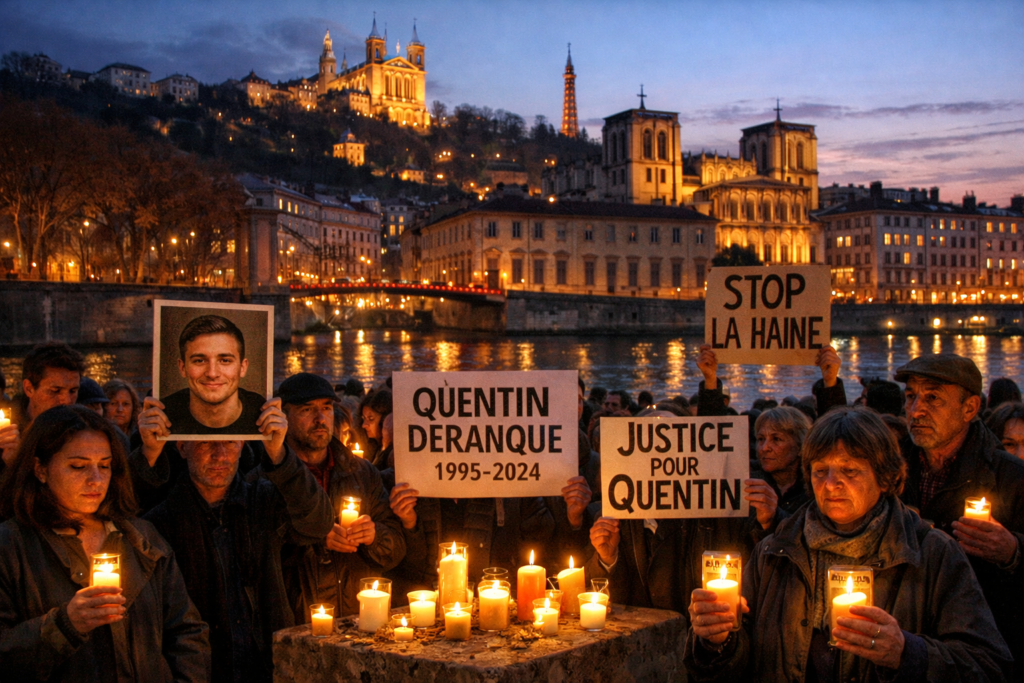
Lawmakers in the French National Assembly observed a moment of silence for Deranque, and a commemorative march has been planned in Lyon to honor his memory, even as the investigation continues.
What This Means Politically
This killing arrives at a precarious moment for French democracy. Municipal elections are around the corner, and political polarization has become more acute — fuelled by economic uncertainty, cultural debates over immigration and identity, and the rise of both far-right and far-left movements.
As France’s political classes prepare for a momentous 2027 presidential campaign, episodes like this one risk deepening divisions and encouraging rhetoric that fuels polarization rather than understanding. Respect for peaceful protest, fairness in investigation, and justice through established legal processes are now centerpieces of public debate.
Broader Context: Political Violence in Europe
While France has a long tradition of robust political engagement, clashes between rival groups — particularly at the extremes — have occasionally erupted into violence. But deaths tied to political confrontation are rare and especially jarring in a nation with deep democratic roots. The Lyons incident echoes earlier historic confrontations between opposing factions, but its modern backdrop is unique — shaped by social media, real-time video, and a 24/7 news cycle that turns local tragedies into national crises almost instantly.
In the broader European context, clashes between extremist groups — whether on the far left or far right — have at times unsettled societies and tested democratic institutions. Authorities stress that political expression must never cross the line into violence, and that France’s legal system must pursue justice impartially to protect social harmony and the rule of law.