Families in Ruins: Inside the Deadly Israeli Airstrikes on a Gaza Tent Camp and Ongoing Violence in the Strip
For many Palestinian families in the Gaza Strip, the night of Feb. 15, 2026 will be remembered as a moment of unbearable loss and agony — not just another headline in a long, protracted conflict but a deeply personal tragedy that unfolded amid already‑fragile hopes for peace and stability.
At least 11 Palestinians were killed in a series of Israeli airstrikes that struck across the densely populated enclave, including a tent encampment sheltering displaced families, according to local health officials and civil defence sources. The strikes came as both sides traded blame over violations of an existing ceasefire, undermining delicate peace efforts and stirring fresh fears among civilians who have suffered for years in a war that has reshaped their lives and livelihoods.
A Tent Camp Shattered — Real Stories, Real Loss
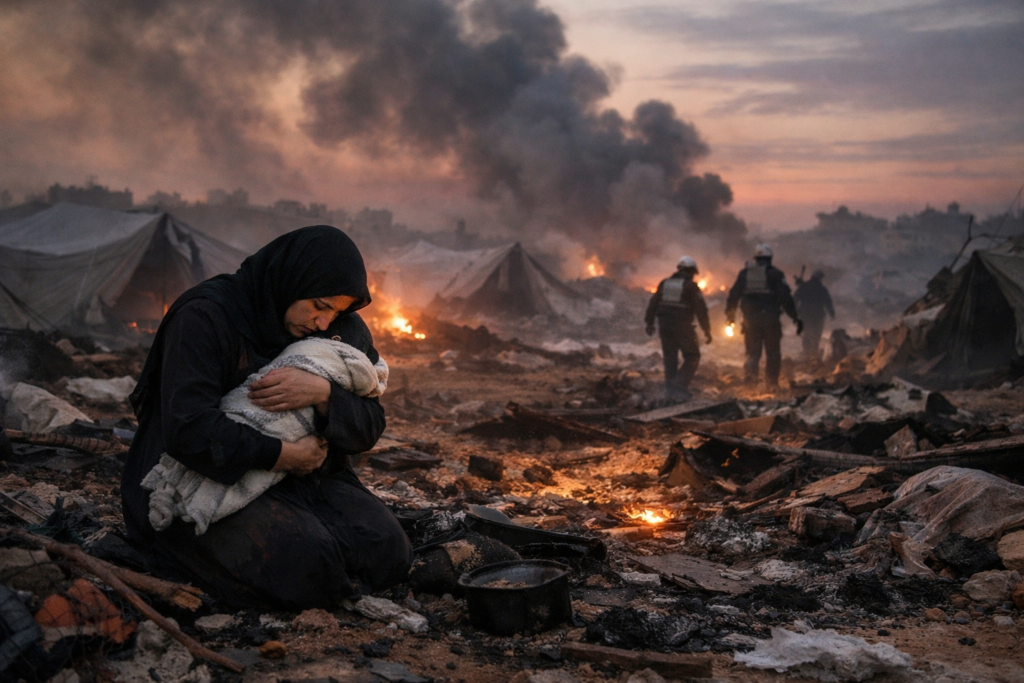
The tent encampment hit by the bombs was more than a cluster of cloth shelters — it was home to families forced from their original houses by earlier cycles of violence and displacement. Local medical officials reported that several people, including women and children, were killed when an Israeli bomb struck that camp where displaced families had sought safety.
One Palestinian civil defence worker described the scene: tents burned to the ground, belongings charred, and desperate residents searching for loved ones amid wreckage. Although the precise identities of the dead are still being tallied, the toll included men, women, and those too young to fully grasp the horror around them.
The Israeli military said it carried out the airstrikes in response to what it called “ceasefire violations” by Hamas militants, including allegedly armed men emerging from tunnels across a demarcation line known as the “Yellow Line” under the U.S.-brokered truce agreement. Israel maintains that its actions are legally justified as defensive measures against militant threats.
But the human cost of the strikes resonates far beyond battlefield claims.
Amid Fragile Truce, Violence Persists
Since the ceasefire took effect in October 2025, the Gaza Strip has remained under an uneasy calm — punctuated by periodic bloodshed and mutual accusations of violations. According to Gaza’s health ministry, roughly 600 Palestinians have died in Israeli attacks since the truce began, a figure that reflects the persistence of violence despite diplomatic efforts to halt hostilities.
On the same day as the tent camp strike, health officials also reported that other sites across Gaza — including homes and urban areas — were hit during say multiple air raids, killing additional civilians. These incidents have reignited anger and grief among local families who hoped the ceasefire would bring respite after years of repeated bombardments, displacement, and devastation.
Hamas, the governing authority in Gaza, condemned the strikes as a “massacre” and a major breach of the ceasefire, accusing Israeli forces of targeting civilians and ignoring international humanitarian standards. The militant group urged international pressure to stop further attacks and enforce the terms of the truce.
Living in the Shadow of War
For displaced Gazans, the tent encampment was not just shelter — it was a symbol of survival amid chronic displacement. Many who fled bombed‑out neighborhoods have been moving from place to place, living in tents near open fields, makeshift structures, and overcrowded camps that lack basic sanitation and medical care. Children, especially, have known little but hardship and fear in their young lives.
In some areas, families recount how they were forced further from their homes after previous strikes, then ordered again to move when conditions became untenable. The tent camps — intended only as temporary havens — quickly turned into sites of renewed tragedy when the airstrike hit. The emotional echoes of these losses reverberate through neighborhoods, mosques, and makeshift aid stations where relatives sobfully call for peace and answers they fear may never come.
A Wider Humanitarian Crisis
The conflict’s ripple effects extend well beyond those killed or wounded on a single day.
Across the Gaza Strip — home to more than 2 million people — civilians endure limited access to medical care, food shortages, electricity blackouts, and crumbling infrastructure. Large swaths of Gaza’s territory remain heavily damaged from repeated aerial assaults and ground operations since the war’s escalation after the Oct. 7, 2023 Hamas attack on Israel, which killed more than 1,200 people in Israeli territory.
Even under the ceasefire, sporadic violence has continued, complicating humanitarian access and reconstruction efforts. Hospitals and clinics struggle to treat the wounded, and displaced families overcrowd makeshift camps in the hope of safety more than comfort.
The broader toll of the Gaza conflict — spanning years of struggle — has left countless families grieving, physically injured, or uprooted from their ancestral homes, with hope now bound up in political negotiations and fragile diplomatic plans that are themselves at risk of derailing.
Voices of Grief and Resilience
Amid sorrow, many Palestinians have shared their heartbreak publicly, whether through social media, interviews with local journalists, or anguished pleas to international media. Mothers who lost children, fathers who bury sons and daughters, and elders who saw homes disintegrate tell strikingly similar stories: they long for peace, dignity, and an end to violence that has shaped their entire lives.
Onlookers around the world — from humanitarian groups to everyday citizens following the conflict — have expressed deep concern at the recurrence of civilian deaths in areas deemed safe zones or shelters. Some international voices echo calls for stronger adherence to international humanitarian standards and protections for noncombatants caught in the crossfire.