Epstein Files Fallout: Resignations, Firings and Global Probes Rock Business, Politics & Diplomacy
In the weeks since the U.S. Department of Justice released millions of pages of Epstein files — documents tied to the late financier Jeffrey Epstein — a wave of resignations, professional upheavals, and formal investigations has rippled across the globe. What began as a legal obligation under the Epstein Files Transparency Act has become a full-blown reputational crisis for executives, diplomats, academics and public figures whose names or communications with Epstein appear in the trove of records.
For many Americans and observers worldwide, the fallout is more than a matter of intrigue — it’s a dramatic affirmation of how deeply wealth, power and connections can have consequences long after a person’s death.
Here’s a deep look at how the Epstein files are reshaping careers, prompting scrutiny, and forcing institutions to reckon with uncomfortable truths.
What Are the Epstein Files?
In late 2025 and early 2026, the Department of Justice began releasing pages from a massive cache of documents connected to its investigations into Jeffrey Epstein, a convicted sex offender who died in jail in 2019 while awaiting trial on federal sex trafficking charges.
Congress, under the Epstein Files Transparency Act, required the DOJ to publicly share these files — including emails, financial records, correspondence and government materials — although many pages were heavily redacted in the initial releases.
The result: a window into decades of Epstein’s private circle — and the people who, willingly or not, intersected with him.
The Human and Corporate Impact
The release of the files has triggered a wave of public departures and corporate shake-ups, particularly in business and legal leadership:
Business and Executive Resignations
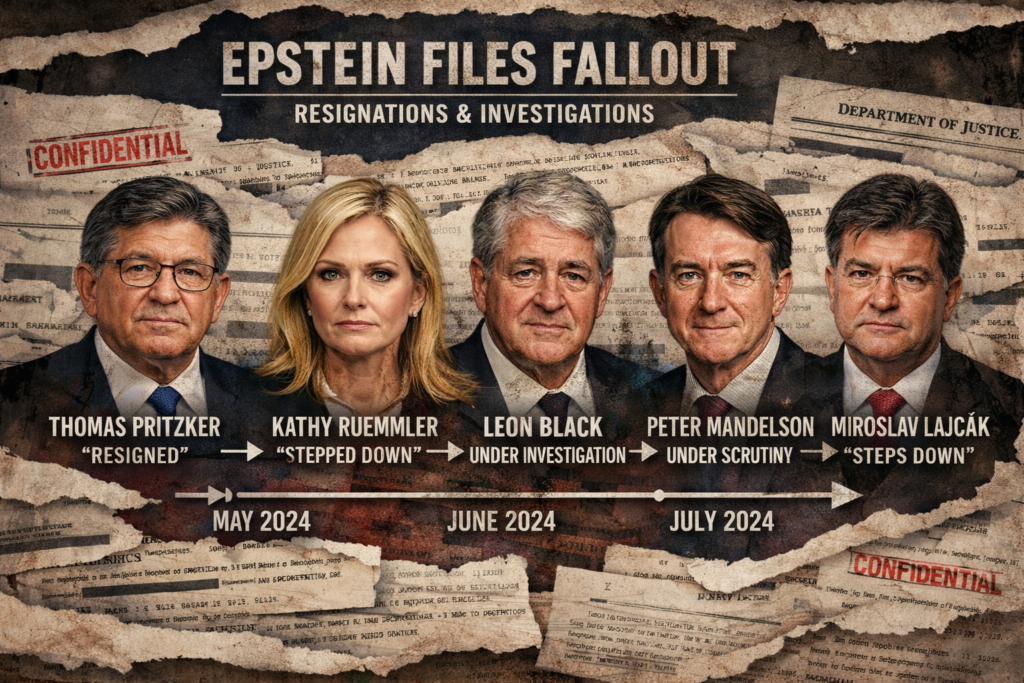
- Thomas Pritzker, the 75-year-old executive chair of Hyatt Hotels, stepped down amid scrutiny over emails showing his continued contact with Epstein even after Epstein’s 2008 conviction. Pritzker said he regretted his association and will not stand for re-election to the board.
- Kathy Ruemmler, former White House counsel under President Obama and then general counsel at Goldman Sachs, announced her intention to resign after email correspondence with Epstein surfaced.
- Sultan Ahmed bin Sulayem, chairman and CEO of DP World, a Dubai-based global port operator, resigned after business partners pulled support following revelations of his relationship with Epstein.
- Brad S. Karp, longtime chair of law firm Paul Weiss, also stepped down after his communications with Epstein were made public.
- Entertainment executive Casey Wasserman is reportedly selling his talent agency and has faced pressure to step down from leadership roles as a result of documented exchanges with Epstein and his close associate Ghislaine Maxwell.
These departures reflect both the reputational risk of association and the fear among companies and institutions that continued ties could damage brands or weaken trust with employees, clients and stakeholders.
Global Political and Diplomatic Fallout
The impact extends well beyond corporate corridors:
Political Figures Feeling the Heat
- Miroslav Lajčák, former president of the U.N. General Assembly and Slovakia’s national security adviser, resigned after emails with Epstein became public.
- Jack Lang, a former French culture minister and later head of the Arab World Institute, resigned amid French inquiries into financial and diplomatic ties exposed by the files.
- Peter Mandelson, once a British ambassador and Labour Party leader, is under investigation by UK police over alleged misconduct tied to Epstein documents — and saw his London lobbying firm Global Counsel collapse amid the controversy.
These revelations have reignited public debate about political accountability — especially in Europe, where diplomatic ties and historical relationships are now being questioned in the harsh light cast by the now-public documents.
Public Figures and Cultural Fallout
Even outside business and government, cultural institutions have felt the impact:
- David A. Ross, former chair of the School of Visual Arts in New York, resigned after email exchanges involving Epstein were revealed.
- Many charities and organizations have cut ties with well-known patrons whose associations with Epstein surfaced, including the closure of Sarah Ferguson’s charitable trust in the U.K. following disclosures.
These developments highlight how far Epstein’s influence and connections reached — touching sectors that had previously been seen as distant from legal or political scrutiny.
Ongoing Investigations and Legal Questions
While many of the departures have been administrative or reputational, investigations continue in both the U.S. and abroad — and some could yet evolve into legal action.
France, for example, has launched broader probes into human trafficking, tax fraud and financial crimes linked to Epstein’s Paris activities, signaling that political and financial elites may face judicial scrutiny beyond resignations.
At the same time, critics have taken aim at the DOJ’s release process itself. Additional pages of files — numbering in the millions — remain under review, and questions persist about heavy redactions and whether all relevant documents will eventually see the light of day.
Some lawmakers and transparency advocates have argued that parts of the files still obscure key facts about individuals mentioned, and have called for clearer public disclosure.
Emotional and Cultural Resonance
For many survivors of Epstein’s crimes and families affected by his trafficking and abuse, the fallout has real emotional weight. Knowing that people in power once shared flights, meals or correspondence with Epstein — even if they deny wrongdoing — has stirred anger, sadness and a sense of betrayal among advocates and the public alike.
One survivor advocate described the moment of seeing these names in print as “a painful reminder that power and privilege sometimes shield wrongdoers and their networks for too long.”
And while departure announcements or diplomatic resignations may seem like corporate housekeeping to some, for many families and survivors, they symbolize accountability — or, at the very least, the beginnings of it.