Deadly Israeli Airstrikes in Gaza Renew Violence as Trump Prepares ‘Board of Peace’ Initiative
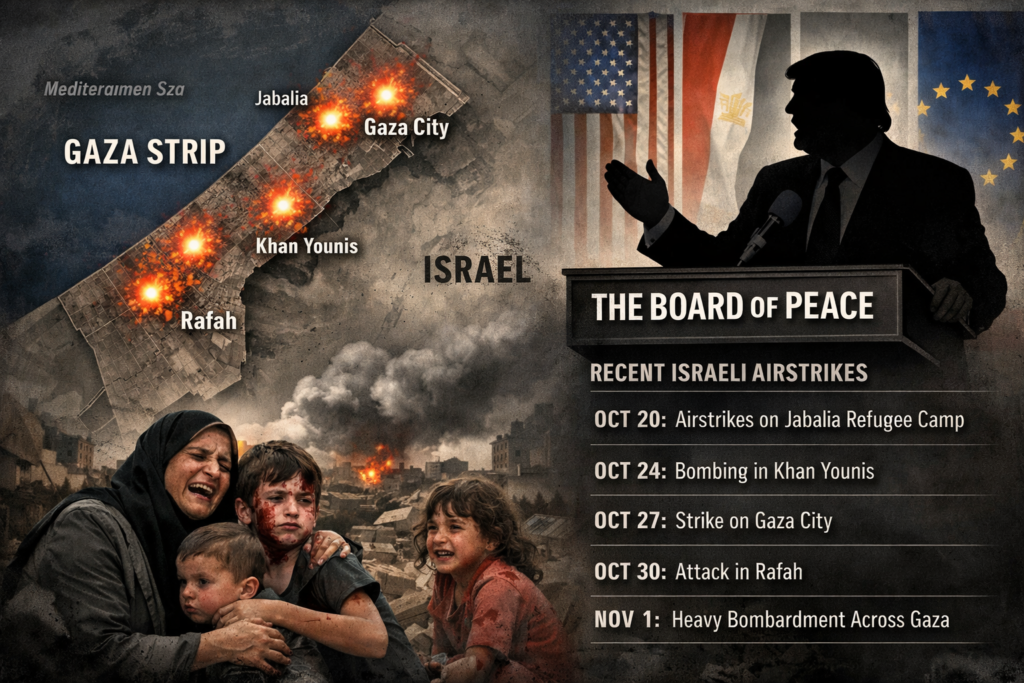
GAZA STRIP (January 9, 2026) — Brutal Israeli airstrikes across the Gaza Strip have killed at least 13 people, including children, amid a fragile ceasefire and rising concerns about the future of peace efforts in the region. The violence comes just days before U.S. President Donald Trump is expected to formally announce a new “Board of Peace” aimed at stabilizing Gaza and supervising the truce between Israel and Hamas, officials and health workers said. The deadly strikes shattered a measure of calm that had prevailed since an October 2025 ceasefire brought a temporary halt to the intense conflict that ravaged the enclave for more than two years. Even as diplomatic efforts move forward, the latest clashes underscore how tenuous the ceasefire remains, with each side accusing the other of violations that continue to cost civilian lives.
Casualties Reported Across Northern and Central Gaza
Local health officials reported that at least 13 Palestinians were killed Thursday, including young children, during multiple airstrikes carried out by the Israel Defense Forces (IDF) across northern and central parts of the Gaza Strip. Families in Gaza City and nearby Deir al-Balah were among those impacted, with the bodies of victims arriving at hospitals amid cries of grief and shock. At least one 11-year-old girl, who had dreamed of becoming a doctor, was among the dead, according to hospital staff. Several others, including teenagers and young boys, were also killed when shelling struck densely populated residential areas and makeshift shelters, hospital officials said. Residents described scenes of devastation as rescue teams pulled bodies from rubble and sought to care for dozens of wounded civilians.
Israel Responds to Militants’ Actions
The Israeli military justified the strikes as a response to a failed projectile launch from militants in the Gaza City area, asserting that its forces were targeting Hamas infrastructure and fighters responsible for threats against Israeli security. The IDF has frequently cited militant activities as justification for its operations, even amid ceasefire arrangements.
While the formal ceasefire has not entirely broken down, both sides have accused the other of breaching its terms. Israel maintains that its operations are defensive and aimed at preventing further attacks, while Palestinian officials and mediators argue that civilian harm and forced displacements are unacceptable consequences of the ongoing bombardments.
Trump’s Board of Peace: A Bold Yet Contested Plan
The violence comes as President Trump prepares to unveil his long-anticipated Board of Peace initiative — a key pillar of his broader Middle East peace plan. The board is intended to provide oversight of the ceasefire, facilitate reconstruction, and ensure a phased transition to a governing structure that ultimately disarms Hamas and installs a technocratic Palestinian government. Trump has selected Bulgarian diplomat Nickolay Mladenov, a former U.N. Middle East envoy, to serve as the board’s director-general. Mladenov has consulted with officials from both Palestinian and Israeli leadership in recent days, including senior Palestinian Authority figures and Israeli Prime Minister Benjamin Netanyahu, as the blueprint for the board’s responsibilities takes shape. Under Trump’s plan, the Board of Peace would also oversee the deployment of an international stabilization force, supervise the demilitarization of Gaza, and coordinate humanitarian efforts and Israeli troop pullbacks. However, critics say there has been little substantive progress on these critical objectives.
International Leaders Call for Stabilization Force
As tensions escalate, leaders from Egypt and the European Union have urged the rapid deployment of an international peacekeeping force to shore up the ceasefire and protect civilians. EU foreign policy chief Kaja Kallas described the humanitarian situation as “extremely severe,” calling for greater international involvement to prevent further bloodshed.
Complex Political Dynamics
Political friction complicates the Board of Peace’s mission. While the plan envisions a future Palestinian governing role under a technocratic government, Israel remains deeply skeptical of transferring authority to either Hamas or the Palestinian Authority, concerned that either could undermine Israeli security. These disagreements have slowed the implementation of key elements of the peace strategy and raised questions about how effective the board can be without stronger buy-in from all parties.
Human Cost and Civilian Impact
The civilian toll of the conflict continues to mount. Since the ceasefire went into effect in October 2025, more than 400 Palestinians have been killed in sporadic Israeli strikes, according to local health authorities in Gaza. Humanitarian agencies highlight escalating needs as basic services remain scarce, infrastructure lies in ruins, and access to food and medical care is limited. Families of victims lament the loss of loved ones, emphasizing the anguish of watching children and neighbors killed in strikes that have become all too common in the enclave. The psychological trauma — alongside the physical destruction — underscores the enormity of the region’s ongoing humanitarian crisis. Humanitarian workers also warn that the continued violence jeopardizes the already fragile peace process and makes long-term stability even more elusive.
Looking Ahead
As Trump’s Board of Peace prepares for its official launch next week, uncertainties remain over whether it can act as a meaningful force for de-escalation. The repeated ceasefire violations — paired with mounting civilian casualties — challenge both local and international efforts to stop the cycle of violence and begin rebuilding Gaza.
World leaders and aid organizations are watching closely, urging sustained diplomatic engagement and insisting that any durable solution must address not only security concerns but also the dire humanitarian needs of Gaza’s civilian population.
Amid these developments, residents — both in Gaza and Israel — are left to grapple with the human toll of conflict and the complex road ahead toward peace, reconciliation, and reconstruction in a region long marked by violence and political strife.